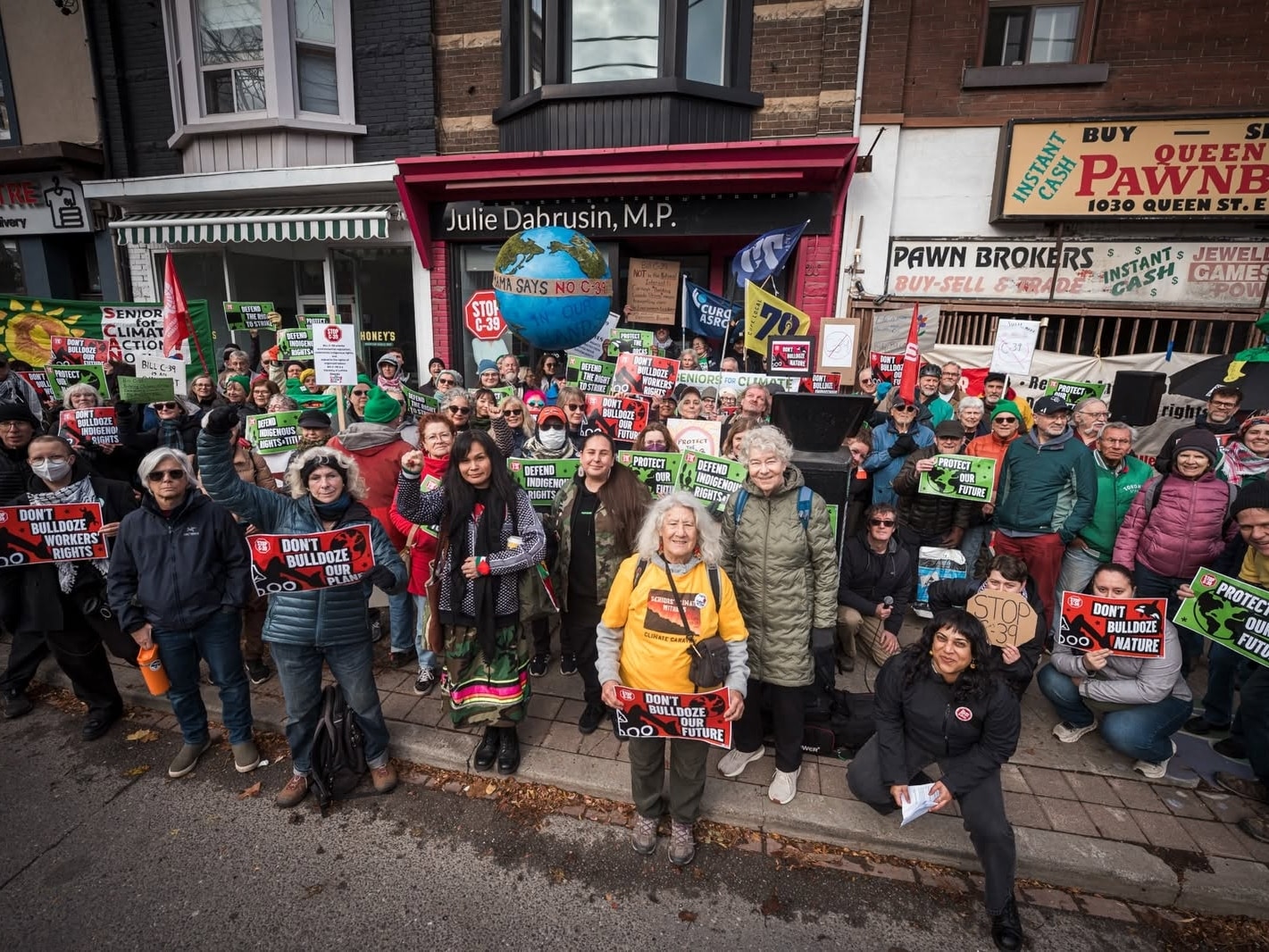
Advocates for Indigenous sovereignty and climate action in Canada are organizing for a long struggle to protect the lands and waters of northern Turtle Island. On November 12, CPTers joined rallies outside parliamentarians’ offices calling for the withdrawal of Bill C-39, a federal omnibus bill containing dozens of legislative changes to expedite so-called “Projects of National Interest” such as pipelines, mines, and fossil fuel processing plants. This bill builds on Bill C-5, passed last year, which established the “Projects of National Interest” designation, and provincial bills which likewise aim to fast-track resource extraction projects.
At the same time, many Indigenous activists are protesting Manitoba Premier Wab Kinew’s public call, on October 26, to abolish the Indian Act. The Indian Act, enacted in 1876, is undeniably a racist and paternalistic law that imposed colonial governance on Indigenous people with the aim of assimilation. Some of its most oppressive components have been repealed, but it remains deeply problematic. Nevertheless, many Indigenous people are concerned that abolishing it could weaken the federal government’s obligations toward Indigenous communities. Indigenous advocates have been debating whether and how to replace the Indian Act for decades.
Both of these political issues leave people reading between the lines to try to decode politicians’ intentions and the implications of their pronouncements. Prime Minister Mark Carney, who had a reputation as progressive on environmental issues before his election, is now arguing that Canada must increase fossil fuel extraction in the short term to protect its economy, while also massively expanding mining and electricity generation to support a “green transition.” His Liberal party boasts that they will make Canada “the world’s leading energy superpower.” Conservation does not appear to be on the agenda. For years, Indigenous activists have warned of Liberal governments’ “SWAT” strategy in relation to Indigenous peoples: deceptive “Special Words and Tactics” (a play on police “Special Weapons and Tactics” teams in the US and elsewhere). Strong critical thinking and expert opinions are needed to make sense of policy announcements such as the government’s introduction to Bill C-39 which claims that it will “[protect] the environment and [uphold] the rights of Indigenous Peoples” and “[strengthen] protections for workers,” when, in fact, it fast-tracks environmental assessment and Indigenous consultation processes and makes it easier for the government to end strikes.
As ever, people who want genuine political change will need to organize to learn, strategize, and take action. Pray with us for the growth of social movements that act with wisdom and creativity to disrupt the dominance of private capital, protect the planet, and support human flourishing.