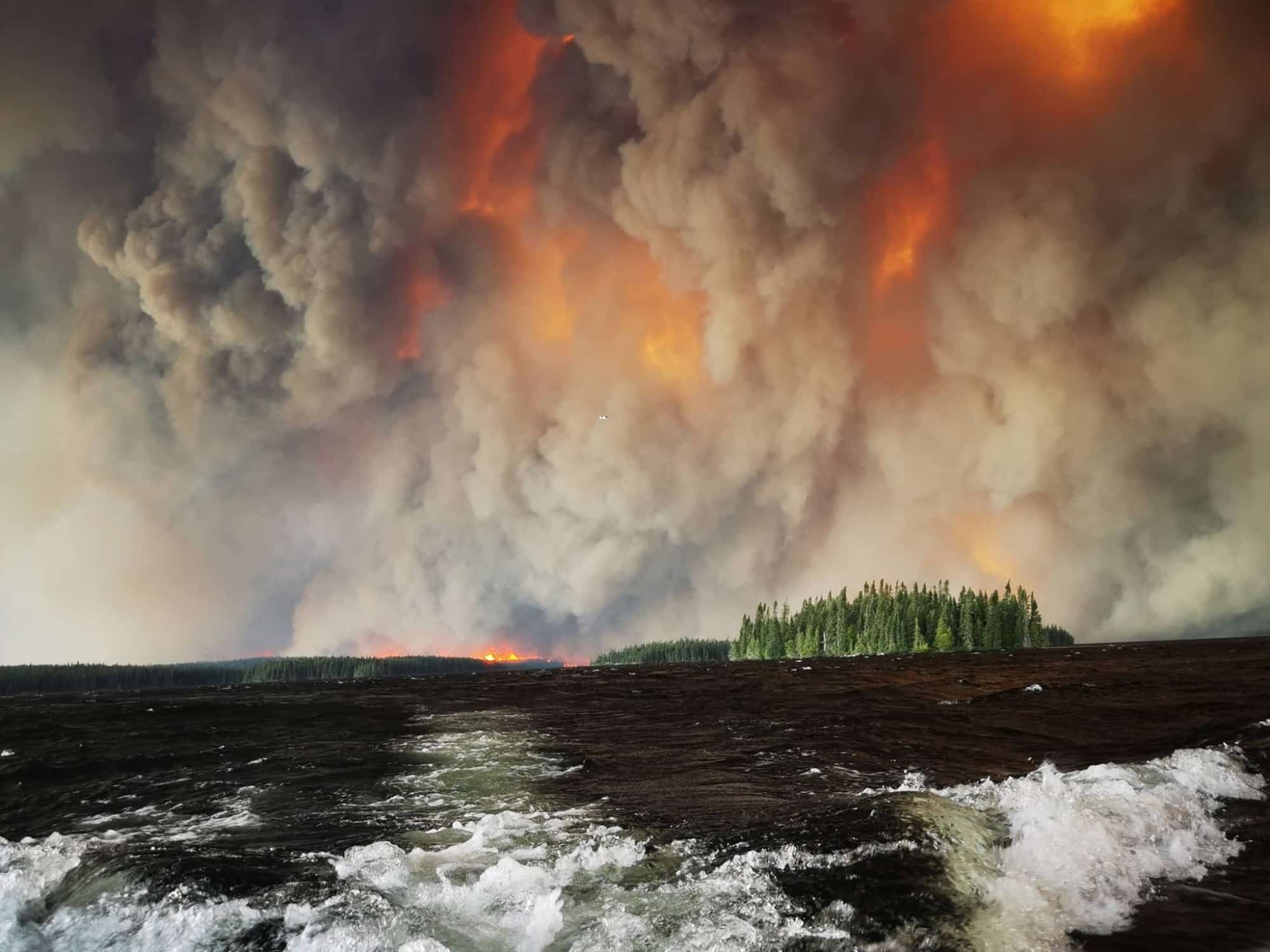
For most people on Turtle Island, the most alarming sign of climate change is that every summer now, the land burns. As of 15 July, 185 wildfires are burning in northern Ontario and air quality across Ontario is among the worst in the world. The skies are clouded with a sickly yellow tinge that makes midday feel like twilight. A brief walk outside causes a sore throat or a feeling of breathlessness.
While everyone is seeing and feeling the effects of the fires, it is underserved Indigenous communities that suffer the most devastating impacts. In Ontario, five First Nations communities have been ordered to evacuate: Whitesand First Nation, Namaygoosisagagun First Nation, Lac des Mille Lacs First Nation, Gakijiwanong Anishinaabe Nation, and Kiashke Zaaging Anishinaabek, as well as the community of Armstrong. Other communities are on standby to evacuate if fires spread.
Members of Namaygoosisagagun (also known as Collins First Nation) will not be returning home anytime soon. On 13 July, members of the community had minutes to flee by boat before a fast-moving wildfire engulfed their homes. A member of the community told the media, “Once we left my house finally after packing what I could in a pack sack, the fire was right behind our place. We had to run to the beach and once we got there, it was only moments before the fire had jumped over the (train) track and was coming for us.”
Sol Mamakwa, the provincial representative for the district of Kiiwetinoong, issued a statement Tuesday, saying “what we are witnessing right now is devastating … an entire First Nation community has been erased because of this disaster.”
Nishnawbe Aski Nation (NAN), a regional council of 49 First Nations, released a statement in which they expressed deep concern for First Nations facing evacuation, as well as those affected by road closures and telecommunications outages. NAN “is particularly concerned about the disruption to critical services in affected communities, including road closures that are impacting daily medical transport for community members requiring dialysis and other essential health services.”
While wildfires are natural, their number and intensity has increased noticeably in the past two decades. Lise Vaugeois, provincial representative for the district of Thunder Bay – Superior North, commented in a statement, “Fires are part of a natural cycle, but the extreme temperatures we are experiencing across the county [sic] and the growing severity of weather events are indicators of climate change. We need both the provincial and federal government to acknowledge this reality and treat these changes as the growing emergency that they are.”
Please pray for:
- Communities displaced or isolated by wildfires;
- People with health issues aggravated by wildfire smoke;
- Courage and determination to demand political action on climate change;
- The empowerment of Indigenous sovereignty and climate movements.