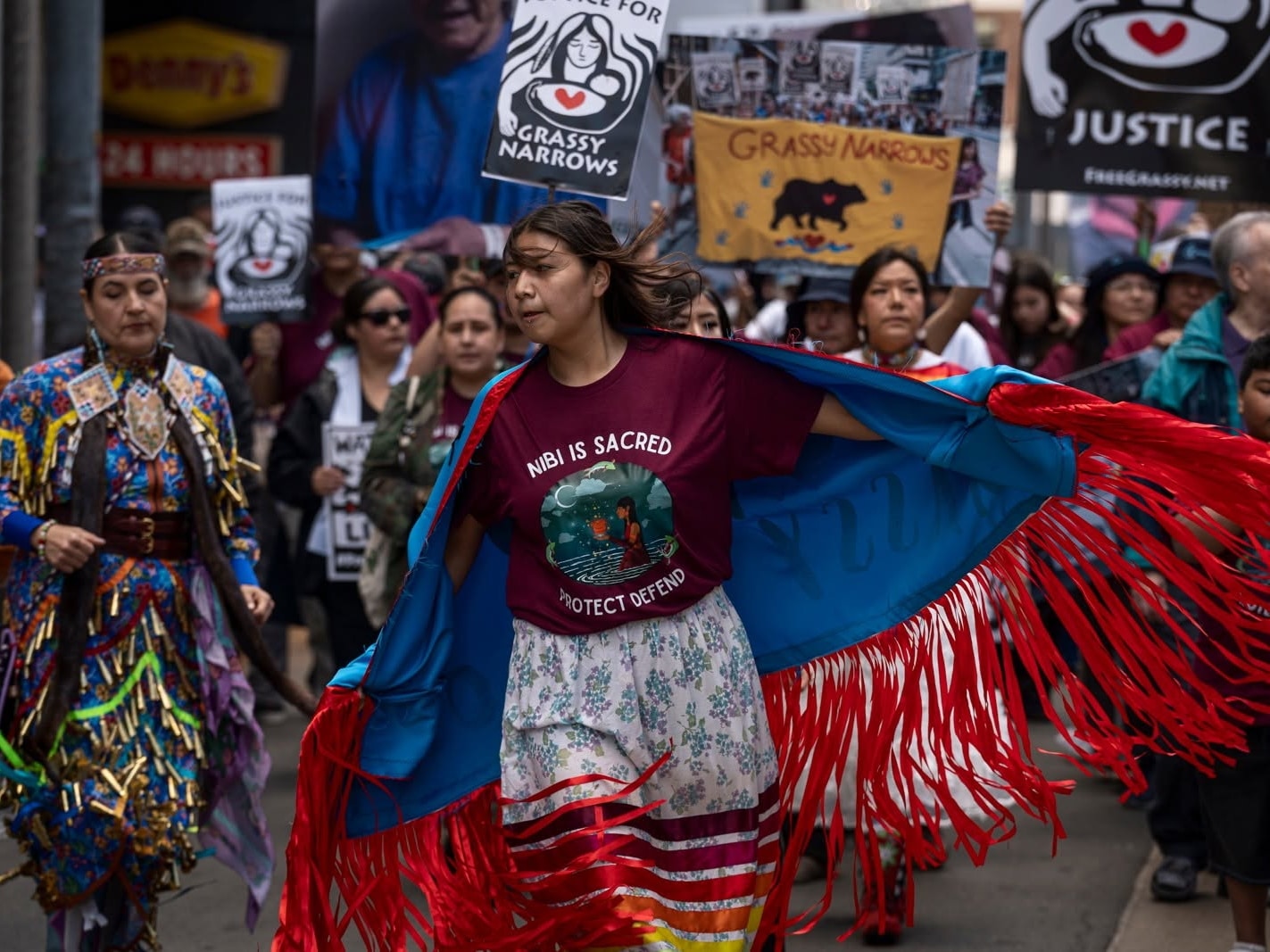
On 23 September, members of Asubpeeschoseewagong Anishinabek (Grassy Narrows First Nation) and Wabaseemoong (White Dog First Nation) led 9,000 people in a march through the streets of Toronto to call for compensation for over 60 years of mercury poisoning and for the closure of the Dryden Mill, which continues to release sulphate waste into the English-Wabigoon river system. The march was led by the youth of Grassy Narrows, walking and dancing to the beat of the Grassy Narrows Men’s Drum Group.
The communities have fought for decades for justice for mercury poisoning caused by a pulp and paper mill in the 1960s. Despite decades of stonewalling by governments they have persisted. In 2017, the Ontario government promised to clean the river and committed $85 million in funding. In 2020, the provincial and federal governments committed funding for a Mercury Care Home in Grassy Narrows to provide medical and nursing care to people affected by mercury poisoning. The communities are still fighting for compensation that reflects the true impact of the mercury crisis on the people’s health, livelihoods and culture. They are fighting to close the Dryden Mill after research demonstrated that its sulphate emissions amplify the process of mercury bioaccumulation in the river ecosystem. They are fighting to stop other industrial projects that threaten the health of the land and waters, including a proposed gold mine and a proposed nuclear waste disposal site.
“We are here to tell FordNation and Mark Carney that our lives matter and they can’t continue to allow industry to poison us for profit,” said Grassy Narrows Chief Sherry Ackabee at the River Run rally. “Our children should not suffer from illness, they should be able to enjoy a good life like any other child.”
With current governments, protecting the land will be an uphill struggle. The Ontario provincial government and the Canadian federal government have both shown a commitment to accelerating the approval of resource extraction projects regardless of environmental and Indigenous rights concerns. Ontario Premier Doug Ford is a vocal advocate of new mining projects and has publicly described them as opportunities that Indigenous communities should not refuse. On 1 October, Prime Minister Mark Carney announced that the Pacific Link oil pipeline – a project that the Canadian and Alberta governments are funding after oil corporations declined to take on the investment risk – will be designated as a “project of national interest” for fast-tracked approval. Indigenous Land Defenders and Water Protectors across northern Turtle Island and their allies in Indigenous solidarity and environmental movements are preparing to resist these projects through advocacy, court challenges, and if necessary, direct action.
Join us in praying for our communities and movements to take courageous action to protect the land and waters that feed us and the air we breathe. May our connection with Creator and Creation root us in the wisdom that life must not be sacrificed for profit.