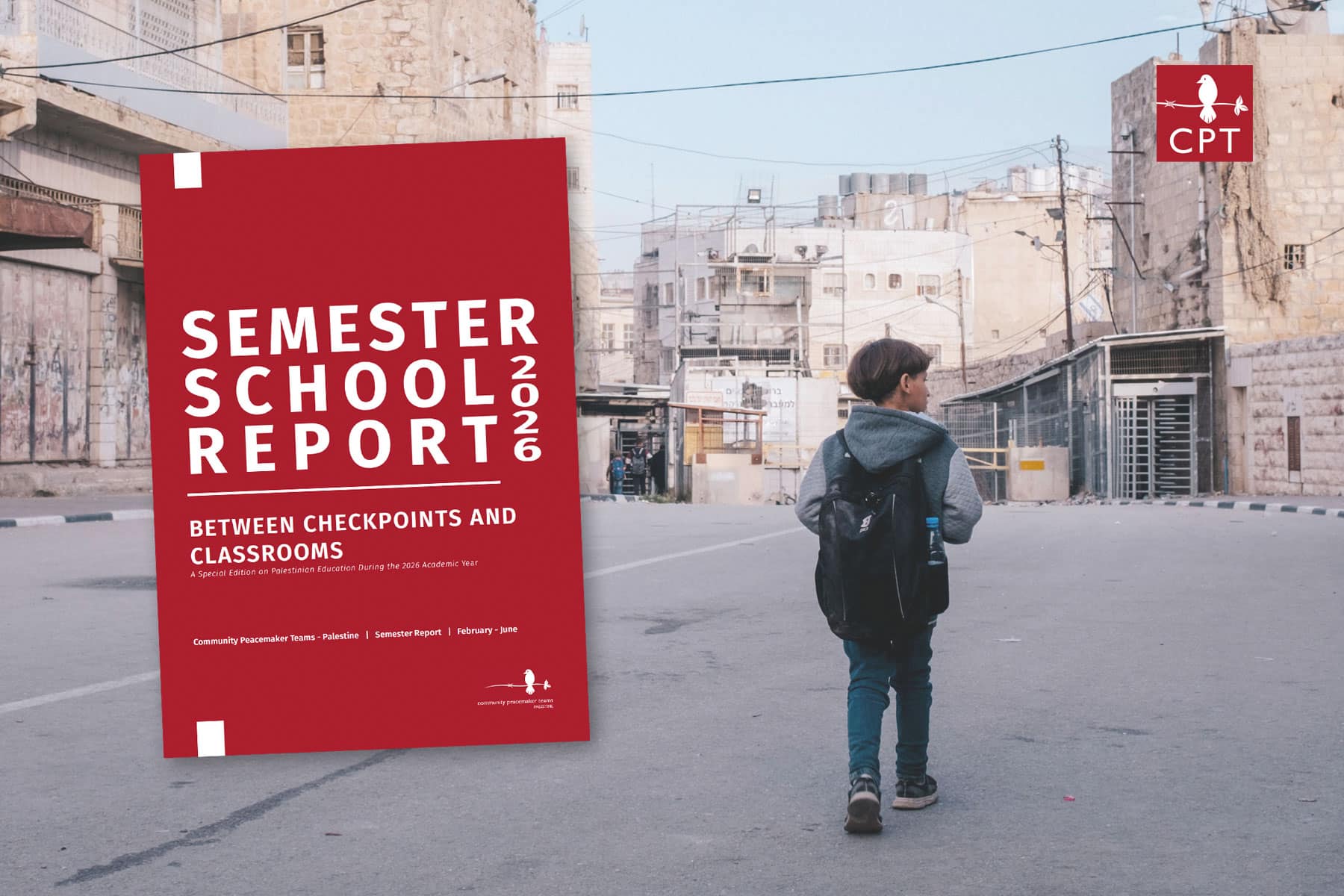
According to the Convention against Discrimination in Education and the Universal Declaration of Human Rights, education is a fundamental human right. Yet for many Palestinian children, learning is overshadowed by uncertainty and dread. Military checkpoints, movement restrictions, and settler violence disrupt students’ access to education.
Community Peacemaker Teams (CPT) Palestine has documented human rights violations and has accompanied children in facing threats to their right to education in Al- Khalil (Hebron) and Masafer Yatta, a group of Palestinian communities in the South Hebron Hills, since 2002. In addition to our school accompaniment program, CPT works in solidarity with Palestinian communities through a protective presence, monitoring and documenting human rights violations, and advocacy. School accompaniment involves CPT members accompanying children on their journeys to and from school, including through areas where military restrictions and settler violence can threaten their safe access to education.
The second semester of the 2025–2026 academic year unfolded amid escalating restrictions imposed by Israeli authorities, supported by continued US political and military backing. Increased checkpoint closures, intensified military activity, and ongoing settler violence further limited children’s ability to access education safely and consistently. These same conditions also affected CPT’s ability to monitor and accompany students. While our commitment remains unwavering, heightened restrictions and security risks often prevent us from reaching schools and documenting every incident.
Another major factor affecting education in the second semester of 2025-2026 was the US/Israel war with Iran, which began on 28 February, exactly one month after the start of the semester. This resulted in school classes going online for a month and a half. Schools resumed with in-person classes in April.
Represented in this report are the obstacles that Palestinian students, teachers, and families continuously face in achieving their right to education. Despite these challenges, the Palestinian community as a whole continues to show perseverance and to resist the oppressions in their lives. The determination of students and teachers to learn and teach under such circumstances is a powerful reminder of how the right to education must be upheld, protected, and respected.
This report is based on the results of a qualitative data analysis approach. Data was collected through interviews and conversations with students, teachers, parents, school staff, and community members. These interviews provided valuable insights into the challenges affecting access to education and the broader impact of movement restrictions on students, schools, and local communities.
You will find, first, a section describing methodology: how the team went about collecting and analysing interview material about the experience of school life. The heart of the report is the section entitled Data Interpretation, where we comment on the recurring themes arising from the interviews. We then consider first the possibilities (Our Impact), and next the challenges for our own work. In Looking Ahead, we list several specific commitments, and we conclude with an overview.
By combining the perspectives and experiences of students, teachers, and parents, this report aims to provide an understanding of how movement restrictions and the dehumanizing conditions of occupation continue to hinder students’ access to education.