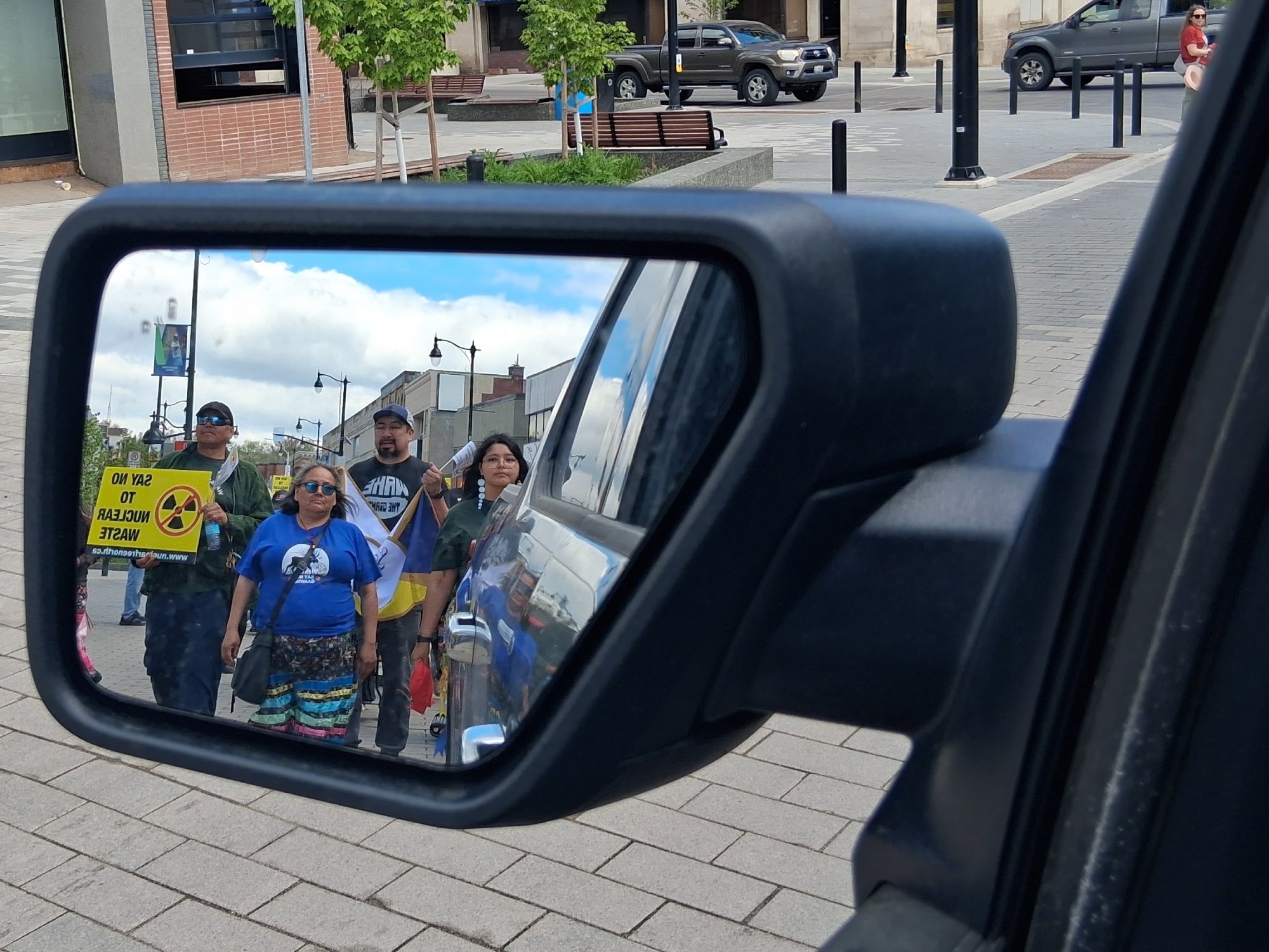
Driving a vehicle at two kilometers an hour was more difficult than I thought. As I feathered the brakes of the pick-up truck, I kept a close eye on my rearview mirror. Behind me, members of Grassy Narrows First Nation were marching and singing, leading hundreds of Indigenous leaders and allies from Waverley Park to the harbour in Thunder Bay, Ontario. CPT was there to support Grassy Narrows and Fort William First Nations in their ongoing resistance to plans to bury nuclear waste in Treaty 3 territory. Someone had run up to my window. “You’re driving too fast, can you please slow down?” I glanced at the speedometer. Oops! I had accelerated without meaning to and was losing the people at the back of the march. Words from the Chiefs’ speeches in Waverley Park still rang in my ears: “This is another form of poisoning.” First mercury, now nuclear waste.
The people of Grassy Narrows have been dealing with mercury poisoning since the 1960s, when the Dryden paper mill released thousands of kilograms of mercury into the Wabigoon river and watershed. While over 90% of Grassy Narrows residents continue to live with mercury poisoning, the government has repeatedly refused to clean the river and properly compensate the people. Furthermore, the Dryden paper mill is still operating, releasing chemicals that are exacerbating the toxic effects of the mercury still present in the water. In May, CPT joined members of Grassy Narrows in Dryden to demand that the mill be shut down.
The selected nuclear waste repository site, located upstream of Grassy Narrows, is yet another example of government and industry pushing capitalist agendas that disproportionately burden Indigenous communities with health hazards and ecological degradation. This is environmental racism on full display. Not unlike mercury and nuclear waste, colonialism continues to leech into the ground, poison the waters, and reveal the toxicity at its core.
The Nuclear Waste Management Organization (NWMO) claims to “respond to the values and concerns of Indigenous Peoples.” However, in a statement issued to the federal government’s impact assessment process earlier this year, Joseph Fobister, Director of the Grassy Narrows Land Protection Team, stated clearly that Grassy Narrows was not consulted:
Grassy Narrows was not informed of the Nuclear Waste Management Organization’s (“NWMO”) site selection process for the nuclear waste storage project and learned about this process independently around 2020, ten years after the site selection process was launched in 2010. Grassy Narrows was not meaningfully informed nor included in the site selection process, despite writing to NWMO several times to seek information to help us better understand NWMO’s decision-making process and to raise concerns about the process and the proposed nuclear waste storage project upstream of our Territory in the Wabigoon River watershed.
Ultimately, NWMO offered to meet with Grassy Narrows only at the very end of the selection process once the outcome was clear. Grassy Narrows’ grave concerns about the process and about the site were brushed aside and the site was selected against our strong objections.
The nuclear waste repository plan is also a clear violation of Grassy Narrows’ Land Declaration, published in 2018. In the Declaration, the people of Grassy Narrows reaffirm their sovereignty and self-determination, including their right to make decisions about land use on their territory. The Declaration specifically bans all “mining, transport, storage, and disposal” of radioactive materials on Grassy Narrows territory.
After the march in Thunder Bay had ended, our CPT cohort drove up Animikii-waajiw, or “the place where the Thunderbirds land,” to watch the sun set. When we got to the top of the mountain, leaders and Elders from Grassy Narrows were drumming and singing: We will sing and dance and fight and die as long as the sweetgrass grows… the waters flow… the sun shines…
When I was driving the truck earlier that day, I had been focused on one route, one march, one weekend. But as I listened to the songs that evening, I was reminded of a longer view: a kind of commitment that spans across decades, a kind of solidarity that has future generations in mind.
I recalled how, only a couple of months earlier, Prime Minister Mark Carney had uttered an abhorrent claim that he could “outlast” Chrissy Isaacs, an activist and member of Grassy Narrows. But here, on Animikii-waajiw, it was clear whose vision of the future would endure. Here, songs rang deep with a fierce commitment to the Earth and the great-grandchildren of Grassy Narrows. And Chrissy’s voice was among them.
When Chrissy Isaacs went to Ottawa with other members of Grassy Narrows this past week, she asked to speak with Carney directly: “You need to apologize to my people. And you need to clean the river, shut down that mill and compensate our people because our lives matter. We were robbed of a good life.”
While the government refuses to apologize, Wabigoon River remains poisoned, Dryden Paper Mill remains open, and nuclear waste remains slated for Treaty 3 Territory, please support Grassy Narrows in the following ways:
- Sign the petition to Prime Minister Carney and Ontario Premier Ford.
- Tell those you know near Toronto to attend the River Run this September.
- Follow Grassy Narrows Solidarity on social media.