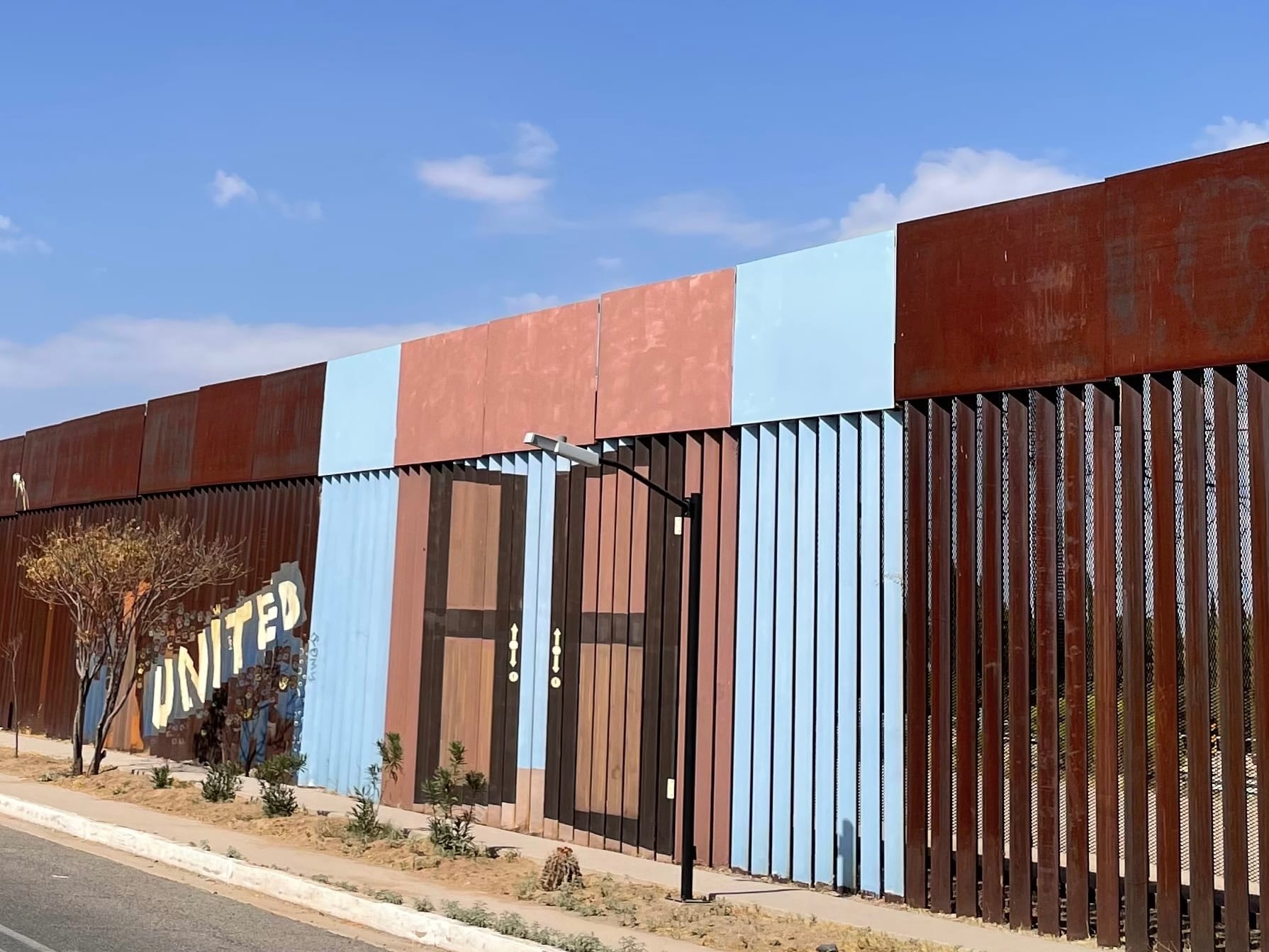
My first experience on a CPT delegation was on the US-Mexico Borderlands, in November 2024. There we spent a lot of time with the Wall. We traveled back and forth many times through the Wall’s gate at the Agua Prieta, Sonora crossing with Douglas, Arizona. On the US side of the Wall, we visited a cemetery and participated in a vigil for people who died trying to cross the border from south to north. On the Mexican side of the Wall, we admired the beautiful artwork that resisted and, in small spans, overcame the ugliness of the Wall. We visited a place in the desert where many migrants have scaled (or, thanks to soil erosion, possibly crawled underneath) the Wall.
During July and August 2026, while working for the first time as a CPT volunteer in Palestine, I encountered another oppressive border barrier. In Palestine, the West Bank Barrier is referred to by Palestinians and human rights advocates as the Separation Barrier or the Apartheid Wall. It was mostly built between 2002-2006 and stretches more than 700 kilometers. The stated rationale of the Israeli builders was security. What’s revealing of its actual purpose is that most of the length of this barrier – 85% – is located inside the West Bank, east of the 1949 Green Line, the border that separates Israel and the post-1967 Israeli-occupied West Bank. This Separation Barrier was built by Israel to bring many more Jewish settlements in the West Bank into space effectively annexed by Israel and has facilitated the building of more settlements in the years since. In other words, the West Bank Wall has been used to further Israeli expansionism into Palestinian territory.
Furthermore, the military checkpoint-restricted and travel permit-required space between the Green Line and the Apartheid Wall makes travel between Palestinian cities, towns, and rural areas even more difficult. This separates many farmers and herders from their lands and communities, and family members from each other. In this way, the Separation Barrier is part of the same Israeli colonizing project that has, for nearly six decades, driven illegal Israeli encroachments throughout occupied Palestine, the violent demolition of Palestinian properties, and the suffocating restrictions on Palestinian movement across the West Bank. The crazy quilt pattern of the contemporary West Bank map, with Palestinian areas fragmented from each other by settlers and Israeli military forces, ensures the continuation of heavy Israeli occupation and further strangles any lingering idea of a viable Palestinian state being created in this land.
It is often said that walls between nations are about the fear of the foreigner, the fear that migration will endanger culture, economy, and security. While fear – however misplaced – may play some role, what is clear is that walls are also built to bolster the power of demagogic regimes and to advance imperialism. In the US, the building of the physical and symbolic Wall on the border with Mexico has been used by presidents keen on building domestic support among those citizens whose economic and cultural insecurity can be both aroused and then partly allayed by such measures. The Wall itself is also a forever painful reminder to Mexico that much of the territory north of the Wall (the current US Southwest up the Pacific coast all the way to northern California) was taken from Mexico by US “Manifest Destiny” in the mid-19th century.
In Israel, the building of the Apartheid Wall during the second Palestinian Intifada of 2000-2005 was similarly a way for the ruthless regime of Ariel Sharon to try to strengthen itself with the Israeli domestic public. Construction began in the area around Jerusalem that had been long claimed by Israel and to which Israel wanted to limit Palestinian access. Above all, the Separation Barrier fostered further Israeli expansionism. In what amounts to outright land-grabbing, this post-2002 installation of electronic and barbed wire fencing in rural areas and concrete walls in urban areas deep inside Palestinian territory has put approximately 10% more of the Israel-occupied West Bank on Israel’s side of the movable borderline.
As summarized by the Institute for Middle East Understanding (IMEU), the Separation Barrier has painfully isolated many East Jerusalem and West Bank Palestinians from each other as well as from holy places and economic livelihoods. To cite one statistic, the Wall has cordoned off more than 10,000 Palestinians and approximately 34,000 acres of Palestinian farmland in the “seam zone”, which lies between the Green Line and the Wall, with 84 Israel-regulated gates most of which are rarely open. A UN report cited on the IMEU website states: “Agricultural-based livelihoods of thousands of families have been undermined due to the gate-and-permit regime, which hinders farmers from accessing their farming and grazing lands.”
The Apartheid Wall has been particularly devastating to the city of Bethlehem which is now enclosed and separated from its surrounding lands and from its historically rich cultural and economic relationship with Jerusalem. In Bethlehem, my first view of the Separation Barrier was from the window of our car on the night we traveled to a World Cup watch party (Egypt vs Argentina) in the city. During a later visit to Bethlehem, in daylight, I walked twice along the Wall. On these walks, I took particular interest in the street art covering the 9-foot-tall concrete barrier, and took photos much as I had done on the Mexico side of the US-Mexico border wall.
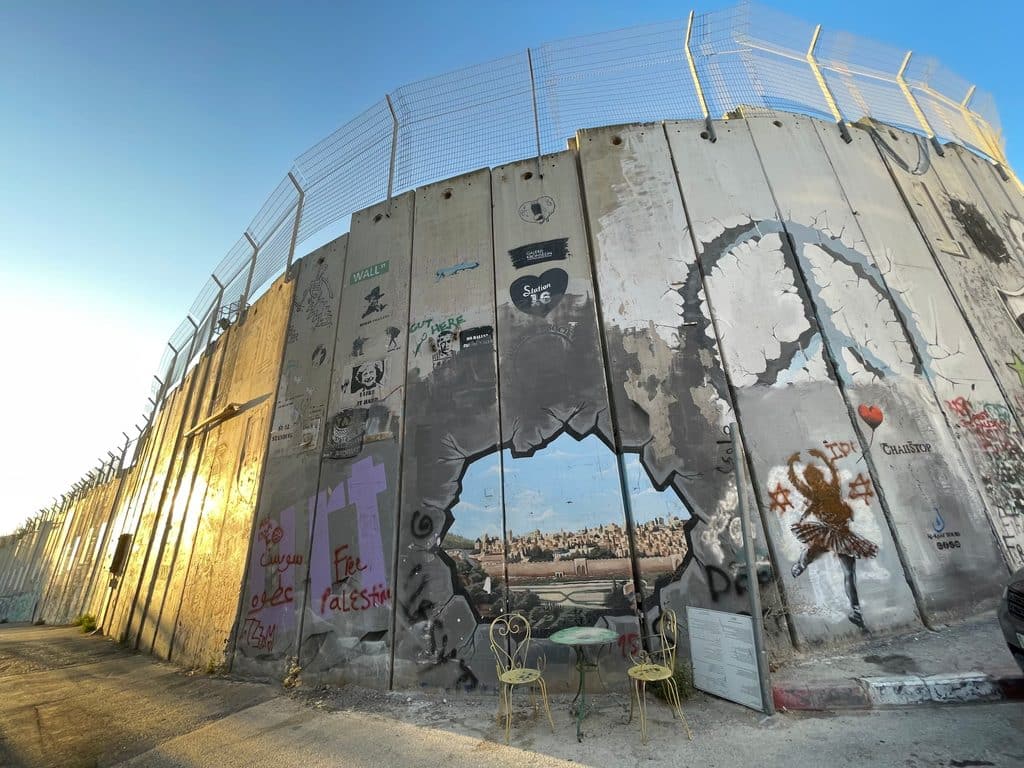
This is what drew my attention: one wall painting in Bethlehem creates the illusion of an opening in the Apartheid Wall toward a picturesque and inviting city on the other side. Sitting next to this imagined aperture, someone has placed a small table with two decorative iron patio chairs for appreciative viewing, I am imagining, of a free world. This artwork reminded me of a memorable painting on the Wall in Aqua Prieta, Mexico that conjures up a very large open door in the forbidding Wall, a passage through that unites rather than divides people.
During CPT training in 2026, a member of the CPT Palestine team shared with us a multinational and trilingual (Arabic, English, and Spanish) political hip-hop song featuring Palestinian rapper Shadia Mansour. The song, “Border Ctrl”, directly referenced and related the oppressive walls in Palestine and in North America.
This border control
Congesting our soul
Taking its toll on us all
We gonna dissolve
This Mexico Bethlehem wall
If you hear us heed the call
For me, this song is a reminder that the struggles and the visions of each part of the CPT family, indeed of the whole global human rights family, are often quite similar. May we all heed the call to dissolve walls.