
This summer, the CPT Palestine team made several visits to the Tamimi family in Jabal Jalis, Al Khalil/Hebron. It was always an honour to be invited into their home. I had many conversations with Reham Tamimi, who teaches out of the family home and is raising her children there. Her hospitality and welcome were always warm, and she shared many stories—both disturbing and powerful—about her family’s resistance to settler violence and harassment.
During one visit, Reham gave me a tour of her family’s property. She gestured toward large swaths of land she could no longer access, now occupied by Israeli settlements and a military base. Not far from her house, a fence cut across the land, and a road for settlers ran along the other side. “When they were putting up that fence,” Reham told me, “I lay down on the ground and refused to move.”
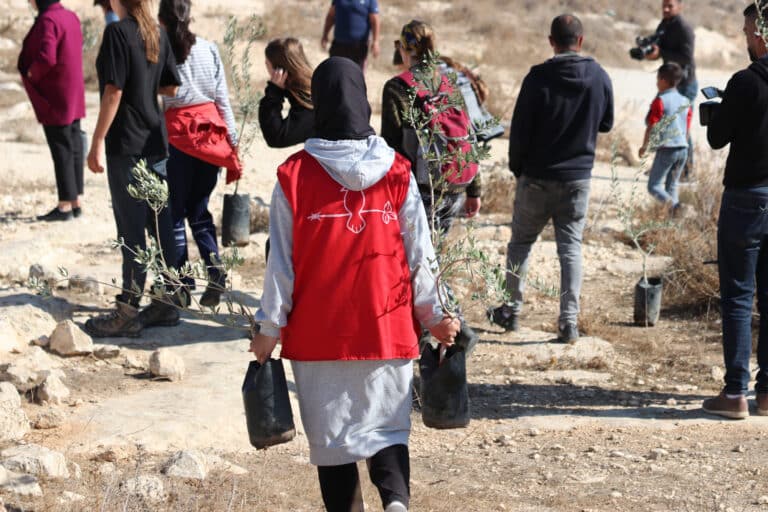
The Tamimi family is building a playground and garden for their community on their property. The neighbourhood kids could hardly contain their excitement, but the settlers in the area were less than thrilled. Every day, settlers stopped their cars in front of the Tamimi’s home and yelled at the family. They claimed the construction project was illegal, even though the Tamimi’s were building on their own land. One night, settlers arrived at the family’s home with machinery and attempted to destroy their garden. They were accompanied by soldiers.
Over the years, Reham has experienced brutal harassment from Israeli settlers. She told me about settlers who tried to hit her with their cars. One time a settler grabbed her by the neck, intending to choke her. She was pregnant at the time. Reham also explained that her family wasn’t drinking from their water tanks. Three years ago, settlers had poisoned the Tamimi’s water supply with fertilizer, and she was afraid they had done so again.
As we sat down to an incredible meal of chicken, rice, and sauce made from the milk of the Tamimi’s sheep, I remembered the story Reham’s father had told me about settlers poisoning his animals. What must it be like to live on edge, all the time?
Later Reham and I walked to a beautiful, quiet lookout spot, where she offered me a seat. “This is a place I feel calm,” she told me, as her hijab fluttered gently in the wind. “I can breathe and find strength here.” The view was stunning. From this vantage point, you couldn’t see the military base or Israeli settlements.
Back at the construction site, Reham’s relatives were hard at work, laying brick upon brick in the relentless summer heat. I watched the kids excitedly running about, stopping only to gape at the bulldozer that was clearing a patch of land for the playground. Their popsicle-smeared faces grinned eagerly. A baby was being passed from relative to relative, receiving countless kisses. “I am convinced that our children or grandchildren will see the liberation,” Reham’s brother, Faraj, had told me.
May there be liberation for these little ones. For all of Palestine.