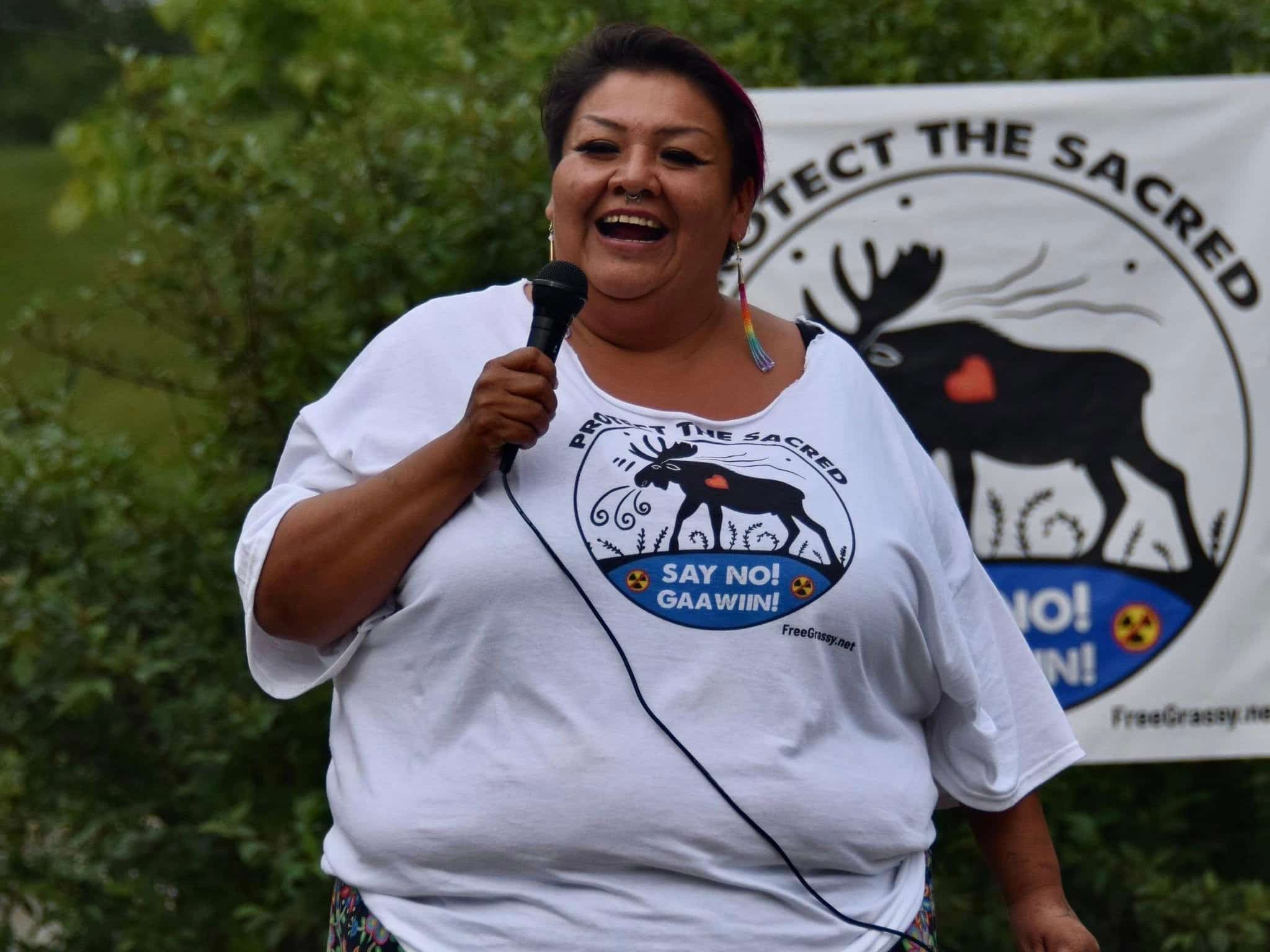
On 6 June, members of Grassy Narrows First Nation and Fort William First Nation will gather with supporters in Thunder Bay (in northwestern Ontario, Canada) to protest plans to bury nuclear waste on Treaty 3 territory. Since discovering the proposal to build a “deep geological repository” for nuclear waste at a site near Ignace, Ontario, upstream of Grassy Narrows, community leaders have opposed it publicly.
The people of Grassy Narrows know all too well that governments and corporations routinely overstate the economic benefits of industrial projects and fail to manage the environmental risks. For 50 years they have lived with mercury poisoning from the Dryden Mill which wiped out their thriving fishing economy and harms the health of over 90% of community members to this day. In 2002, the women and youth of the community put their bodies in front of logging trucks to stop industrial logging that was destroying their hunting and trapping territory and releasing mercury held in the soil. In 2018, Grassy Narrows passed a Land Declaration which asserts that the community will make their own land use decisions about their traditional territory, and bans industrial activities such as logging, mining, oil and gas extraction and transportation, and extraction, transportation and disposal of radioactive materials.
Joseph Fobister, the Director the Grassy Narrows Land Protection Team, wrote in a statement to the federal government’s impact assessment process:
We are deeply concerned that nuclear waste poses the potential for the escape of radioactive material because any escape would harm us for many generations and our lands would never be the same. Our watershed and our people have already suffered too many impacts from the results of industrial activity, including an ongoing mercury crisis. We cannot accept this further risk to the health of our lands, river, and people.
The federal government is moving ahead with plans for the nuclear waste repository despite the objections of many First Nations downstream. The planned site is among the headwaters of the Rainy River watershed, which flows 600 km west through the Lake of the Woods into Lake Winnipeg. At a protest in Winnipeg, Grassy Narrows matriarch Chrissy Isaacs said, “Everybody needs to speak up for the water, because water is very precious and sacred. It affects everybody, not just in our community.”
We invite you to pray for the waters of your own homeland – wherever you are – that they may be clean and sustain life. Pray for those who care for the water and protect it.
We also invite you to pray for the fruition of the vision of the Grassy Narrows Land Declaration, which calls for reconciliation by way of restoration of Indigenous sovereignty and reparations for the harm done to the people and environment. Pray that all people may be able to imagine and work for a future of healthy ecosystems and healthy people.