On 31 May, Colombia held presidential elections. Unless one candidate receives 50%+1 vote, voters must return to the polls for a second round, choosing between the top two candidates from the first. The recent results require a second round of voting, between two opposite political poles of the country.
One is led by Ivan Cepeda, the political Left candidate who would succeed current President Gustavo Petro. This pole is based on the defense and protection of human rights, the environment, and social movements. It is concerned with fossil fuel energy transition, and the continuation of peace talks with armed groups. It is focussed on the implementation of the 2016 Havana agreements, on reform and on the deepening of the social changes established by the current progressive government.
Another pole is headed by candidate Abelardo de la Espriella, who has the support of former politically rightwing President, Alvaro Uribe Vélez. He is a protégé of the new international far right, and proposes the cancellation of the peace talks, abandoning the implementation of the 2016 agreements, unrestrained fracking, the total subjugation of Colombia to the will of the United States, the regression of human rights and social advances, budget cuts to the regions, work in favor of the wealthiest, and the intensification of neoliberalism and neofascism.
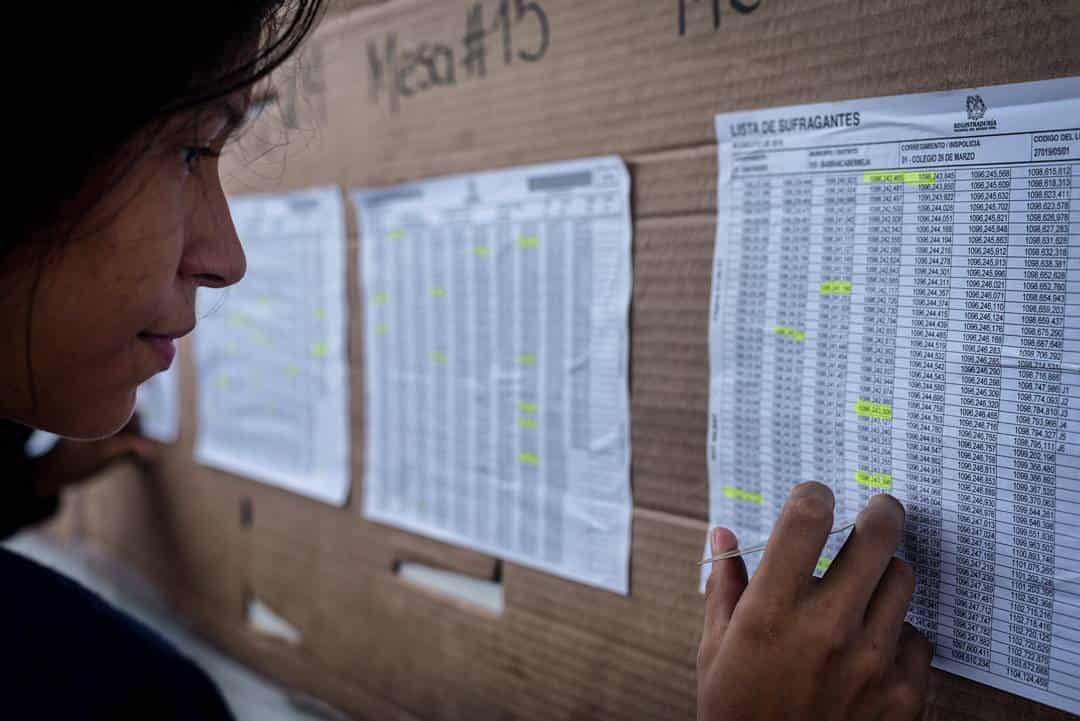
Contrary to all the polls, which predicted Cepeda would win in the first round outright, the preliminary vote count gave De La Espriella the victory with 10,360,000 votes (43.74% of the vote) against 9,687,481 votes (40% of the vote) for Cepeda. The preliminary count, as its name suggests, is a tally of votes conducted by the electoral registry to quickly inform voters of the results, but it has no legal standing until the official count is carried out by judges who verify the votes and declare the official result.
It is known that De La Espriella, who has no history in Colombian politics, achieved this vote with the power of the large traditional political machinery, an extraordinary investment in bots that managed public opinion on social media, the help of private electoral software that does not allow auditing and even the complicity of international right-wing governments.
Cepeda, on the other hand, achieved a historic, albeit inaccurate, vote count, exceeding by 2.4 million votes what Gustavo Petro obtained in the first round four years ago. He did so with a modest campaign, based on meetings with supporters in public squares and seeking programmatic alliances that did not compromise his potential ability to govern. These elections, moreover, drew 24 million voters, representing 57.7% of the electorate, surpassing any previous first-round presidential vote in Colombia.
On 31 May, the Colombia that voted NO in the 2016 Peace Referendum1 spoke out – the Colombia that wants to continue marginalizing people and benefiting the privileged. The people themselves also spoke through the President of the Republic, and Iván Cepeda, who stated that he would only recognize the official count after the electoral commission answered three questions:
1. Why are there 800,000 registered voter IDs that were not originally on the electoral registry?
2. Why are there indications of polling stations with atypical voting patterns?
3. Why are foreign countries interfering in the Colombian presidential elections?
The vote counting commission will have the task in the coming days of explaining each and every vote to Cepeda’s campaign. Iván Cepeda’s life has been one of tireless struggle for human rights, in which he has survived genocide2 and persecution, and has persevered despite the difficulties. The final vote will be in two weeks. In his own words: “We will not let fascism take over Colombia. The fight continues, and we will triumph.” History will tell whether we become like Javier Milei’s Argentina, or if we join the ranks of Lula da Silva’s Brazil and Claudia Sheinbaum’s Mexico.
1 2016 Referendum on Agreements signed with the then largest guerrilla group FARC. The No vote won with 50.2% of the vote.
2 Cepeda’s mother and father were assassinated for their political activism in the Patriotic Union (known as the UP in Spanish). Over 3,400 UP members have been intentionally assassinated, which was ruled a the genocide of the UP by the Inter-American Court of Human Rights.