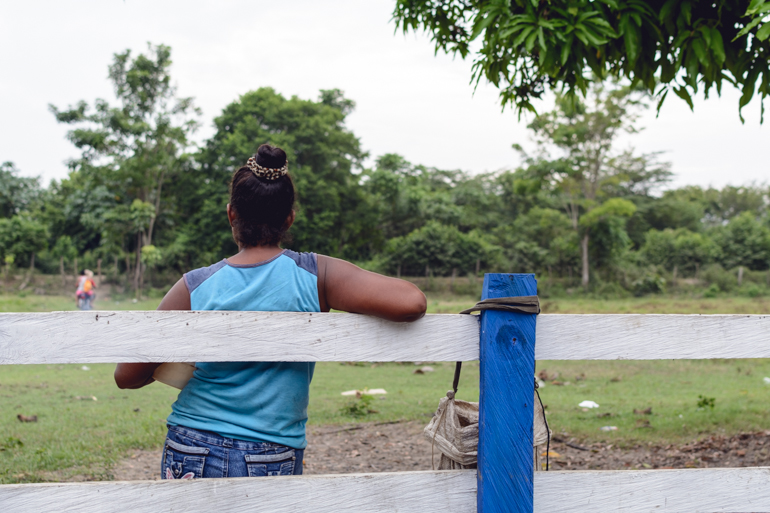
As we arrived at the meeting with the people of Bella Union, a village neighboring El Guayabo, I saw a woman sitting under a green tree with a big smile. I immediately thought it would be interesting to know more about her.
Our task was very specific: to document cases of human rights violations from 1990 to 2014. Soon it was time for the woman with the beautiful smile to share. She was a bit tired because she had given her statement many times without seeing results, so I paid close attention to what she was saying.
As she told me step by step what she had suffered at the hands of violent actors, her smile grew more radiant. She did not seem weighed down by sadness, despite the fact that over ten years ago, violence in the region put out a light in their lives. She continued recounting the events that ended the lives of her family: first the story of her father’s death, then her brother’s, and then she took a break, saying that the story of her son was the most painful.
Even though her fifteen-year-old son was illegally arrested (or abducted), she still found the courage to carry on. She said that she understood the unquenchable strength a mother is capable of finding to defend her child when his freedom is being threatened and he is at risk of losing his childhood. “Being a mother”, she said, “is to give everything for your child”.
She alone, without help from the father of her child, their community, or support of the state, undertook the search for her son in the mountains of southern Bolivar. She never cared how dangerous it would be to go looking for her him. When she got to the place where she thought he was, the paramilitaries immediately threatened her saying that ‘she should not look for what she did not lose’. Feeling defeated she returned home. She still had hope in the depths of her soul, but she became ill because she had risked everything to find her son and had not succeeded.
When she returned, she asked God to bring her son home, and spent three months waiting. One day, miraculously, he appeared in the backyard. She hugged him and tears filled her eyes. Still today, after She believes that he was tortured, and the memories of what happened continue to haunt him.
She enjoys having her son at home, but she has not finished her resistance. She remains stubborn yet hopeful, and is prepared to continue to stay on the land where violence has repeatedly knocked at her door. “If I am capable of getting my son back, I am also capable of giving everything forthis land. It is the only legacy I will leave my family. This is why I keep moving forward.”