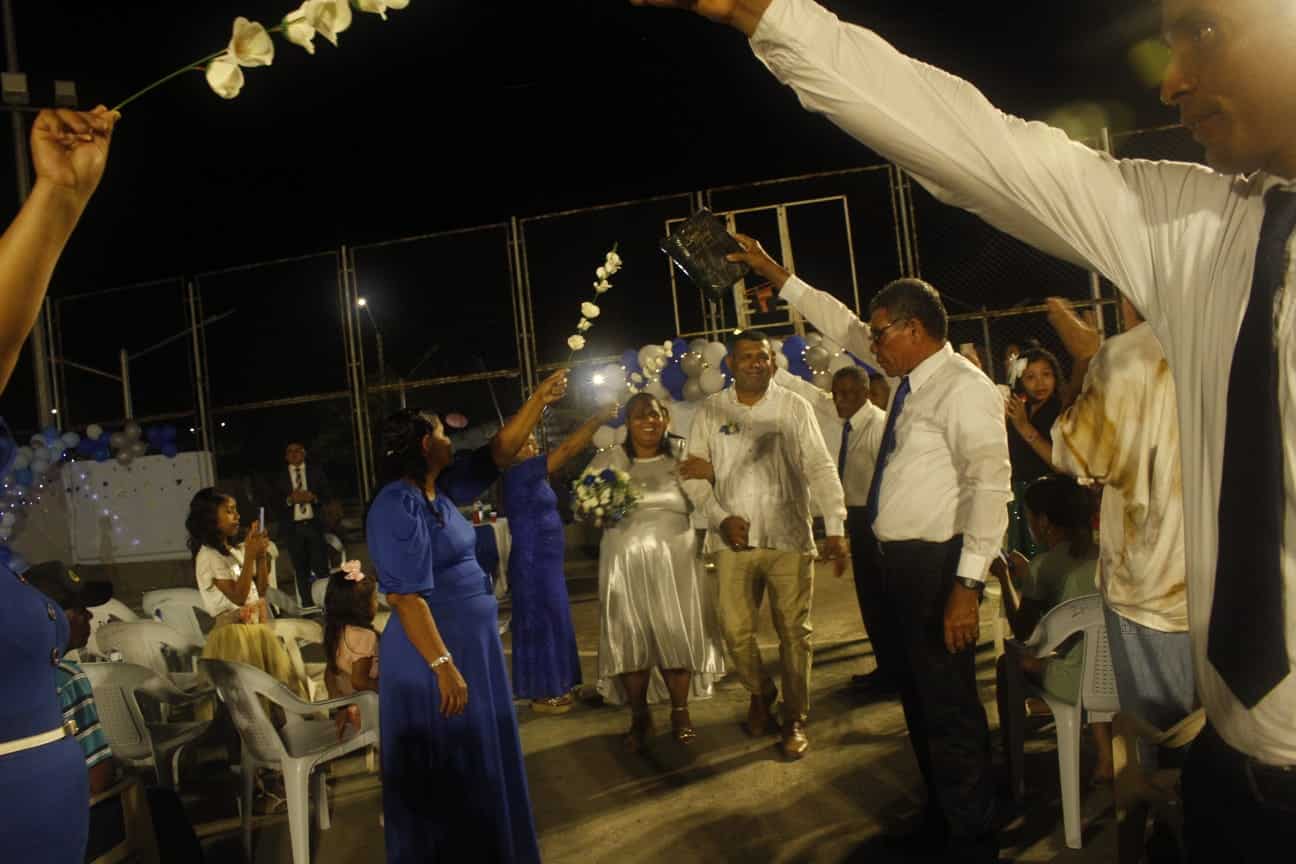
Recently, I was honoured to attend the wedding of two social leaders deeply devoted to one another, to their family and community, to their faith, and to the enduring struggle for peace, justice, and human rights. Each of these devotions nourishes the others; that is the nature of life on the frontline of armed conflict, environmental crisis, and economic deprivation.
Erik and Chela are tireless activists and profoundly inspiring people. They have lived through years of dispossession, displacement, insecurity, threats, and intimidation by both state and paramilitary forces. Yet they are always quick to smile and laugh, greeting us with an abundance of warmth and generosity whenever we visit.
In the weeks before their wedding, they feared for their lives, unsure whether the ceremony would even be possible or whether they would be forced to flee their home. Security is a constant concern in El Guayabo, where the community has refused to cooperate with illegal armed groups trafficking weapons and drugs through the area. Chela’s role as president of the town council makes her particularly vulnerable. As a prominent leader in the farmers’ association AGROPEGU, Erik has long been the target of violent threats.
Despite these risks, Erik and Chela remained in their home and were married in the company of friends and neighbours, including the entire CPT Colombia team. At the wedding, one of my teammates spoke of more than a decade walking alongside them: through forced separations in times of danger, through the joy of celebrating their children’s milestones, and through a relationship that has come to feel like family.
That sense of family struck me on my very first visit to El Guayabo. To me, it embodies the very best of accompaniment—a word derived from the Latin com panis, meaning “with bread.” To accompany someone, as Paul Farmer wrote, “is to go somewhere with him or her, to break bread together, to be present on a journey.” It is to walk beside people and share in their triumphs and misfortunes. At its best, accompaniment is an act of love.
Strength to Love is the title of a collection of sermons by Martin Luther King Jr., who affirmed that “at the center of nonviolence stands the principle of love.” Like the Apostle John, King equated God—the “ultimate reality”—with love. This understanding of love as both a spiritual foundation and a political practice appears across traditions. In Islam, God is al-Wadūd (the Most Loving) and As-Salām (Peace), and Muslims are called to embody raḥmah: compassion expressed through action for justice. Gandhi equated love with truth and placed both at the heart of satyagraha, declaring that “ahimsa [nonviolence] and love are one and the same thing.” The Buddha described spiritual practice as “the liberation of the heart which is love,” and the practice of mettā (loving-kindness) meditation seeks to realise truth and guide action by cultivating boundless compassion that dissolves the boundary between self and other.
CPT grounds its work in this liberating love. Love inspired me to write this Prayer for Peacemakers, and if love has drawn you to read it, I invite you to join me now in a prayer of loving-kindness. We begin by directing the prayer inward, since we often struggle to love others without first loving ourselves. From there, the practice expands outward: to someone who has cared for us (the ‘you’ of part II), to those we wish to support, and finally to all beings.
I
May I be peaceful.
May I be happy.
May I be well.
May I be safe.
May I be free from suffering.
II
May you be peaceful.
May you be happy.
May you be well.
May you be safe.
May you be free from suffering.
III
May Erik and Chela be peaceful.
May they be happy.
May they be well.
May they be safe.
May they be free from suffering.
IV
May all beings be peaceful.
May all beings be happy.
May all beings be well.
May all beings be safe.
May all beings be free from suffering.
In her book All About Love, bell hooks reminds us that love, in its truest form, is action, not feeling. If this prayer has moved you, let it inspire a loving action, however small, and dedicate it to Erik, Chela, and the people of El Guayabo.