
Ten days have passed since fifteen migrants died in a shipwreck off the coast of Chios, Greece. There are questions about the actions of the Greek Coast Guard. According to survivors, the Coast Guard drove its boat right through them, killing their fellow passengers. According to the Coast Guard, it was they who were rammed by the migrant dinghy. In the aftermath, a public relations war has been underway.
The defence is copy-and-paste (as, in other cases, are the witness statements of survivors interrogated by the Coast Guard). It goes like this: Greek borders are under an “asymmetric threat” carried out by “smuggling networks” that care not one bit for human life. And so, in each case, a smuggler must be found and blamed. These smugglers, we are told, work in tandem with those on European soil, masquerading as NGO workers or humanitarians, who must be unearthed, maligned, and prosecuted.
Meanwhile, we are reminded that the officers of the Coast Guard have saved more lives than any professional humanitarian – from whom they face criticism bordering on harassment. They do so in life-threatening circumstances: threatened by the sea and by the migrants themselves, only to be rewarded by being branded “murderers.” It is not, then, that racism kills, but that anti-racism makes us see the victims as perpetrators.
Doctors who attended to the survivors at hospital in Chios said the injuries were like something from a car crash. They have denounced the the “civil-war climate” and the “loss of all sense of humanity.” An autopsy report supports the survivors’ testimonies: the fifteen died not by drowning but from severe head injuries. Even a retired Coast Guard general doubts his former colleagues: the notion that a dinghy would ram a military-spec vessel is “like a bicycle trying to ram a truck”.
Nevertheless, we are starting to see the fallout of a well-oiled public relations operation. Doctors who went to visit the patients were accused of prepping the witnesses in line with their anti-Coast Guard, and therefore anti-Greek, agenda. Another who spoke out was accused by a government Minister of “wanting to kill Greece” and “defending Turkey’s interests” – something like treason, in other words. Our social media algorithms have changed too, feeding us pro-Coast Guard propaganda and doctored images, some from far-right channels, though it’s become difficult to draw the line between them and the mainstream.
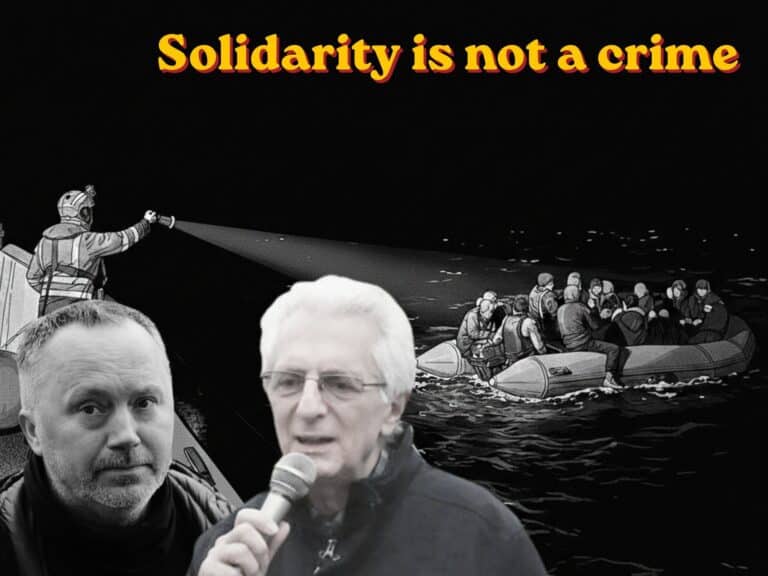
The Greek government has cultivated this climate and is capitalizing on it. It has issued a European arrest warrant on its long-standing target Tommy Olsen, who runs the Norway-based Aegean Boat Report. He’s accused of aiding the smugglers; in reality he has consistently obstructed the illegal pushback policy. CPT’s local partner organization, the Human Rights Legal Project in Samos, has taken up the defence of a Moroccan man accused of being the “smuggler” in the Chios shipwreck case. This week, the Minister of Migration took to TV to say that an “NGO that chose to defend the trafficker instead of the victims” is akin to learning of a rape and defending the rapist. In such terms does Greece assess its border security.
They’ve built a hall-of-mirrors, reflecting back the image of a “victimized state” and, by extension, a victimized majority. Those with power and platforms attempt to project the image everywhere. Do they hope that it’ll stop us seeing that they “protect” the one by terrorizing the other?