For years now, migration policies and “border management” in Greece have been based on pushbacks and the criminalisation of people on the move. In public discourse, a narrative prevails that we are under a hybrid invasion – an asymmetric threat – and we need the Hellenic Coast Guard to constantly protect us, ready to do whatever is needed to prevent people from arriving in Greece and the European Union.
At the same time the government arrogantly refuses to acknowledge the existence of pushbacks, despite the ever-increasing accumulation of evidence, rulings by the European Court of Human Rights and reports by independent international and national human rights bodies.
While the government cannot openly admit to violating international law, it nevertheless has to make it clear enough: it is ready to do “anything possible”. It reinforces a narrative by which killing migrants at sea becomes acceptable.
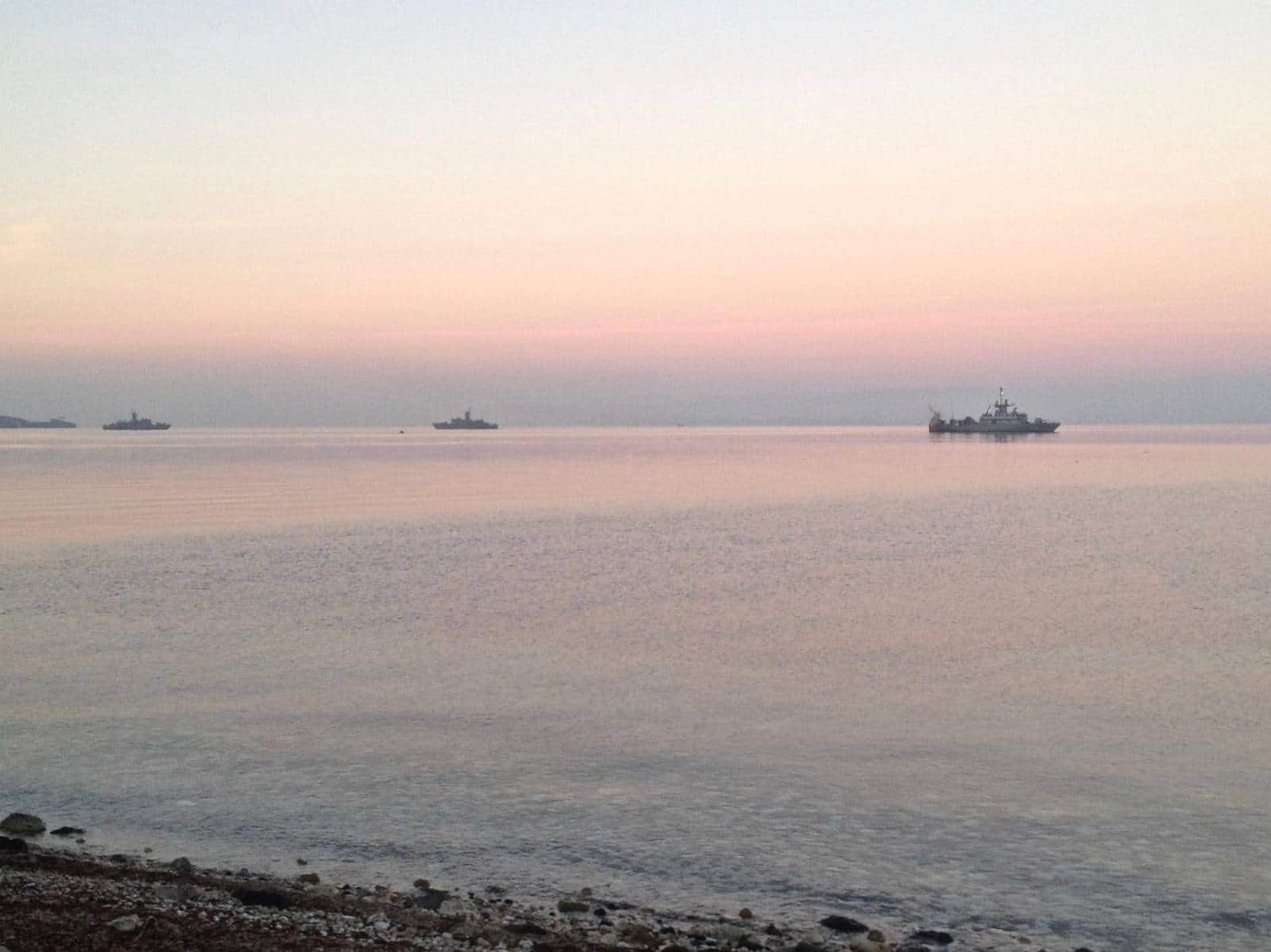
Almost a year ago, on 3 April 2025, the Hellenic Coast Guard attacked a boat with 31 people on board as it was approaching the coast of Lesvos. Twenty-three of them survived, 7 bodies were recovered and a child is still missing. In Lesvos we still remember how the news spoke about a rescue operation, how the survivors’ testimonies were silenced, and how quickly the police found someone to charge.
On 5 March this year, M.H. was brought to court, not only accused of driving the boat in which he and his family were travelling, but also charged with causing a shipwreck and manslaughter. He was accused of responsibility for the loss of eight people, despite the fact that among them were his wife and his two-year-old son. During the trial, we heard several written testimonies, which were read aloud and focused on the threats to which M.H. and his family had been subjected before agreeing to drive the boat. Moreover, the survivors also described how, when the Hellenic Coast Guard reached their boat, they beat passengers with long sticks, how they did nothing to rescue them, how they stayed, watching people drowning in front of them. In the absence of the prosecution’s witnesses (who preferred not to appear), and with all the evidence presented by the defense, M.H. was acquitted of all charges – unanimously and beyond all doubt.
This was not the only case in court that day. Preceding his trial were four more cases against people accused of “smuggling”, two of whom were also accused of causing a shipwreck and death. The case of M.H. was widely publicised, possibly due to the high number of deaths, or because survivors’ testimonies had reached the media. These other cases didn’t make the news, nor did the arrests. Being killed at sea does not make the headlines anymore. These cases are no longer even “tragedies”, just “collateral damage” in the war against migration.
The first hearing was against a person who was arrested a month after their shipwreck had happened. Not only did this shipwreck fail to make headlines, it didn’t even make the Hellenic Coast Guard’s webpage. The only official information one could find came from the Turkish Coast Guard, which released a short statement about a rescue operation that recovered four bodies and the rescue of two more people that had “fallen from the boat in which they were travelling” in Turkish waters close to Lesvos. Apparently, the rest of those travelling in the boat made it to Greece that day. A month later, somebody was arrested and accused of causing a shipwreck, despite arriving in Lesvos a few weeks after the incident for which he was charged. Although the evidence was inconsistent and contradictory, the prosecutor’s proposal was “guilty of all charges”. However, in the end, thanks to the efforts from his privately appointed lawyer, the court decided to acquit him.
In the other cases, the defendants, all represented by state-appointed lawyers, were all convicted of all charges.
That was just one day at court. People on the move, accused of “smuggling” are piling up in Greek prisons, and bodies continue to wash up on our shores. These are the results of the Greek and EU implementation of “migration management”, a model that incarcerates people, not only in criminal prisons, but also in all the detention camps along the Greek islands. Here people must live in highly-surveilled facilities, waiting for an unknown time for the decisions on their asylum claims. Now, with the latest amendment to Greek legislation, those who are rejected will be charged for their “illegal stay”, leading them to criminal prisons too.
Filling up the prisons with migrants, and building camps in isolated locations within high-security prison-like installations, contributes to the ongoing dehumanisation of people on the move, the “others”, the “criminals” who need to be contained and incarcerated. When this narrative takes root in a society, killing people at sea is no longer a crime, not even an unfortunate accident, but the logical result of the “protection of our borders”.
We live in a society that no longer questions the Hellenic Coast Guard’s violent practices; a society where migrant death has been normalised, and even conceived as a necessary measure.
But we won’t accept the normalisation of death, nor will we become silent witnesses to murder. We must hold the memory of every death, keep talking about the situation that people on the move face – in Greece and all the other borderlands of Europe – and stand in solidarity with them.