On 22 April, people around the world mark Earth Day. This year, it seems as though many of our governments’ environmental policies are headed in precisely the wrong direction. On Turtle Island, Canada pays lip service to the idea of reducing emissions, but our governments are scrambling to accelerate fossil fuel extraction and mining projects, with the justification of “protecting” our economy from US tariffs.
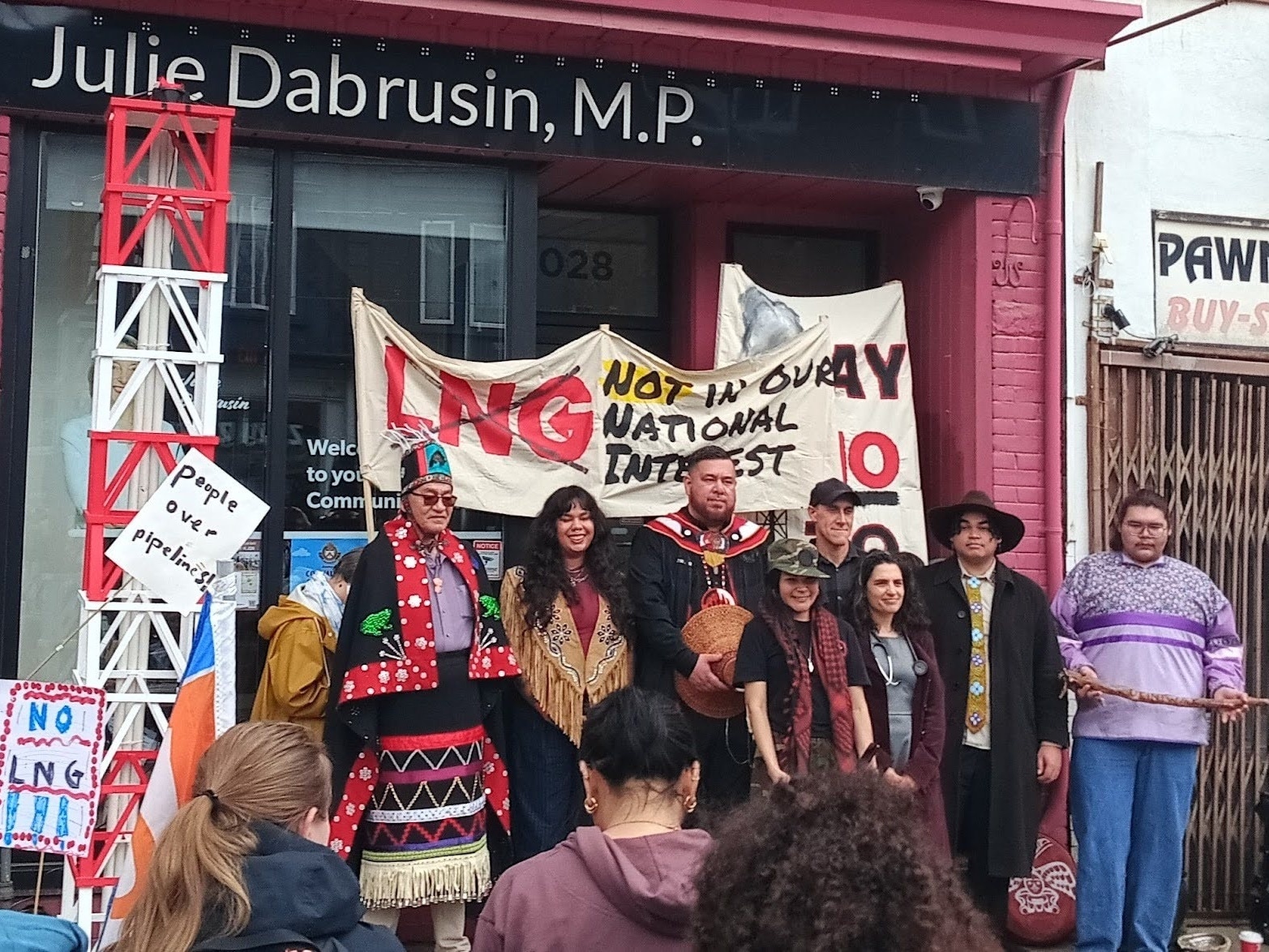
On 17 April, members of the Turtle Island Solidarity Network joined Wet’suwet’en Hereditary Chief Na’Moks and other respected Indigenous and settler environmental advocates to protest outside Environment Minister Julie Dabrusin’s constituency office in Toronto. This was part of a day of action in five Canadian cities protesting Canada’s public funding for Liquefied Natural Gas (LNG) projects.
Speakers focused on federal funding for the CGL Phase 2 project, which is designed to double the capacity of the Coastal GasLink pipeline. They made a convincing case that this project makes neither economic nor environmental sense. CGL does not supply the Canadian market, but transports natural gas across northern British Columbia to the port of Kitimat for export. At a time when worldwide demand for natural gas is falling, Canada is pouring public money into LNG projects that energy corporations are unwilling to risk their capital on.
For years, Wet’suwet’en Hereditary Chiefs have advocated against CGL. Water Protectors from many Indigenous nations, with settler supporters, have put their bodies in the way of bulldozers and militarized police to try to stop construction. The Royal Canadian Mounted Police besieged pipeline resistance blockades and arrested dozens of people in 2020 and 2021, setting off nationwide protests. Residents of Kitimat now live with flare stacks overhead that burn excess natural gas day and night, with pillars of flame sometimes reaching 90 metres high, and complain of respiratory difficulties. Some have received financial compensation on the condition of signing non-disclosure agreements that forbid them from speaking publicly about their experiences. No one, other than politicians, seems to be advocating for LNG expansion, yet our government continues to push the project forward.
Two thousand kilometres east, Anishinaabe communities are organizing to resist development of the “Ring of Fire,” a vast area of mineral deposits in Northern Ontario. The Ontario government has done everything in its power to encourage mining, to the point of passing Bill 5, the Protect Ontario by Unleashing our Economy Act, which allows the government to designate “special economic zones” exempt from any provincial and municipal regulations it chooses, including Indigenous consultation processes. Premier Doug Ford unashamedly promises that mining will deliver the kind of development local communities want – roads, community centres, and so on – as though the government had no responsibility to provide these services. Six Anishinaabe communities have signed onto a Mutual Cooperation Protocol to defend their land and waters from mining exploration to which they have not consented, and to demand government action to address their communities’ urgent needs. As Chief Jeffrey Copenace of the Ojibways of Onigaming put it, “If you are not going [to] help save our lives, then you cannot have access to the lands and waters.”
The Ontario government has promoted mining for so-called “critical minerals” in the “Ring of Fire” as essential to an energy transition away from fossil fuels. Minerals such as chromite, copper, nickel, platinum, and titanium are indeed in high demand for products such as electric vehicles, digital devices, and military technologies. Yet to call these “critical” shows a lack of imagination. How many electric vehicles would we need if every city in Ontario had an efficient public transit system? How much could demand for minerals be reduced though better recycling of electronic devices and regulations against planned obsolescence? How much environmental damage could be avoided if our national defense policy were based on diplomacy and peacebuilding rather than military preparations? As Ramon Kataquapit, a youth leader with roots in Attawapiskat First Nation, pointed out at the “No to LNG” protest, the peatlands of northern Ontario are a massive carbon sink, one of the “lungs of the earth.” The life that they sustain is far more valuable than the minerals below them.
As spring arrives in the northern hemisphere, we invite you to pray for the earth:
- Pray in gratitude for the earth that continues to sustain us and other beings and to surround us with beauty, despite ecological destruction;
- Pray for people who live on the land, whose livelihoods are threatened by climate change;
- Pray for safety and support for those who defend the land and water;
- Pray for people to have hope and courage to act to protect the earth;
- Pray for the transformation of our political and economic systems to prioritize life over profits.