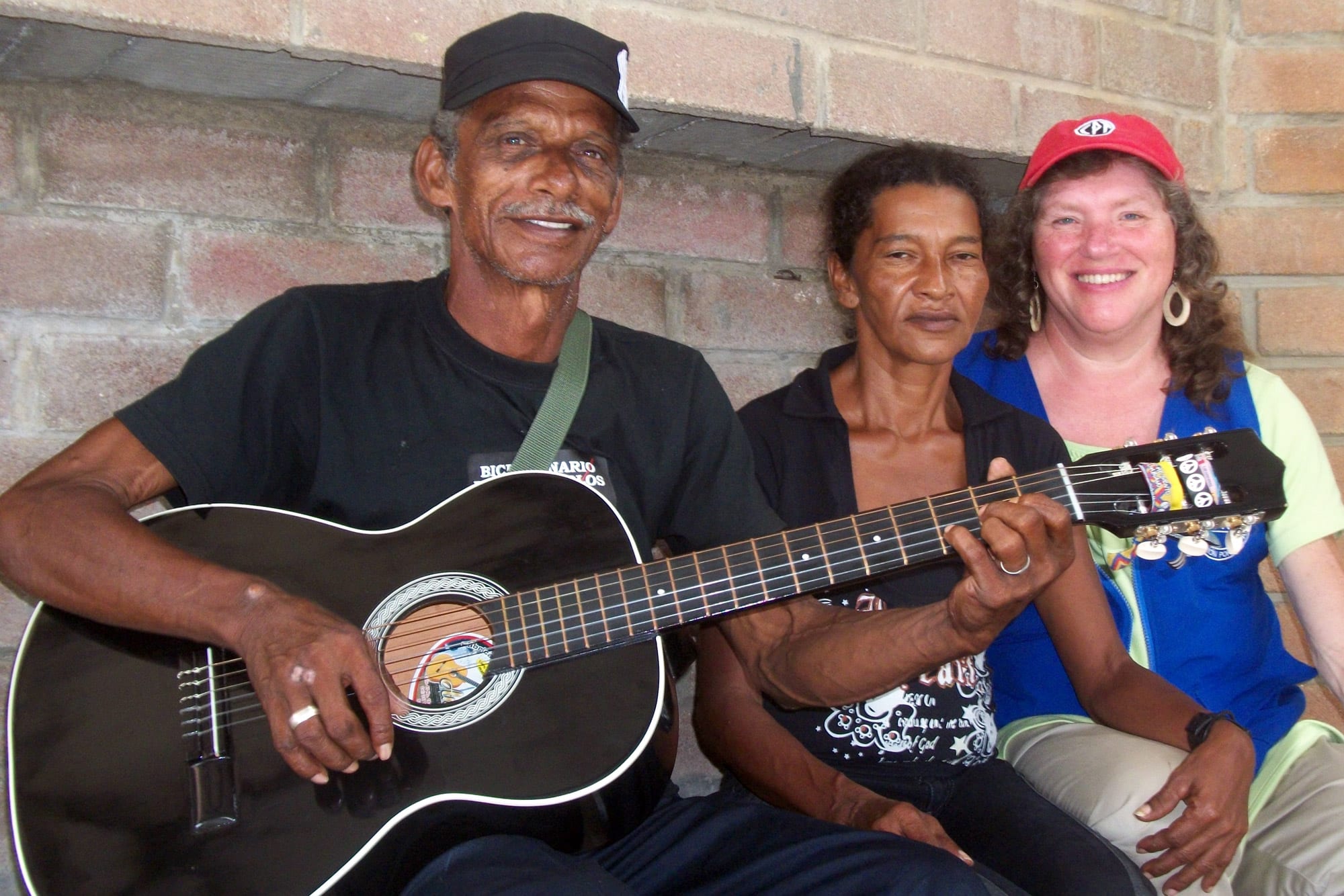
Caldwell: Looking back, what was happening in the world that made the creation of Christian Peacemaker Teams (CPT), as it was then known, necessary?
Kryss: In the early 1980s, the US was deeply involved in Central America. After the Nicaraguan Revolution, the US began quashing armed rebellions in Guatemala and El Salvador with military aid and soldier training. This triggered a wave of migration to our borders that touched people of faith deeply. This era gave birth to activist responses, like the Sanctuary Movement in which churches would shelter refugees, or Witness for Peace which took faith leaders to the Nicaragua-Honduras border to stand in the way of counter-revolutionary forces, or the grassroots Pledge of Resistance where thousands pledged nonviolent civil disobedience if the US invaded Nicaragua.
In 1984, Ron Sider spoke at the Mennonite World Conference, calling on “peace churches” to move beyond theory and become active participants in nonviolent change. Out of this context of faith-based activism CPT was born in the US in 1986, inspired by Sider’s call to form a concrete organizational response.
Caldwell: Kryss, you were in Nicaragua during those early years. What eventually prompted you to join CPT?
Kryss: I returned to Chicago in 1993 and was working two part-time jobs when [founding Director] Gene Stoltzfus asked me to help organize his files. For a month, I worked in the ground-floor CPT office, simply making order out of chaos.
By that summer, CPT was ready to transition from sending short-term delegations to forming a full-time “Peacemaker Corps.” Gene asked me to coordinate the very first training program. In October 1993, we launched that inaugural training with seven people in Chicago. One thing led to another, and what started as a part-time filing gig became a lifelong vocation.
There were other groups, like Peace Brigades International (PBI), doing similar work, but CPT was specifically calling the historic peace churches into active rather than passive peacemaking. We were part of an emerging family of third-party nonviolent intervention – intervening directly in conflict to reduce violence, and doing it from a faith basis.
Caldwell: Mark, how did you first get involved with CPT?
Mark: I came out of college looking for the overlap between faith and justice work. After three years in voluntary service, I saw CPT as the perfect “container” for those principles.
It felt different from the “classic” categories of international work. It wasn’t relief and development work, and it wasn’t missionary work. It was a new vehicle for third-party nonviolent intervention. We weren’t just going to conflict areas to “help”; we were going there to partner with local people already taking risks for justice. We were there to join the struggle for peace and justice.
Kryss: It’s true that we weren’t entirely alone, we already mentioned PBI, but CPT was unique in its specific faith call to the historic peace churches.
Caldwell: Pierre, how did you find your way into CPT?
Pierre: Growing up in a small church in Quebec, I often heard volunteers talk about their work overseas. I wanted to do something similar, to connect my faith with social justice, but it always felt out of reach. Relief and development organizations often required formal education or thousands of dollars to join, which I didn’t have.
In my early twenties, I was what I call a “cafe activist.” I’d sit around with friends drinking coffee and “solving” the world’s problems, but then I’d just go back to my job at the factory. I had an itch to do something real, but I didn’t know how to start.
Everything changed when I received a handwritten letter from my aunt Lena who was already with CPT. She wrote: “If you’re young, energetic, and speak French, come to Haiti with me.”
It was a “now or never” moment. I joined a delegation in May 1996 and realized that CPT was exactly what I was looking for. Unlike other groups, they didn’t require a specific degree; they just wanted someone committed and willing to be present. I thought, “that, I can do.” What started as a three-year trial turned into a thirty-year vocation. CPT became my community.
Why CPT trains
Caldwell: CPT members come from diverse backgrounds with little formal training in “intervention.” Why has rigorous training become such a fundamental pillar of the organization?
Kryss: It stems from the vision that peacemaking requires as much discipline and preparation as war. We aren’t “Lone Rangers” going off to save the world; we work in teams and make decisions by consensus. Training is an initiation into that common culture. It moves us away from the hierarchical, patriarchal systems of the world and gives us a shared language to act together with discipline.
Mark: I call training the “glue.” Our work is broad and specialized – from Colombia to Palestine – and while training can’t prepare you for every specific scenario, it provides the tools for collaborative strategy. Without that shared experience, the organization would become disjointed. It’s the constant thread that holds our community together, even as the specific content of the training evolves over time.
Pierre: We are bombarded by the myth that violence is the only thing that “works” and that nonviolence is just a beautiful theory. Training changes that narrative. It provides a literal “toolbox” of skills and transforms nonviolence from an abstract idea into a practical, powerful set of actions. Training treats peacemaking with the same discipline as military preparation, it transforms nonviolence from an abstract idea into a practical, powerful set of actions.
Caldwell: How does the intensive CPT training actually translate into action once you’re on the ground?
Mark: Training provides a common framework. In the early days, that meant having templates for everything: from how to write a press release to assigning specific roles during a public witness. It ensures that when a team hits the ground, everyone knows how to behave and support one another.
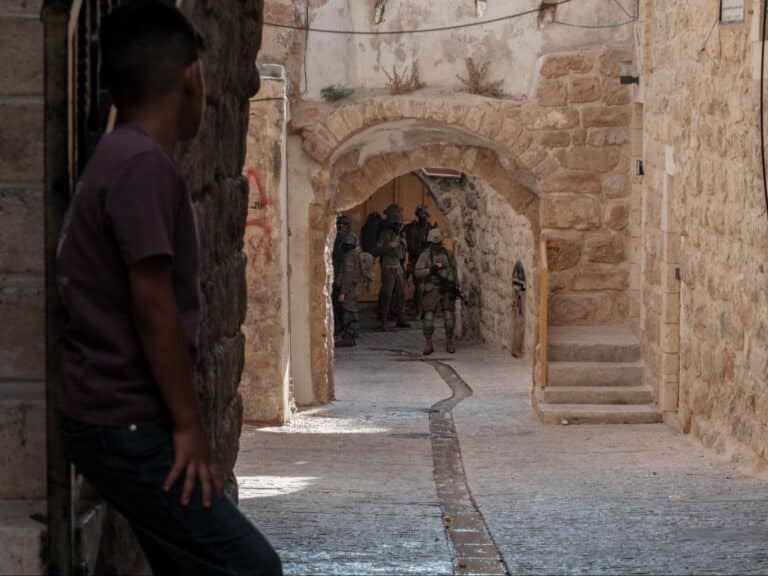
Pierre: For me, it was the “hassle lines”, intensive role-playing where we practiced interacting with mock soldiers or police. Later, when I was actually approaching a soldier in Hebron, I would recall those practice conversations. Having already “lived” the scenario in training gave me the tools to handle the real situation with more confidence.
Kryss: It also nurtures creative thinking. We used to spend days planning an action together, which forced us to work as a collaborative team. That discipline to think “outside the box” has shown up everywhere. Training gave us the toolbox to shine a light on injustice in ways that shifted the narrative.
Mark: It really comes down to trying to “be the change.” We want to see a world where power is shared, so we practice “power-with” instead of “power-over” starting from day one of training.
Turning the tables
Caldwell: How do nonviolence and the reality of power speak to one another in CPT’s work?
Pierre: For me, CPT’s success comes from “turning the tables” on traditional power structures. It reminds me of theologian Walter Wink’s view of nonviolence: it’s not passive; it’s about standing up for yourself in a way that shifts the dynamic completely.
I think of my Aunt Lena in Colombia. We were at a paramilitary checkpoint and had taken some photos. The commander, a man known as “Gordo Jose,” sent a young soldier over to seize Lena’s camera. Lena, a 60-year-old grandmother, tucked the camera into her underwear, looked at the young man with the machine gun, and said, “If you want it, you’re going to have to go in there.” The soldier was scared out of his wits!
We then went to talk to Gordo Jose directly. He was angry because he thought if we published the photos, the guerrillas would identify his men and kill their families. We told him, “We will blur their faces.” Suddenly, he settled down. By addressing his fear, we disarmed him. We still published the report on their abuses, but we broke the traditional “armed-man-has-the-power” dynamic.
CPT embodies the “Third Way” of nonviolence – it’s not only “fight or flight,” but about nonviolent defiance that strips the oppressor of their power.
Pivotal shifts
Caldwell: Looking back, were there specific moments that shifted how CPT operates?
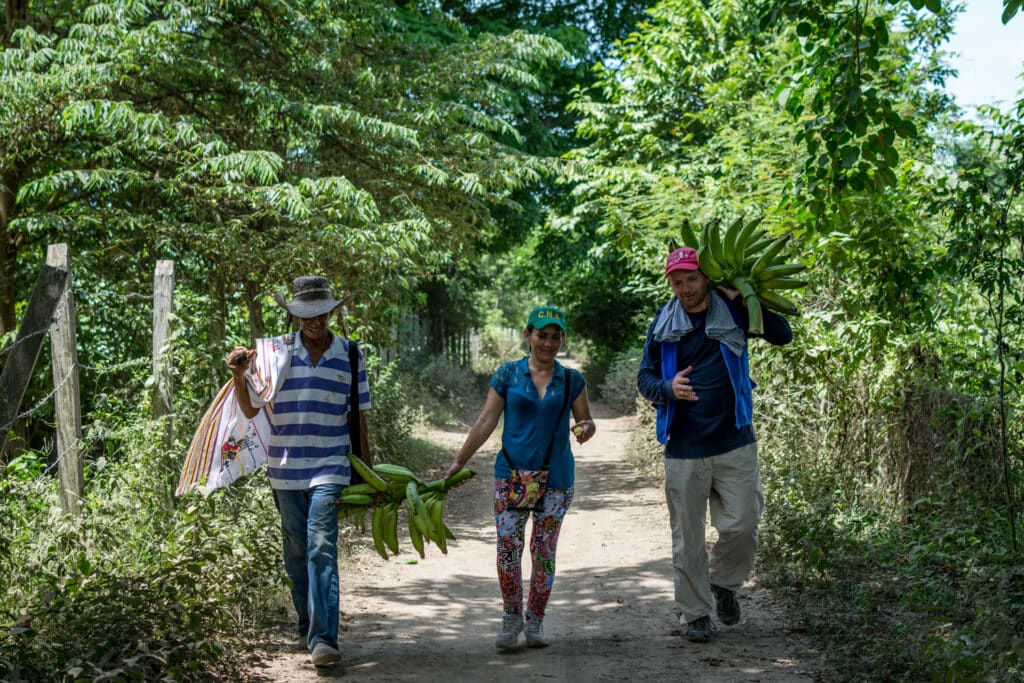
Kryss: A major turning point happened in Colombia around 2001. At the time, our team was almost entirely US and Canadian citizens. The Colombian government kept deporting us, making it impossible to keep a team on the ground. Out of necessity, we started recruiting local volunteers. This led to our first Global South participants joining CPT training and working as full team members.
Mark: It was a lesson in resilience. We weren’t diverse – we were mostly white North Americans – and we couldn’t weather the challenge of deportations. We learned that an organization is only as resilient as it is diverse.
Kryss: The shift from a North American-centric model to a global one has significantly changed CPT’s demographics and resilience. It transformed our mentality. We used to think “passport privilege” was an essential ingredient for peacemaking. That was debunked. It forced us to examine how white supremacist thinking lived in our organization and committed us to the ongoing work of undoing it.
Pierre: I’ll admit, early on, I was skeptical. I wondered how Colombians could provide accompaniment to other Colombians when the traditional theory was that only a foreign passport provided protection.
But our “crazy” or creative nonviolent actions attracted people regardless of their nationality. We learned that the collective protects us, not just a passport. Today, other international organizations are still struggling with whether to allow nationals to serve in their own countries. CPT moved past that years ago.
From Christian to Community
Mark: Kryss, what other moments were pivotal for the organization’s growth?
Kryss: For me, it mirrors a spiritual quest. Just as an individual asks, “What does it mean to follow Jesus?” CPT has always asked, “What does it mean to undo oppression?”
From our very first training, undoing racism was part of the curriculum. Around our 25th anniversary, we made a formal commitment to dive deeper into this. We shifted our mission from “getting in the way” to “building partnerships to transform violence and oppression.” CPT’s journey illustrates a move toward intersectionality – the understanding that different forms of oppression (like racism, colonialism, and religious bias) are linked and must be addressed together. That shift eventually led to our name change in 2022.
Caldwell: That name change is a major milestone. How do you explain the shift from “Christian” to “Community” Peacemaker Teams?
Kryss: It follows the same learning curve as our realization about “passport privilege.” In the field, we found ourselves working side-by-side with Muslim teammates and partners from all backgrounds. Requiring our non-Christian teammates to bear the name “Christian” felt profoundly disrespectful. It wasn’t the world we were trying to create. We changed the name to honor the people we actually work with.
Mark: I’d put it simply: the name change was a recognition of an identity change that had already happened. We didn’t just change who we were; we finally chose a name that matched who we had become.
Captivity in Iraq
Mark: Talking about pivotal events, we’re observing the 20th anniversary of the Iraq kidnapping (2005-2006). It thrust CPT onto an international stage and made the risks of this work very real. It was a 118-day “all hands on deck” crisis. During the crisis we saw a general outpouring of support. But when the survivors were eventually freed, we faced a flood of criticism based on a blatant double standard. Many people (not our supporters) called us “naive,” telling us that nonviolence was a failure because our members were taken and Tom Fox killed.
But soldiers get killed every day, and society’s dominant voices don’t call the military “naive” or say the endeavor is a failure.
For us, the crisis was an affirmation of our mission. Our supporters stayed with us. We were actually flooded with donations and new applications.
Kryss: The emotional toll was devastating, especially when Tom was killed. It brought home exactly what we all knew was a possibility when we signed up.
Pierre: I remember a security expert at a conference arguing that if a peace worker is killed, the whole program should be pulled out because “protection” has failed. I told him the opposite was true for CPT: we had never seen more people apply to join than after the Iraq kidnapping.
Learning the long game
Caldwell: Looking back, what did you misunderstand about this work in the early days? How have you been transformed by the journey?
Mark Frey: I expected constant confrontation with soldiers. In reality, 80% of the work was drinking tea and building relationships. The “tough days at the office” were often spent visiting families and accepting the hospitality of tea and a plate of cut cucumbers. The work is built on those quiet moments of connection.
Pierre: Early on, I saw this as a three-year volunteer stint where I could live on a $200 stipend. But as I stayed, I had to learn how to make this a vocation. I had to learn that it’s okay to rest. When you do this long-term, you can’t burn the candle at both ends. You have to learn to take care of yourself.
Caldwell: People often ask if the work is dangerous. Does that lead to a “savior complex” where you feel you must always be on call?
Mark: It took time to figure out healthy boundaries. I had to realize that while my “passport privilege” allowed me to do things others couldn’t, it didn’t mean I had the power to solve everything.
Pierre: When I was 22, I felt invincible. I’d say: “Wake me up at 2am, I’m ready.” I’m 50 now: don’t wake me up at 2am! We were fed this idea that we were going to end the occupation, but that’s a heavy burden to carry.
Kryss: It’s important to remember that our partners were the ones calling us into those situations. However, our understanding of those partnerships has matured.
Pierre: One person who transformed CPT culture was Milena, one of our first Colombian team members. As foreigners, we used to run every time someone called “emergency.” Milena started asking “is it really a crisis?”
We discovered that often, if we said we couldn’t make it, the partners would say, “okay, we’ll figure it out.” The communities existed long before CPT arrived. Milena helped us realize we aren’t superheroes. If we don’t take care of ourselves, we can’t be effective. We had to learn to distinguish between a true crisis and the everyday pressure of the work.
The engine of peace
Caldwell: What has the journey of funding CPT been like? What makes our model unique?
Kryss: From the beginning, we were intentional about going “grassroots.” We chose to depend on individual donations and congregations rather than big government or foundation grants. We didn’t want our work to disappear just because a specific grant ended.
Mark Frey: That model makes us more resilient. We don’t have one “big pot” of money that can vanish; instead, we have thousands of small ones. However, it is labor-intensive. It takes more work to maintain relationships with 2,000 donors than it does with one large funder.
Our model has also shifted. In the early days, “reservists” (part-time staff) were expected to fundraise for their own involvement. This naturally grew our network. As we moved toward more full-time staffing, that financial burden shifted back to the organization. It’s been a challenge we’ve had to adapt to as our internal identity evolved.
Pierre: When I speak at churches, people often say, “Pierre, you’re so brave, I could never do what you do.” I always tell them, “That’s okay. I can go to Palestine or Colombia, but you can be part of the work by supporting it.”
When you donate, you are part of the team. I love seeing people’s faces change when they realize they aren’t separate from us. Without our donors, we simply couldn’t be on the ground.
Stories of transformation
Caldwell: Can you share a moment where you saw CPT’s work truly make a difference for a partner community?
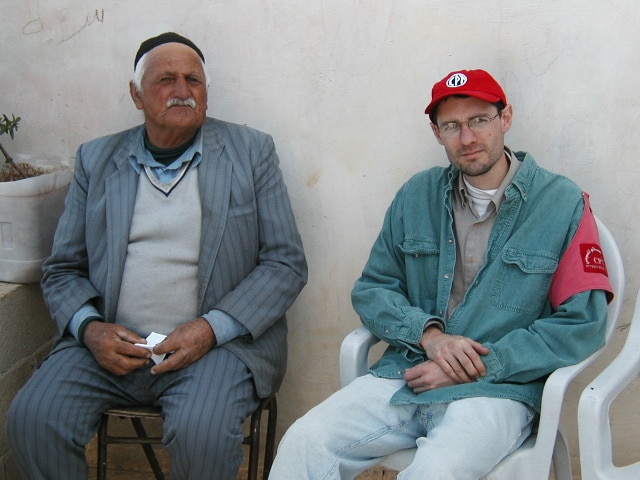
Mark Frey: There are two levels to this. On an individual level, we’ve seen CPT’s presence stop literal bullets. I remember Pierre and Sarah physically jumping between soldiers’ guns and a crowd to prevent firing. But on a systemic level, CPT was an early voice raising awareness about Palestinian home demolitions. We brokered relationships between Palestinians and Israeli peace activists that eventually led to the formation of the Israeli Committee Against House Demolitions. We weren’t just observers; we were catalysts for new networks of resistance.
Pierre: People often think our work is only about confronting armed actors or stopping evictions. But one of my favorite memories is from Colombia. A farmer named Eric needed to get a goat to his farm on the back of a motorcycle. I hopped on and held that goat upside down by its legs while we bumped along the trail.
Afterward, Eric said, “That’s what I appreciate about CPT. It doesn’t matter what we have to do – you are just here with us.” That relationship creates the trust that makes the “big” wins possible, like when that same community finally won a government guarantee that they would never be kicked off their land.
Kryss: It almost sounds like a joke, but “drinking tea” is the real work. In Chiapas, I saw how those small interactions built a sense of empowerment. I remember a moment when soldiers had hung their backpacks on a community’s sacred cross. It was deeply unsettling for our partners. A CPTer simply said, “Well, let’s just take them off.” That tiny act of reclaiming a sacred symbol grew. Eventually, the community was marching onto military parade grounds to plant corn – literally taking their land back. We didn’t do it for them; we did it together.
Mark: Exactly. CPT acts as a third element in the mix, a catalyst. In Chiapas, we walked with the community as it snaked down a hillside in a prayerful procession to a military helicopter pad. They took the white rocks that formed the “H” and reconfigured them into a giant peace sign. The soldiers just had to stand there and watch. The community did it themselves, but they might not have taken that specific risk without CPT in the mix to shift the dynamic.