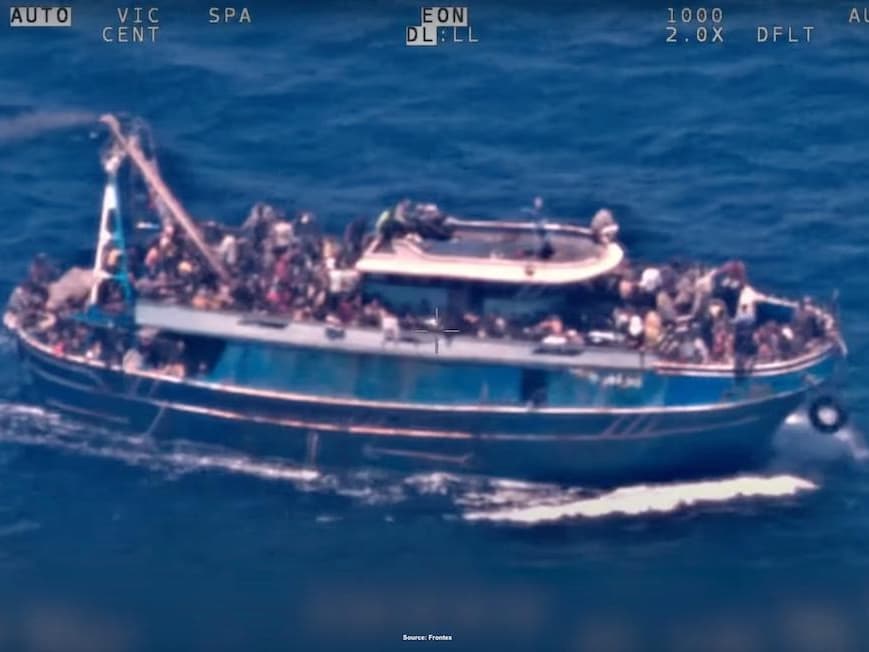
Approximately two years after the state crime off the coast of Pylos, which cost the lives of more than 600 people, 17 members of the Hellenic Coast Guard (HCG), including some high-ranking officers and the then-commandant of the force—who monitored the Adriana’s course for over 15 hours without initiating a rescue operation—have been referred to a formal judicial investigation.
It should be noted that the original case file, compiled by the competent prosecutor, only referred the captain and crew of the PPLS 920 vessel, as well as the members of the Special Missions Unit (KEA) aboard, for prosecution. This sparked strong reactions from lawyers representing survivors and victims of the Pylos shipwreck, as well as from political and humanitarian organizations. Following the completion of an inquiry by the Greek Ombudsman and the submission of their findings to the Naval Court Prosecutor’s Office of Piraeus, the head prosecutor ordered a supplementary investigation into potential criminal liabilities of additional and higher-ranking Coast Guard officers.
Following the completion of this supplementary preliminary examination, the Naval Court Prosecutor brought criminal charges and ordered a full investigation:
For the captain of vessel PPLS 920, charges include:
- Causing a shipwreck that could endanger human life and resulted in the deaths of a large number of people (at least 82 individuals);
- Dangerous interference with maritime traffic, in the form of disrupting maritime communication through actions equally dangerous to the safety of navigation, which could have endangered lives and resulted in the death of at least 82 individuals;
- Failure to render assistance by a ship’s captain.
For the crew of the PPLS 920, criminal charges were brought for simple complicity in the aforementioned acts committed by the captain.
Additionally, criminal charges were filed against the then-commandant of the Coast Guard, the supervisor of the operations center (Joint Rescue Coordination Center – JRCC), two other officers in charge of monitoring, and all aforementioned members of the PPLS crew for exposing others to danger—a legal obligation to rescue those in need—and for leaving them helpless, which resulted in the deaths of at least 82 people.
However, the case file excludes today’s Coast Guard Commandant Tryfon Kontizas and other officers involved in managing the incident. It is noteworthy that Mr. Kontizas, who at the time of the incident served as Director of the HCG’s Security and Policing Division with direct responsibilities in the operation on the day of the shipwreck, was promoted to Commandant of the Coast Guard in March 2025, even while potential criminal liabilities on his part were still under investigation.
Two years after the Pylos shipwreck, the state crimes against migrants—who continue to lose their lives in search of a better life—are increasing. Pushbacks, which are openly defended by the new Minister of Migration, along with detention and stripping of basic human rights for migrants who manage to reach Greece, as well as intensified deportations and “voluntary” returns, are creating a dystopian reality.
The demand for justice for the state crime in Pylos is the least we owe to the memory of the shipwreck’s victims and their loved ones, as well as to those who survived and carry unspeakable trauma. It is also a critical point in the fight to protect migrants and their rights. At a time when European governments are promoting discrimination, racism, and exploitation, we raise our voices to demand a world of justice and solidarity.