
The war between the American, Israeli, and Iranian governments has greatly affected Palestinian lives. Missiles do not distinguish between Israelis and Palestinians. Palestinians live nearby and are targeted at the same rate. Rockets fall even in the West Bank, threatening Palestinian lives. Israel and the United States have so-far killed more than 1,332 people from Iran and 486 from Lebanon, most of them civilians, attacking schools, hospitals, and residential areas.
As CPT Palestine, we have documented these effects in the areas we cover – in the H2 area of Al-Khalil/Hebron, and Masafer Yatta/South Hebron Hills.
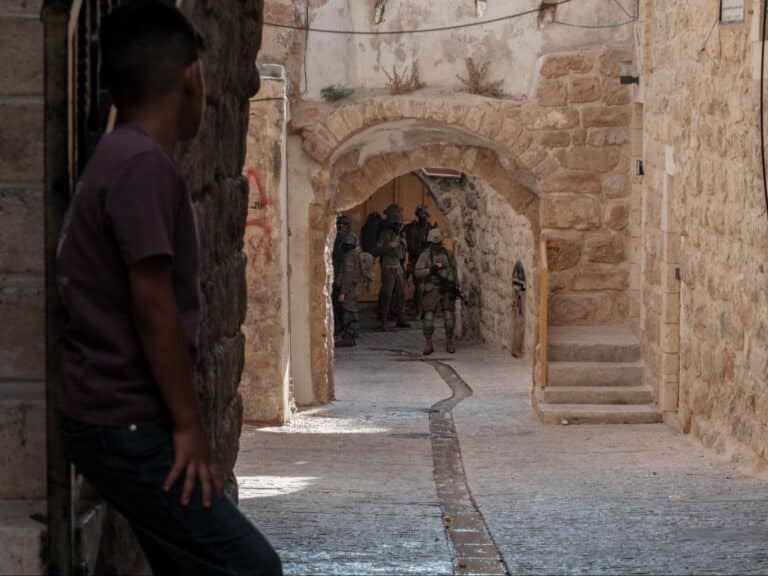
When Ramadan started on 18 February, Muslims were visiting the Old City of Al-Khalil and the Ibrahimi Mosque. This is the busiest month of the year for visitors. Despite all the restrictions, closures, and detentions at the checkpoints, people still came. After the war started on Saturday 28 February, there was almost no movement. We were under an undeclared curfew. The Israeli Occupation Forces immediately closed the Ibrahimi Mosque and prevented people from visiting it. People were scared to go to the Old City because of the high risk of facing Israeli soldiers and settlers.
Shopkeepers were disappointed. This month usually brings more customers, and the economic crisis was already severe. Israeli forces went through the Ibrahimi Mosque checkpoint to search the shops and inspect them for Palestinian symbols.
The mosque has since reopened, but only 50 people are allowed to enter at a time. Men under the age of 25, sometimes even 28, are not allowed to enter without their parents. Everyone must pass through a full check – ID inspections at two checkpoints – so much fewer people are entering than usual.
Israeli Occupation Forces have restricted movement not only in the H2 area but across all West Bank cities. They control checkpoints at city entrances, preventing residents from leaving. Schools, workplaces, and universities have moved online as people stay at home. We do not know when this will end. Our plans could change at any moment. We are always in a state of emergency.
There are also gas and oil shortages, with rising prices. Families from the restricted H2 area report that for the past three years, the area and its checkpoint have been closed from Friday to Sunday. This week they have been closed for a full week. Families are facing harassment, restrictions, and curfews. Many need food supplies, especially during Ramadan, and are waiting for any relief. Their mental state is poor, and they are under great psychological and emotional pressure.
Despite the war and sirens in many areas, settlers continue their daily attacks on residents in Masafer Yatta and the South Hebron Hills. In Umm al-Khair village, settlers have blocked the main entrance road, and anyone who approaches is attacked. Residents called the police but received no response. In Safi village, settlers used an All-Terrain Vehicle to attack Palestinian residents, shooting and injuring one person. Israeli forces did not stop the attackers but instead arrested several young Palestinian men from the village. In al-Jawaya village, settlers chased residents who were grazing their sheep, forcing them and their flocks into the mountains.
For the first time since Israel occupied the West Bank in 1967, Al-Aqsa Mosque has been closed, preventing people from praying Taraweeh, the special night prayer of Ramadan. The mosque, which is usually full during this holy month, now stands empty. Meanwhile, Israel is using this war to cut off food supplies entering Gaza. The entrances have been closed, food could run out within a week, prices are extremely high, and people in Gaza are facing starvation.
Since the start of this war, six Palestinians have been killed by settlers in the West Bank, and the Israeli government continues to expand settlements in the area.