I would like to remind the peace community of a quote from the Gospel of Luke: “Do not judge and you will not be judged”. And I could share this quote from the Koran: “Do not wrong and you will not be wronged.” These quotes demonstrate the similarities between Christianity and Islam. We cannot allow a few fanatics to hijack our faith. We must go to the source for wisdom.
I was born and raised in Najaf, Iraq. I left Iraq in the late 1970s. Saddam Hussein had addressed the nation. “If you are not with me,” he said, “you are against me.” Eventually I moved to Minnesota in 1986. For 18 years, I ran Sinbad’s Cafe and Market, a Middle Eastern bakery, grocer and restaurant on Nicollet Avenue. I lived in Minneapolis for about 18 years, and was widely credited with helping to introduce Arab culture to the Twin Cities area.
After the US invasion, in 2004, I decided to return to Iraq to help rebuild my homeland, the place where I was born. I always worked to build a bridge of peace. A friend of mine reminded me a bridge has two ends and I should maintain them both. I returned to Iraq like a salmon swimming upstream. I didn’t want to die in my birthplace; instead I decided to return to visit my family, my friends, and the community of peace to which I belong. In Iraq I have four sisters, and 40 nieces and nephews, in Najaf.
I got married in Najaf in January 2007. The honeymoon was wonderful. We stayed in a hotel where the Prime Minister at the time happened to be staying too. We actually had warm water and electricity! The vast majority of Iraqis did not enjoy such luxuries. Their lives are marred by unemployment, disease, ruined neighborhoods, frightening checkpoints, and devastating violence. The typical Iraqi anticipates a blind date with a brutal death.
At that time, there was no law enforcement and no security. Every day that the Occupation continued, the situation got worse. Seven million Iraqis had fled the country, two million were displaced within Iraq, and four-and-a-half million were then malnourished.
Setting up Muslim Peacemaker Teams
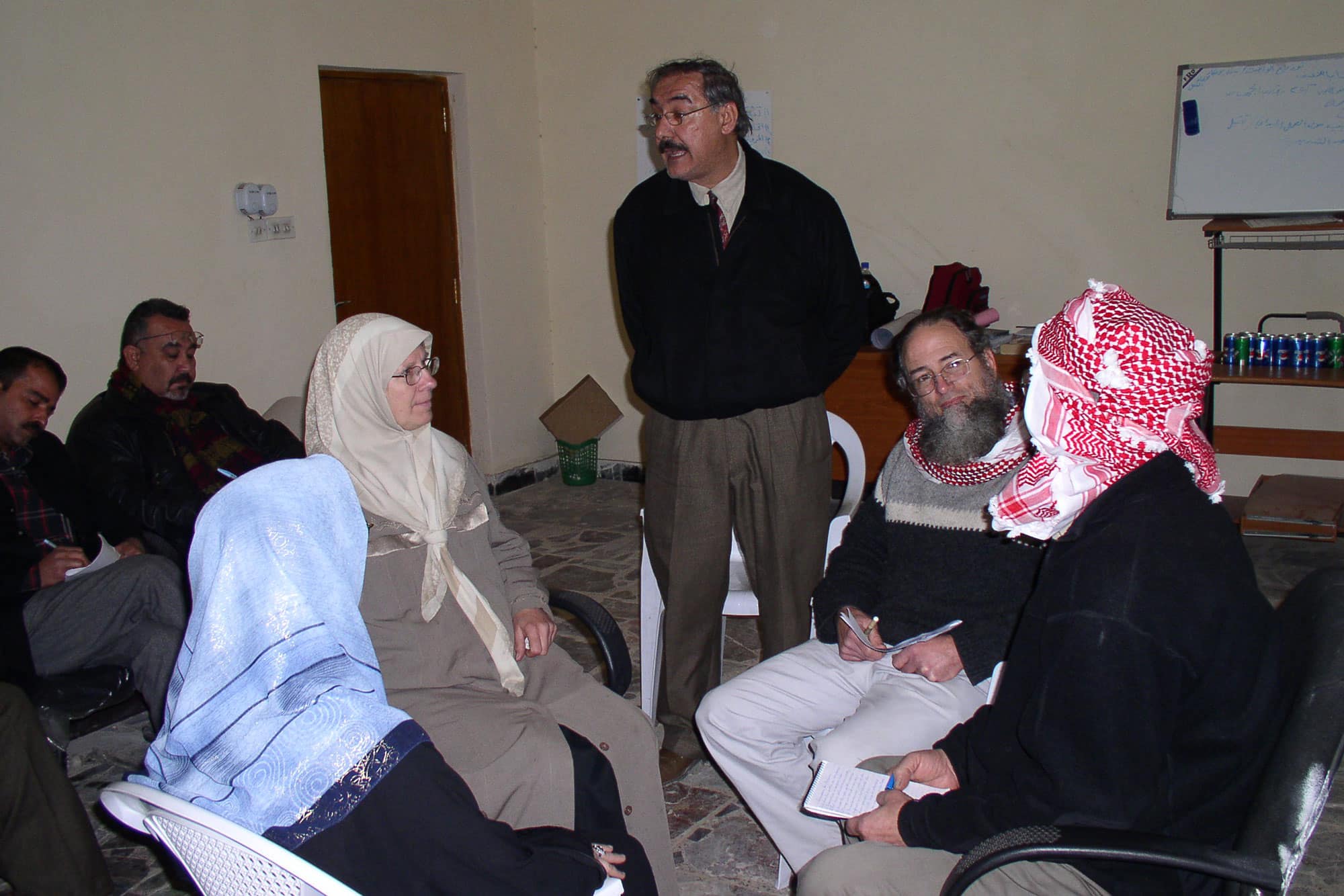
Against the advice of those Minnesotan friends who worried for my safety in Iraq, I spent many of those years working with the Muslim Peacemaker Teams, alongside Christian Peacemaker Teams whom I met by coincidence in Karbala, Iraq. I was introduced to a CPT delegation, made up of beautiful men and women. I was working with the organization Human Rights Watch, and CPT came to visit. Dedicated to the principles of nonviolence, their teams provided humanitarian aid to refugees, documented human rights abuses, and cleaned up war-torn areas.
MPT was born in Iraq in April/May 2005 – from the heart of CPT – in Karbala. Alongside other members of Human Rights Watch, we decided to undertake CPT training in the principles of nonviolence. We aimed to work together on different peace projects.
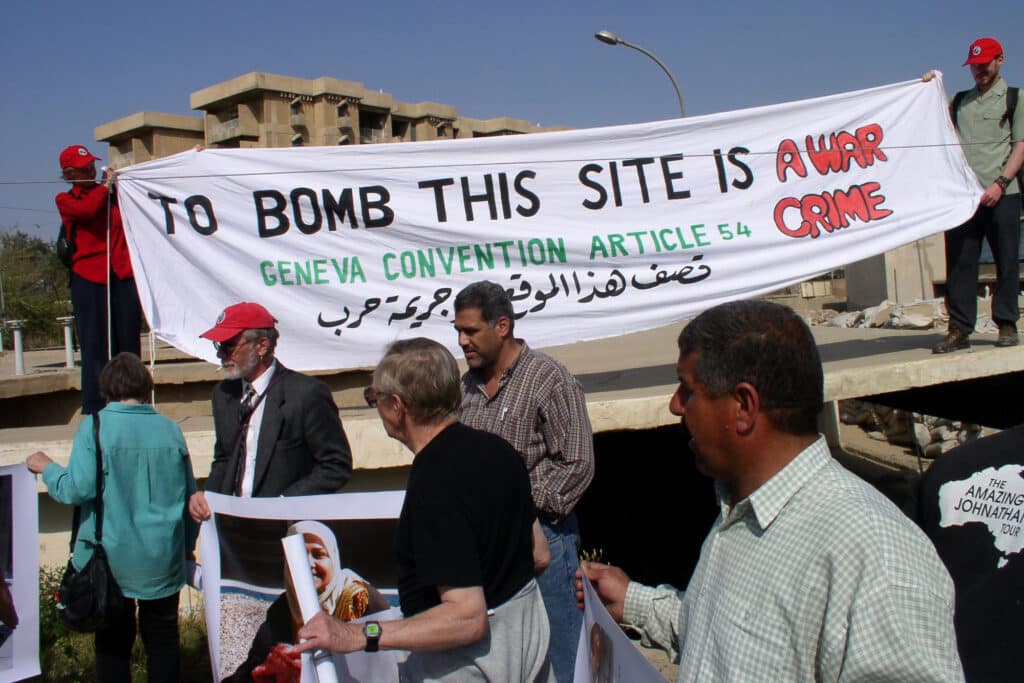
A few weeks later, both CPT and MPT were showing remarkable courage – in Najaf, Karbala, Fallujah, Baghdad, and on the Syrian borders – in the face of the danger and tragedy of the US invasion. Our dear friend, Tom Fox of CPT, was kidnapped in Baghdad and later executed – this was terribly painful. Two months later, a close friend of MPT was shot and killed too. Still, MPT remained dedicated to the peace mission in Iraq.
During my stay in Iraq, I traveled the country, talking to people about their daily experiences. I had a collection of letters written by Iraqi schoolchildren, addressed to Americans. “I would like to offer my friendship and be an ambassador for peace,” wrote Mohammed, aged 9. “The Americans should know that we don’t want to hear tanks and guns outside. We want to hear birds and music.” I wished that some of those letters could be printed in US newspapers to increase cultural understanding between Americans and Iraqis.
I return to the Twin Cities once a year to provide insight about the role of the US military, the resistance, the political and social conditions, as well as the perspectives of ordinary Iraqis. MPT in Iraq is a light in the midst of a violent darkness.
Return to the US
In the US, I’m frequently asked whether I’m Sunni or Shi’a. My answer has always been: My wife is Sunni, I’m Shi’a and my kids are Sushi.
Most Americans assume that Sunni and Shi’a Arabs are embattled in a long-standing feud and that the US military is needed to keep Iraqis from killing each other. I address this misconception, explaining that Sunnis and Shi’as have lived together in peace for centuries.
Rather than calming sectarian conflict, the US Occupation inflamed it by forcing Iraqis to choose whether or not they were on the side of the occupiers. An imposed culture of violence led to more violence. As Iraqis watched their loved ones die, the urge for revenge was often too much to overcome. During the US Occupation, Iraqi lives descended further into poverty and desperation. Some considered violence their only method of survival.
There is still a US military presence in Iraq, with several military bases from which American air fighters are currently bombing the country. Many Americans are concerned about what will happen if and when US troops leave Iraq. Even those who opposed the war still felt that the US had a responsibility to right its wrongs and not “abandon” the people.
I agreed that the US was obligated to pay reparations for what had been destroyed, and it still is. But American troops ought to leave the Middle East, including Iraq, period. They were clearly not on a peacekeeping mission. They had failed. In Iraq, there was no reconstruction. The US-installed Iraqi government was riddled with corruption. Women and children still suffer the most.
Only the Iraqi people, if left alone, could form a sovereign country with a unified government. Peace-loving Americans said no to war. Only they could have ended this war by pressuring Congress to cut off funding. Troops from the Arab League might then be deployed to help with a transition, but the US military could not play a successful, honest role in Iraq – the rapist cannot be the therapist.
It is worth noting that President Trump opposed the invasion of Iraq in March 2003 and criticized George W. Bush harshly in 2015 during his first presidential campaign. Now, his administration is repeating its illegal and hostile attacks, in violation of international law, this time against the Islamic Republic of Iran. What a shameful contradiction!
I have always explained that many Arabs saw the occupation of Iraq and the “War on Terror” as a war on Islam. I maintain that at the heart of Islam is nonviolence, and that the peace of God within allowed me to return to Iraq with courage.
And my message remained:
God is one,
The message is one,
We are all one.