The dirt road leading to Mahmoud Daghameen’s house started to get tighter, bumpier and narrower as he drove me up the hill that eventually led to his house. We approached the outskirts of Samou, only 500 metres away from the illegal settlement of Susya. At first glance, the house does not feel like a home, rather a building that is under constant siege. The windows were sealed off with copper-colored metal plates, with locks over all sides of the house. It was hugged by a metal door with armored steel covering it from the inside. Half of the house was surrounded by sealed iron fences enclosing sheep locked away with iron rods and locks. Nothing was left exposed, and nothing had a homely feeling, rather a square with every nook reflecting a sense that the house itself was prepared for what could come next.
Inside the fortified building, was Mahmoud, his wife Wafaa, and his four boys who called it home. The introductions came slowly, naturally, in the way a guest is welcomed into a home. The children zoomed in and out of the main living room in the house, curious, and mostly shy.
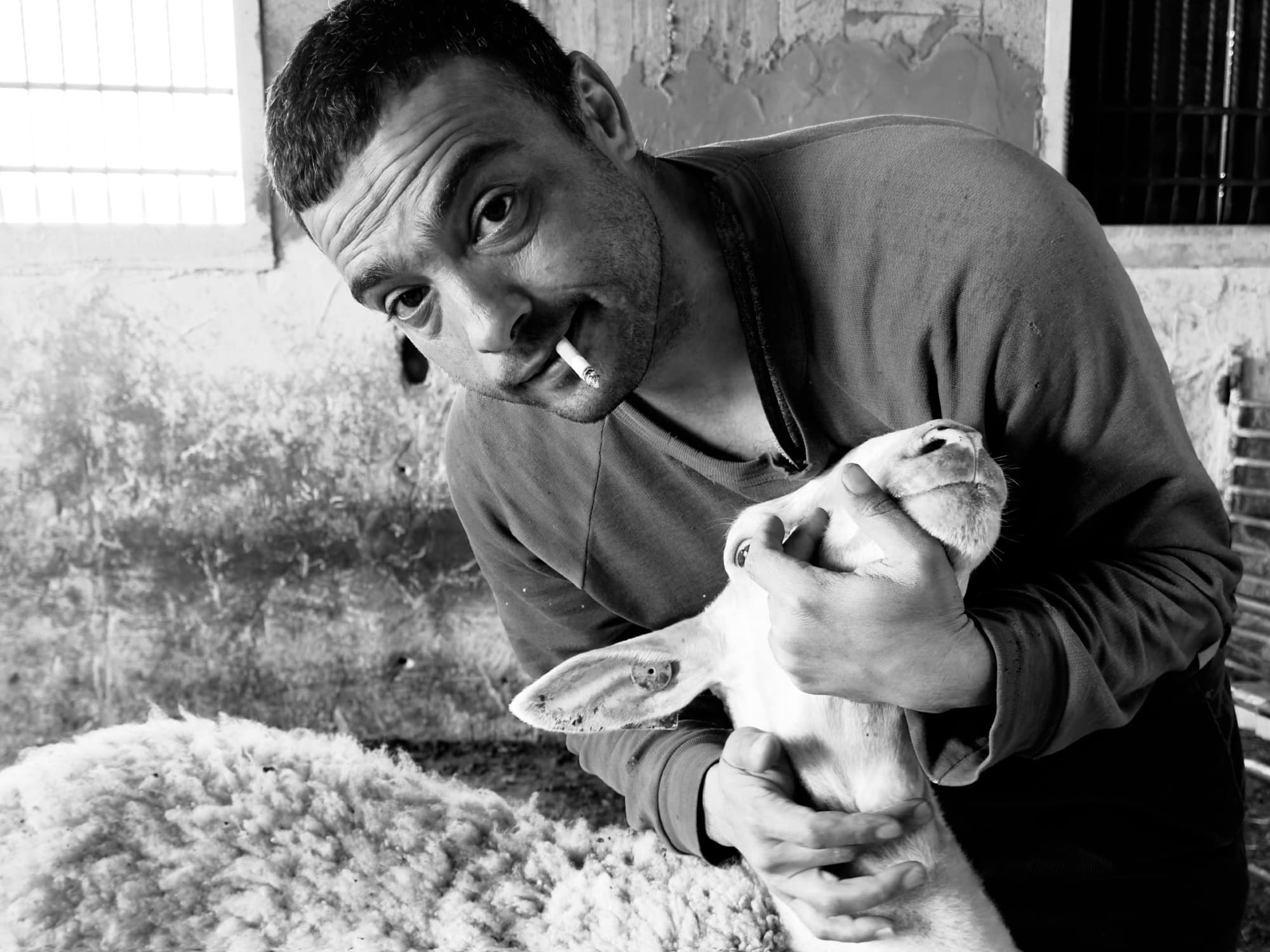
Mahmoud’s connection to the land and livestock runs deep in his blood. The sheep aren’t just livestock. They are evidence of his livelihood, routine, and sense of identity. As I sat listening to Mahmoud speaking about his life in an area like this, he described his life as a shepherd before the war on Gaza in late 2023. He described a different rhythm of life – one in which he had the “freedom” to take his flock and graze them in the surrounding hills, where his movement was defined by constant fear. Now, that freedom has become as narrow as the hairs-breadth gap between each bar of steel surrounding his house. His grazing routes have changed, distances have shortened and made effective grazing impossible, and every step requires caution.
Wafaa’s presence is subtle and quiet, yet it is a reason for the family’s active presence. Her name translates to “loyalty”, a meaning that I saw deeply reflected in her way of life. Her world revolves around maintaining the household, caring for the children, and attending to the 17 chickens’ needs. Her work is often unseen, conducted behind the scenes of a restless all-year-round challenge to attend to the family’s needs.
The children navigate their lives in separate ways. Two of them, Mohammed and Ahmed, attend school three days a week, due to the restrictions on educational systems in the West Bank. Whenever they make their way to school, they step into an unpredictable environment, far from a home that doesn’t feel like a home at all. Sadam and Omri are the toddlers that stay at home, with their own childhood routines that continue under the weight of the conditions surrounding them.
These threatening conditions are tied to specific moments of horror that have had an everlasting impact on Mahmoud and his family. He recalls two major settler attacks, one on 1 November, and another more recently in December. Each incident carries its own misery, but it is the December attack that feels heaviest to them. Eight settlers surrounded the house from all sides and attacked the windows, which had not yet been reinforced. They broke the glass and threw gas bombs inside the house. During the attack, 6-month-old Omri was suffocated and then hospitalized. Mahmoud’s sheep farm was raided, which resulted in the killing of three sheep, and a life threatening injury to a fourth one. The incident nearly cost a child’s life, and while Mahmoud recalled the story, I could see the tension in everyone’s eyes, as if they were reliving it once more.
These settler attacks reinforce Israeli occupation control over Palestinian territory. Settlers terrorise families to the point that some flee in search of safety. They are the executioners of Israel’s ethnic cleansing campaign against Palestinians and the annexation of the West Bank. All Jewish settlements – including the one next to Mahmoud’s home – are illegal under international law. In July 2024, The International Court of Justice (ICJ) ruled that Israel’s occupation violates the Fourth Geneva Convention. Furthermore, it called for the dismantlement of settlements, cessation of expansion, and an end to the unlawful occupation. Yet, this bugle has been sounded for years without effecting any real change.
And yet, life here in Daghameen’s household continues, resilient and persistent. Mahmoud continues to tend to his sheep, with Wafaa behind the scenes keeping the family together. The children attend their schools and are climbing up their educational ladders. These lives, while ordinary on the outside, also carry the meaning of endurance, of what it takes for them to be so deeply committed to their lands.
As my visit came to an end, and as we drove further away, the image of the house stayed in the back of my mind. There’s a certain sadness to the building, not only as a structure, but to the heaviness it holds inside. Its metal-covered windows and armored door don’t just shut out the reality on their doorstep, but also seem to trap the weight inside. Still, it’s the people inside who define it, with the stories they share, and the love they reflect. Wafaa and her children stood outside waving goodbye and hurried back inside, knowing what surrounded them, never fully at ease, never fully at rest.