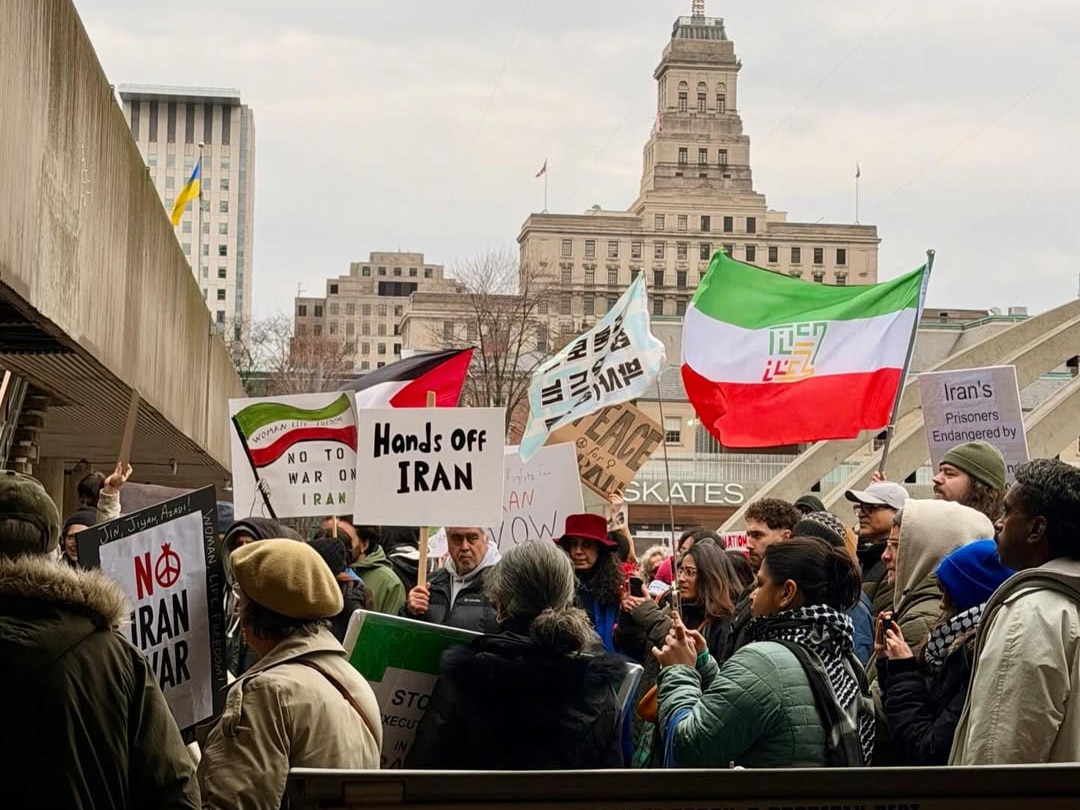
On 28 February 2026, Israel and the USA launched an illegal war against Iran. Their stated pretext was the Iranian government’s brutal suppression of a nationwide uprising the previous month, in which vast numbers of Iranians took to the streets calling for the government to fall. Security forces cracked down ruthlessly, killing thousands.
Israel and the USA claimed this was a war of liberation for the Iranian people, although they targeted civilian infrastructure. Reza Pahlavi, the exiled son of Iran’s former Shah – ousted in the 1979 Iranian Revolution – was presented as a possible figurehead for regime change.
Over the last few years, a faction of Iranian monarchists in exile have more vocally allied with supporters of Israel and the United States, bolstering the case for war. The pre-Islamic Republic flag, which bears the symbol of a lion and sun, can be seen on pro-war marches, far-right demonstrations, and rallies in support of Israel across the West, alongside flags bearing the emblem of SAVAK, the Shah’s secret police force that became synonymous with the torture of political dissidents.
The case for war rested upon a contested question: what do Iranians actually want? To explore that question, last month CPT interviewed a collective of anti-war activists in Toronto’s Iranian diaspora. Since we carried out our interview, after over three months of war, a fragile peace deal is on the table.
Community Peacemaker Teams: The Iranian Collective for Peace and Justice takes a clear stance against both US and Israeli imperialism and the actions of the Islamic Republic of Iran. Could you tell us how the collective came together? What makes this a particularly urgent moment to organize, especially while holding both of these positions at once?
Iranian Collective for Peace and Justice: Our collective was established on 5 March 2026 by a group of Iranian activists in Canada involved in women’s, labor, student, academic, queer, leftist, and social justice movements. The collective came together in the urgent days following the start of US and Israeli strikes on Iran on 28 February 2026, driven by a consensus that firm opposition to this devastating war was essential while also refusing to excuse or legitimize the Islamic Republic’s repression. Even before the war, many of us were already seeking ways to move beyond the manufactured binary of the Pahlavi monarchy versus the Islamic Republic. For us, the question has never been which form of authoritarianism should replace the other. The question is how to imagine a future rooted in freedom, equality, dignity, justice, and self-determination.
This also means rejecting a Persian-centric or homogeneous concept of “Iranian” identity. Any serious conversation about Iran must center the voices, histories, and political demands of its diverse nations and communities, including Kurds, Lurs, Baloch, Arabs, Azaris/Turks, Turkmen, Gilaks, Mazandaranis, and others whose experiences have historically been marginalized or erased.
Our position is anti-war, anti-authoritarian, anti-fascist, and justice-centered, rooted in feminist and socialist values and ideals. We oppose both imperialist intervention and internal oppression, firmly believing that the future must be shaped by people’s own grassroots struggles and movements, not by states, ruling classes, monarchist forces, or foreign powers seeking to appropriate those struggles.
We felt that forming this collective, alongside other left-leaning groups and coalitions in the diaspora, was necessary to counter the rhetoric of monarchists and other pro-war forces aggressively lobbying for foreign military intervention. These reactionary groups operated under the false claim that a US/Israeli-led war would quickly topple the Islamic Republic and facilitate the return of their leader, Reza Pahlavi. In our view, such an illegal and destructive military campaign would not bring liberation but would instead be catastrophic for the people in Iran and their grassroots struggles for freedom, equality, and justice.
Our politics are rooted in the struggles of women, queer communities, workers, students, oppressed nations, and all those who have resisted both state violence and social exclusion. We understand liberation as the transformation of the structures that produce and perpetuate inequality, domination, exploitation, patriarchy, militarism, national oppression, and authoritarian rule.
The collective emphasizes the complete independence of social movements from all states and from the political agendas of the ruling classes, maintaining a foundation that rejects imperialism, authoritarianism, monarchism, fascism, capitalism, patriarchy, and all forms of domination. Consequently, we hold a strict approach that any justification or support for the actions of the United States, Israel, or the Islamic Republic is entirely unacceptable, and our commitment is to the liberation of the people from both domestic despotism and global imperialism.
Opposing the Islamic Republic does not mean supporting war, militarization, sanctions that harm ordinary people, or foreign intervention. The future of Iran must be shaped by the people themselves.
CPT: In recent years, parts of the Iranian diaspora have become more visible. Some groups, particularly within Monarchist circles, have aligned themselves with far-right movements or expressed support for Israel, in opposition to the Palestinian freedom struggle. Why do you think these currents have gained traction now? What challenges do they pose for anti-fascist Iranians committed to international solidarity?
ICPJ: This is a very important question. Monarchists have always had supporters, but historically they did not have a substantial base inside Iran. Since the 1979 revolution, they had never been able to attract the support of the Iranian diaspora to the extent we have seen more recently. We all know how important the role of the media is in shaping public opinion. After the January nationwide uprising in Iran, which began with strikes and protests in Tehran’s bazaar and was sparked by protests against the further collapse of the value of the Iranian currency – the Rial – the Islamic Republic quickly imposed a total internet shutdown across the country. As a result, people’s access to information outside of state media became severely limited.
For years, much of the population has boycotted the regime’s state broadcaster because of its role as a propaganda apparatus. During the internet shutdown, many people were left with access mainly to Persian-language satellite channels. The monarchist current, which has significant financial resources and external support, benefited from this media environment. Major Persian-language media outlets abroad, including Iran International and Manoto, and even BBC Persian, were fully at its disposal for the production and dissemination of propaganda. They played an important role in producing and circulating narratives favorable to the Pahlavi current.
In the absence of internet access, Iran International’s satellite broadcast operated around the clock to promote propaganda in favor of the Pahlavi current and to amplify the idea that the protests inside Iran were happening in response to Reza Pahlavi’s calls. This created the misleading impression that monarchists had a much larger base inside Iran than they actually did.
Interestingly, a few independent media researchers recently published a study showing the extent to which Pahlavism was magnified in two of the four major Persian-language satellite outlets abroad during their coverage of the January protests in favor of monarchists (showing Iran International’s relative magnification of 376% and BBC Persian’s relative magnification of approximately 105%). In short, two factors – first the complete nationwide internet shutdown by the Islamic Republic, and secondly the exaggerated and misleading coverage by widely-watched Persian-language satellite media – allowed the monarchist current to take control of the narrative.
Beyond this, the substantial financial resources available to this current have also helped strengthen their capacity to organize abroad. Independent opposition groups outside the country do not have access to anything comparable.
As for the challenges this far-right and monarchist current creates for progressive and anti-fascist Iranian movements, the most significant issues in recent months have been related to threats, aggression, intimidation, acts of violence, defamation, and organized smear campaigns against any independent voice that does not subscribe to the monarchist script.
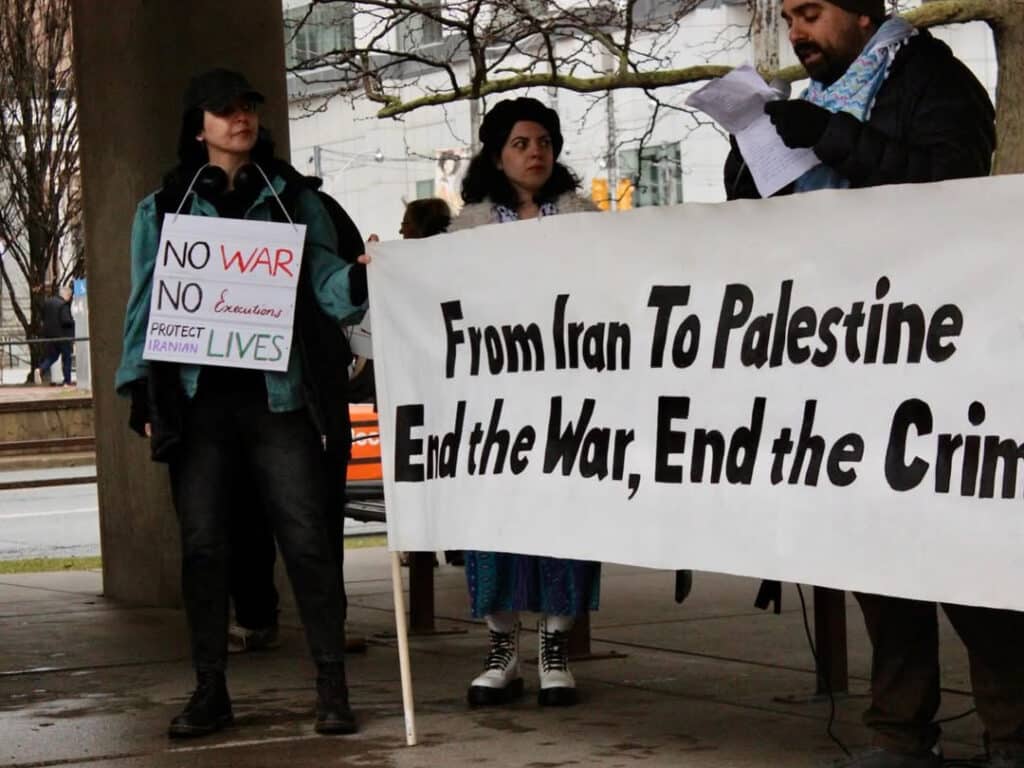
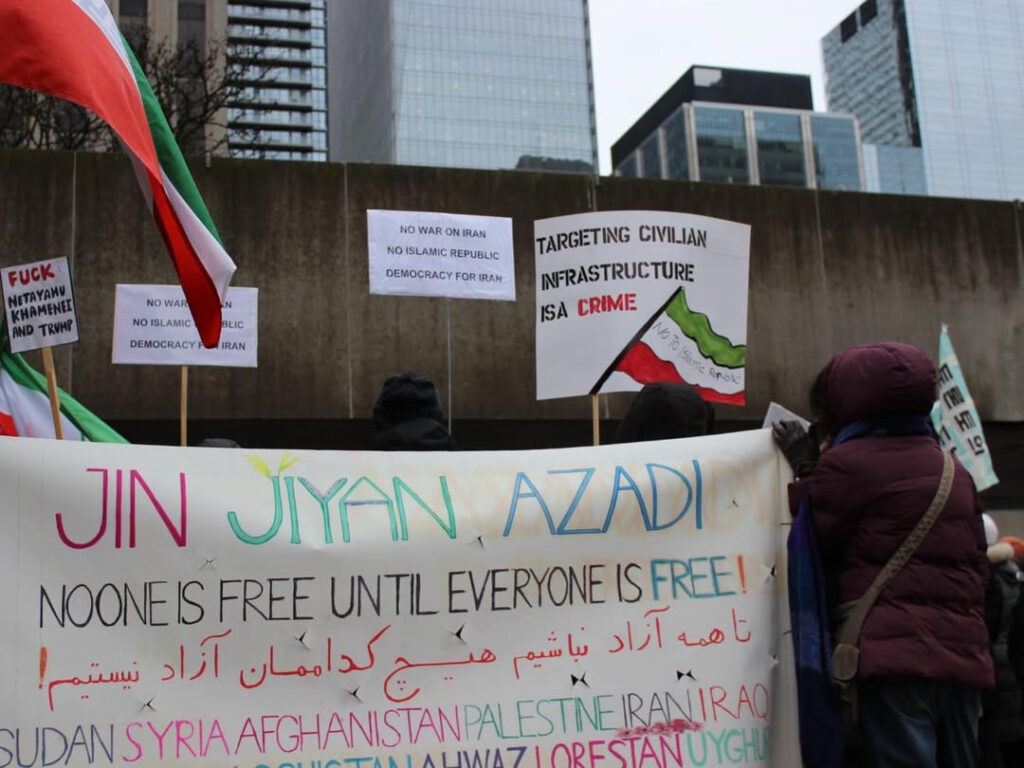
Our own anti-war protest on April 12 – held against war, imperialism, and the Islamic Republic – was targeted by such a campaign. Due to its length, we’ll skip the details here, but more information can be found in our statement condemning this organized intimidation and smear campaign.
CPT: In the early days of the US-Israel war on Iran, loud voices in the diaspora presented the case for war as the last hope for a desperate people. This drowned out a clear, anti-war position. Has the ICPJ faced criticism or backlash for opposing the war? And have you seen any shifts in these pro-war positions as the human cost has become more visible?
ICPJ: As mentioned earlier, yes, we were targeted by such a campaign precisely because of our anti-war position. Those attacking us relied on the false binary of “either the Islamic Republic or war” in order to discredit and intimidate us and any independent anti-war voice. On the day of our protest, a group of counter-protesters appeared carrying Israeli flags, lion-and-sun flags, and images of Reza Pahlavi, Trump, Netanyahu, and even the SAVAK flag (the repressive apparatus of the former Pahlavi monarchy). Using loudspeakers, they insulted, harassed, and threatened participants of our anti-war and anti–Islamic Republic rally and tried to disrupt our peaceful protest.
At the same time as this gathering in Toronto, Collective members in Ottawa organized a similar rally there.
While our Collective in Ottawa was preparing for the demonstration, on Thursday 9 April, two individuals who identified themselves as being from Public Safety Canada [a federal government department] went to the homes of Collective members and asked about the reasons and motivations behind the rally. They stated that concerns had been raised regarding interference in the organization of the demonstration and that these matters were under review. The Collective members explicitly rejected these allegations and are pursuing the matter through their lawyers.
The Pahlavi supporters’ attempts to erase any independent position among Iranian political activists was both desperate and revealing. At our rally, alongside slogans against the US-Israeli aggression on Iran, Lebanon, and Palestine, we also chanted slogans against the Islamic Republic and against executions in Iran. Yet on that same day, through loudspeakers, we were attacked by these Pahlavists. Later, they shared photos and personal information of several people who had participated in our action on an account on X, labeling them with fabricated terms such as “Mujahedin” and “jihadist” in an attempt to defame and intimidate us – though these efforts were ultimately unsuccessful. Aside from these monarchist groups, our collective has not, so far, been directly targeted by others because of our anti-war position.
Regarding the shift in opinions from pro-war to anti-war positions, we have observed such a shift to some extent, though mostly indirectly. For example, on major satellite channels like BBC Persian, compared to a few months ago, there is now greater inclusion of voices opposing war, and even the language used by hosts and reporters has changed. Additionally, some individuals who previously openly supported war are now either silent or attempting to justify their earlier positions. We believe a similar shift has also occurred within Iran, but due to the lack of internet access, it has become harder than ever to gauge public opinion.
CPT: With months of internet restrictions inside Iran, many voices, particularly from within the country, are harder to hear. Meanwhile, international media often amplifies a narrower range of perspectives. Can you share what you are hearing from within Iran, especially from workers, women, students, queer communities, and different national or ethnic groups? How are these groups putting forward anti-war positions alongside their ongoing fight against state repression?
Despite over 80 days (at the time of the interview) of almost total internet shutdowns imposed by the Islamic Republic, the message from social justice activists within Iran is clear: war has become both a direct source of destruction and a pretext for intensifying state repression. Workers now face a choice between unemployment and extreme exploitation, with wages collapsing to just a few dollars a day amid soaring inflation and sharp currency devaluation. For working-class women and queer people, this crisis has deepened systemic discrimination and economic dependency. This burden is even more acute for the systemically marginalized and oppressed peoples of Iran – including Kurds, Balochs, Arabs, Lurs, Turks, and Afghan migrants – who face layered and structural discrimination and the securitization of their basic livelihood demands.
The Islamic Republic has further weakened and fragmented movements through “class-based internet” access, ensuring capitalists and other economic and political elites remain connected while working class and marginalized communities are silenced.
Independent activists within Iran, who long warned that war would be catastrophic, devastate grassroots movements, and embolden the Islamic Republic’s repressive policies, are now seeing those warnings prove tragically accurate. These groups are under more pressure and surveillance than at any time since the Iran-Iraq war of the 1980s. We have been witnessing a sharp decline in visible organizing and public statements from workers’ organizations, student groups, and other equity and justice-seeking groups inside Iran. Consequently, while they continue to hold a firm anti-war position, they simultaneously reject the regime that oppresses them.
They denounce escalating persecution and executions while also rejecting militarism and the rise of far-right and fascist movements, including a return to monarchy, calling instead for internationalist solidarity against capitalism, imperialism, patriarchy, and domestic despotism.
This anti-war stance does not necessarily reflect the views of the entire population; many people in Iran, especially within the middle and upper middle classes, were influenced by the Pahlavists and their massive propaganda campaigns to convince people that imperialist intervention was the only way to topple the Islamic Republic. This pro-war and dangerous movement significantly sabotaged the January uprising in Iran and, as mentioned earlier, continues to violently attack social activists and civil rights defenders, both inside Iran and abroad, if they oppose war. The devastating impact of this war proved to most people that Trump and Netanyahu are not friends of the people of Iran or the region, and that both are war criminals. It proved that the road to liberation is only through people’s grassroots movements and self-determination, and not through imperialist forces and geopolitical conflicts.
CPT: After January’s violent suppression of protests in Iran, some in the anti-war movement continue to judge Iran primarily in terms of its geopolitical role, especially in relation to the genocide in Gaza. Has your collective encountered hesitation or tension from potential allies when it comes to supporting freedom movements within Iran? How do you navigate those conversations? How does this pose a challenge for building an anti-war alliance?
ICPJ: Our collective has not specifically faced the issue mentioned in your question, since for our 12 April anti-war and anti-Islamic Republic action, we received endorsements from a number of leftist groups in Canada, most of which were non-Iranian.
After the government’s massacre of protesters in January, many leftist, feminist, and labour organizations around the world condemned the killing of innocent people in Iran and expressed solidarity with the people of Iran. However, many others in leftist and progressive circles in the West either remained silent or aligned themselves with the regime’s narrative regarding that brutal crackdown. This was a deeply painful realization for many of us in the collective.
Those leftists who believe that an anti-imperialist stance requires defending the Islamic Republic have fundamentally misunderstood the issue. The foundation of leftist politics has always been the pursuit of equality and justice and opposition to oppressions and exploitations. Those who identify as leftists but fail to stand with the working class and the oppressed people in Iran against the repressive, misogynistic, capitalist and neoliberal policies and actions of the Islamic Republic seem to have forgotten these fundamental values. They seem to have trapped themselves in the false binary of either standing by the Islamic Republic or US imperialism.
Moreover, the Islamic Republic has long pursued its own ambitions and objectives as a regional power. Over its 47-year history, the regime has consistently expanded its influence across the region, approaching local and regional struggles not out of genuine solidarity, but as leverage to advance its own state interests and ideological, power-based ambitions.
The Iranian labour, feminist, and other social justice movements have consistently and strongly supported the Palestinian liberation movement and condemned the Israeli apartheid regime of genocide and ethnic cleansing, which has been carried out with the full support of the US and its allies.
However, we emphasize that the true and everlasting emancipation of the Palestinian people is not a genuine goal for the Islamic regime. Rather, it is merely a political tool. Regardless of the current disagreements stemming from the geopolitical situation, we believe that, ultimately, the peoples of Iran, Palestine, Lebanon, Syria, and the rest of the region share a deep, mutual interest in overcoming imperialist interventions and systemic oppression. True solidarity lies in all of us, as peoples, standing together to fight for our right to self-determination, completely free from all imperialist and regional state interventions.
CPT: Both the US and Israel have claimed to have materially supported protest movements inside Iran. How should we understand these claims, recognizing both the reality of foreign intervention and the long history of resistance to state repression within Iran?
ICPJ: We should treat these claims with deep skepticism. Trump and Netanyahu have repeatedly lied in pursuit of their own political interests. We have seen this clearly in Gaza. They will stop at nothing – not even genocide – in pursuit of their interests. We saw what they did in Gaza and the lies they told about it. While it is true that Israel has spies and agents within Iran at the top levels of security and the regime itself, during the January protests, the role of the US and Israel amounted to handing over Iranian protesters to be slaughtered, due to the lies spread by Trump, Netanyahu, and Reza Pahlavi. Netanyahu claimed that Mossad forces were present on Iranian streets alongside protesters, and Trump, on his social media, encouraged people to take to the streets, claiming that “help was on the way”. We saw what that “help” turned out to be: bombs falling from the sky on innocent people, destroying schools, hospitals, and essential infrastructure.
These lies not only failed to help but gave the regime further justification to intensify repression and to kill protesters – both in the streets and now in prisons. Since the start of the war, executions in Iran have increased dramatically, often carried out behind closed doors without due process, based on largely false accusations such as spying for Israel or the US. This shows how the war has provided the Islamic Republic with an opportunity to settle scores with the dissenting population.
The reality is that the January protests began organically in response to the collapse of the Rial and quickly spread within days. They had nothing to do with calls from Reza Pahlavi, Netanyahu, or Trump. If you’ve followed social movements in Iran in the past couple of decades, you would know that after the “Woman, Life, Freedom” uprising, the overthrow of the regime became one of the key slogans of the protesters who repeatedly took to the streets despite the great risk to their lives and well-being. The Islamic Republic suppressed that movement through violence, but everyone in Iran – including the regime – knew it was temporary. Society was like a tinderbox, ready to ignite at any spark.
Even before January 2026, this could be seen in ongoing protests and strikes across the country on a daily basis. The protesters represented a wide array of civil society, such as retirees, teachers, nurses, students, and workers from diverse nations and communities who have often been marginalized. Hardly a day passed without some sort of protest in Iran. The US and Israeli interventions only harmed the people’s movements from the outset, and the subsequent military attack pushed these movements into the margins. One cannot expect people to take to the streets or organize themselves while bombs are falling on their heads.
We pose a question to those who amplified the false claims of Netanyahu: which one is a more rational explanation? That people in Iran were so fed up and angry that they came to the streets to protest their tyrants, or that Israel had tens of thousands of spies in a country as vast as Iran to take to the streets in January?
CPT: For readers in Europe and North America who want to support anti-war efforts and struggles for justice in Iran, what forms of action or solidarity do you see as most meaningful?
ICPJ: We want to take the opportunity to thank those who take this stance – even before offering active support – simply for standing on the right side of history. Many people buy into the fabricated binary of “either the Islamic Republic or war,” which is a mistake. We must rigorously amplify the voices that are against war, militarism, imperialist interventions, and repressive regimes in the region, including the Islamic Republic. Only by doing so can we break this false dichotomy. Anyone with a platform – whether in media, social media, or even in personal conversations with friends and family – can help amplify this message. In addition, independent collectives and activist groups similar to ours across Europe and North America have begun organizing and mobilizing protests, like the ones we held on 12 April in Toronto and Ottawa.
We call on leftists, progressives, feminists, labour organizers, anti-racist groups, queer communities, anti-war movements, and all justice-seeking people around the world to support these actions: not only to strongly condemn the United States’ and Israel’s war against Iran, but also to stand in solidarity with the people of Iran and their struggles against the Islamic Republic’s oppression and for freedom, equality, justice, and self-determination, free from foreign intervention.
Meaningful solidarity means refusing selective outrage. It means standing with people’s movements, not states. It means supporting workers, women, students, queer communities, oppressed nations, and all those fighting for freedom and justice inside Iran, while also opposing imperialist war and foreign intervention.
Our message is simple: liberation will not come from bombs, monarchists, or imperial powers. It will come from the people themselves.
Follow the Iranian Collective for Peace and Justice – Canada on Instagram or on Telegram.