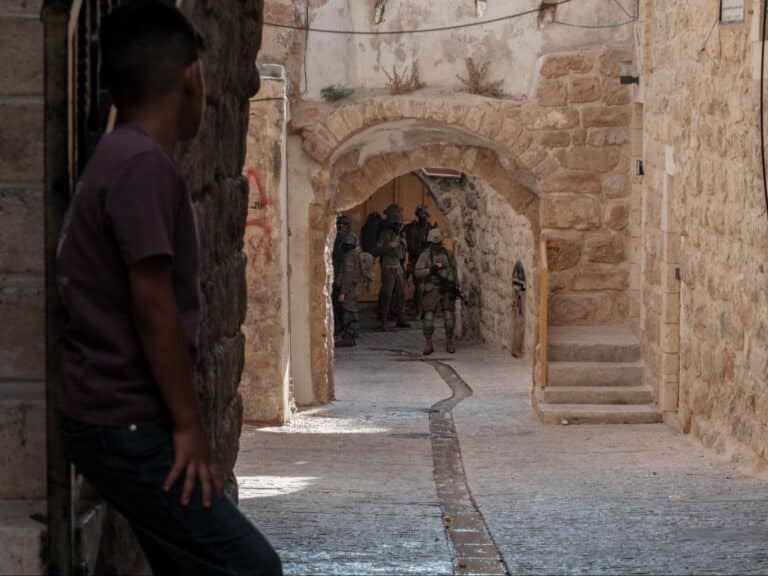
One of the greatest contradictions of our time is that, even though we are among the healthiest and longest-living people in history, we are becoming increasingly fearful. The constant fear of an external threat moulds a defensive society, which in turn manifests as intolerance to other cultures, political structures, and people. According to this racialized approach, migrants are not always necessarily portrayed as being racially inferior – this often depends on other factors, such as financial status, as well – yet their cultures and values are often represented as “alien” and a threat to Western (or Greek) core values.
The figure of the “other” constantly shifts between two extremes: the voiceless victim and the evil-doer. Instead of approaching migrants inclusively, we end up using outdated “us versus them” analogies. By relying on these analogies, we cannot see the “other” as fully human – with rights and obligations. Instead this framework normalizes the assumption that migrants are potential security risks.
Fear, in turn, fuels the demand for security and order. The language of “keeping people out” has become standard in how we talk about migrants, whether they are already here or at our borders. It boils down to a simple, dangerous premise: “we must protect ourselves from them.”
In recent years, this logic has manifested in the rise of crimmigration – a system where the lines between migration law and criminal law entirely disappear. Xenophobic policies not only label people as “illegal”, but intentionally frame migration as a crime. Once a person is characterized as “illegal”, their rights are no longer seen as universal, but as “conditional benefits” that can be revoked. This approach allows for the normalization of detention centers – thresholds of exclusion – that function as prisons for people who have committed no crime other than seeking safety. Crimmigration ensures that the migrant is viewed through the lens of threat management and the need for new policy.
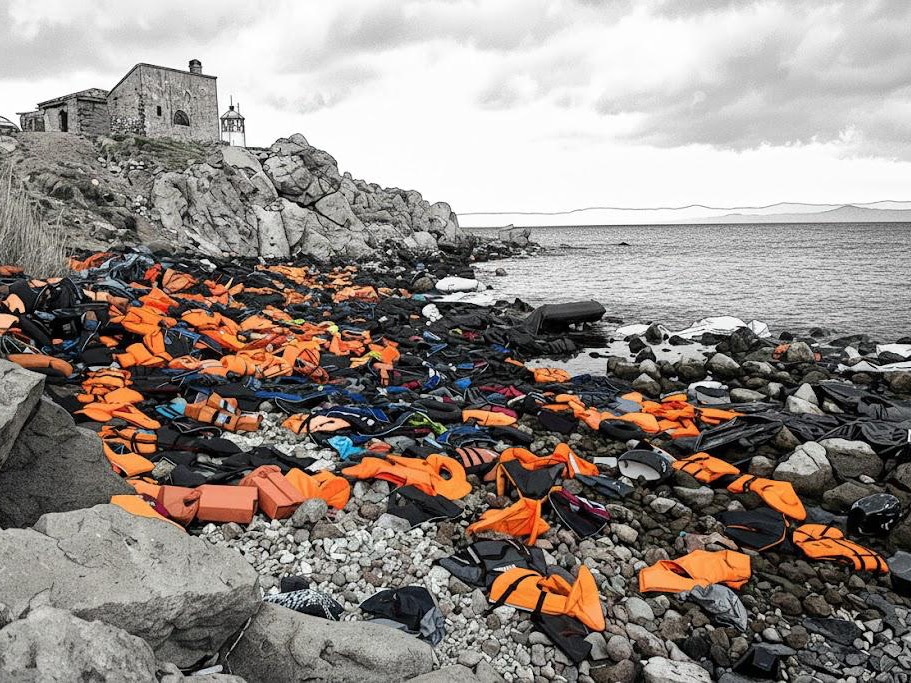
The latest evidence of this militarized narrative unfolded on 3 February 2026 in Chios. Late that Tuesday night, off the coast of Vrontados, a high-speed Hellenic Coast Guard patrol vessel (PLS 1077) collided with a boat carrying approximately 40 refugees. The results were catastrophic. Fourteen people lost their lives instantly. One woman later died in the hospital from severe injuries, and two pregnant women suffered the loss of their unborn children. Over 24 people were injured, including 11 children.
The aftermath of this tragedy has revealed once more the dynamics of narrative manipulation and the accountability gap. The authorities have spent years building a militarized frontier. They therefore frame those deaths not as a crime but as an attempt to protect our borders, against the backdrop of a manufactured war. The state’s response to the Chios crime exemplifies a well-calculated strategy to shift responsibility, just as the ICE operations in Minnesota – where the “other” is once again hunted in the guise of security – shows the dissolution of the line between administrative management and criminal punishment, another example of “crimmigration.” This approach resulted too in various arrests and the tragic loss of the lives of US citizens at the hands of ICE agents. It demonstrates how easily the spectrum of “enemies” can be broadened if needed.
Greek officials initiated a narrative of blame in an attempt to shape public perception. Minister of Migration Thanos Plevris, and other high-ranking officials, attributed the tragedy entirely to “murderous smugglers.” This rhetoric obscures the material facts of the encounter.
First, the Greek Coast Guard vessel (PLS 1077) was significantly larger, faster, and more technologically advanced than the migrants’ boat. Nevertheless, the official narrative claimed that the smaller vessel “maneuvered toward” or even “attempted to ram” the patrol boat.
Secondly, there is again a systemic failure of transparency: authorities claimed that on-board cameras and thermal imaging systems were not recording at the precise moment of the collision. Apparently it was not considered necessary. This is yet another case of “technical absence,” which impedes any independent assessment of the Coast Guard’s maneuvers, creating a vacuum where the state’s version becomes the only acceptable “reality”.
Finally, the state is once more trying to risk assess and manage the survivors: either they are victims or criminals. As mentioned, refugees are often portrayed as “voiceless victims” of smuggling gangs; simultaneously the state pivots towards criminalization by arresting survivors – in this instance a Moroccan national – on suspicion of smuggling. By treating the survivors as suspects rather than witnesses the state successfully ensures that the conversation is focused on “threat management”.
By labelling the victims of state crime as “survivors of smuggling”, the state normalises its use of force. Paradoxically, the victims are blamed for their own demise for “choosing” such a dangerous route, despite the non-existence of safe ones. The crime in Chios is not isolated. It was the outcome of a border regime built on deterrence. We saw yet another example of this policy a few days ago: once more a shipwreck took place in the Aegean, this time in Turkish waters. Four bodies were recovered and three people are reported missing.
Similarly, ICE operations frame victims as an operational security risk, turning neighborhoods into conflict zones. This has transformed cities into a domestic frontier where rights are conditional benefits too. Terror and populism are the blueprints of a border policy built on invisibility and death. The calculated choice to prioritize terror over human dignity works in parallel with a wider attempt at social intimidation, involving the manufacture of “enemies”, in order to maximize political and social consensus.
These institutional approaches must face harsh inquisition. They have transformed the Aegean into a graveyard while proclaiming law and order. Their systematic prioritisation of militarization and preventative policies over human life is a choice.
Ending these recurring tragedies is not complex or complicated. The simplicity highlights how much such policies are a choice. Demands such as the establishment of safe and legal migration routes, the reinforcement of genuine search-and-rescue operations, full transparency, independent accountability for border enforcement authorities, and the dismantling of deterrence-based policies that criminalise survival are not new, nor are they ground breaking.