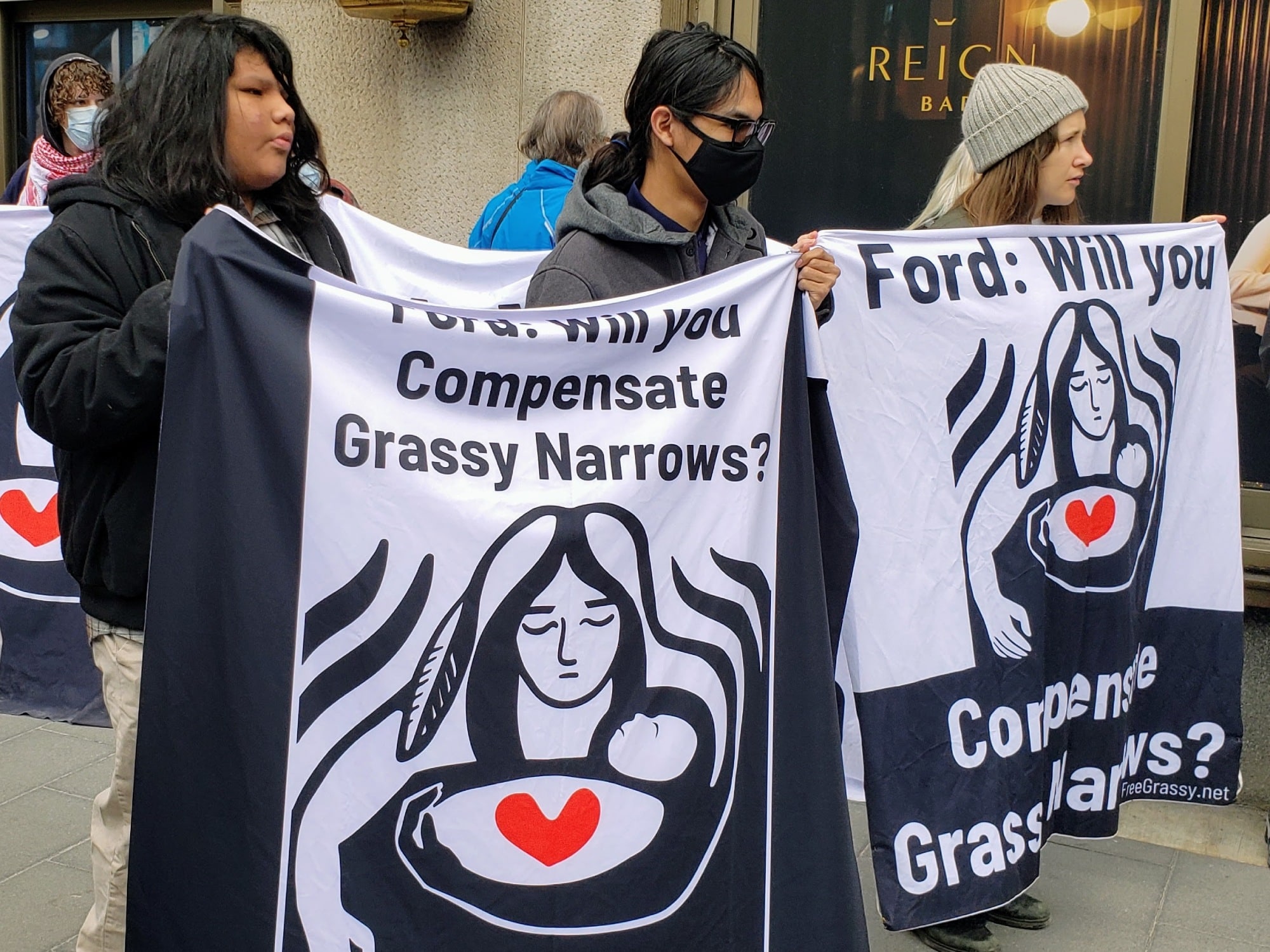
Amid contemporary stories of Canadian injustice toward Indigenous communities, the mercury poisoning crisis affecting Grassy Narrows and Wabaseemoong First Nations exposes political bad faith.
From 1962 to 1970 a pulp and paper mill in Dryden, Ontario, dumped more than nine tonnes of mercury into the English-Wabigoon River System upstream of these First Nations. News of the dangerous levels of pollution instantly closed their thriving fisheries. Sixty years later, 90% of people in both communities live with mercury poisoning.
For decades, both provincial and federal governments denied that the communities were facing ongoing mercury poisoning and instead, leaning on racist stereotypes, pathologized the people, blaming their health problems on individual lifestyle choices.
After decades of organizing, educating, protesting, and advocating, the community of Grassy Narrows won a victory in January 2017, when both provincial and federal governments admitted the community had been poisoned and pledged financial assistance to clean the river and build a mercury treatment center. Despite these commitments, the follow-through has been weak. Every step of the way, Grassy Narrows has had to demand action. In addition, governments continue to ignore the community’s demand to close the Dryden Mill, which continues to operate, unsettling the river’s ecosystem and releasing sulphates which react chemically with the mercury in the riverbed, making it more toxic.
For sixty years, governments’ default response has been to ignore the concerns of people from Grassy Narrows, until public pressure forces them to act. When politicians ignore requests to meet with community leaders, members of Grassy Narrows and their supporters have found creative ways to draw attention to their demands. In a world where politicians hide behind press secretaries and corporate-owned media, demanding the attention of politicians at press conferences or party fundraising events has been a successful form of nonviolent direct action and accountability. When confronted about the situation in Grassy Narrows, politicians have often responded in ways that expose the contemptuous colonial attitudes that underlie white supremacy.
First, money
Colonization is driven by greed and exploitation. In 2019, supporters of Grassy Narrows disrupted a Liberal Party fundraiser where Justin Trudeau, the Prime Minister at the time, was speaking. A supporter approached the stage and asked loudly if the government would fund a mercury care home in Grassy Narrows. As security guards removed her, Trudeau laughed and thanked the protester for her “donation” to the fundraiser. His impulsive sarcasm revealed a dismissive attitude toward an Indigenous community’s corporate-created suffering. Grassy Narrows’ demands were deemed unworthy of a response because they did not represent an opportunity for political advancement or financial gain. Trudeau only saw fit to acknowledge the contribution the supporter made to his campaign by buying a ticket to the fundraiser. Trudeau’s careless words exposed a crass self-interest incongruent with his progressive public image, and after several days of media attention he apologized, and then pledged funding for the mercury care home.
This kind of response is not party specific. Ontario’s Conservative Premier, Doug Ford, expressed an even more naked dedication to corporate profit when, in June 2025, days after Grassy Narrows supporters disrupted his “FordFest” community barbecue, he described Indigenous chiefs opposed to mining as “coming hat in hand all the time to the government” while declining “an opportunity on a silver platter.” The logic of settler colonialism is clear – First Nations, robbed of their sovereignty and traditional livelihoods, are expected to cooperate with resource extraction as a condition of access to basic services. Ford apologized after Sol Mamakwa, Ontario’s only First Nation Member of Provincial Parliament, spoke on public radio calling his comments “deeply offensive,” “deeply racist,” and representing a “fundamental lack of understanding of what it means to have a treaty relationship with First Nations.” However, Ford has since passed policies that reduce the agency of First Nations in decisions about resource extraction.
Ford’s more frequent response to confrontation by supporters of Grassy Narrows has been to ignore them and rely on police to silence them. This past February, while Ford spoke at the Mississauga Board of Trade, a Grassy Narrows supporter asked: “Premier Ford, Grassy Narrows is still being poisoned. Will you compensate residents of Grassy Narrows?” Ford avoided the question, cracked a joke about protestors being “a few minutes late” and thanked his Ontario Provincial Police security detail for removing them.
Police suppression
Police are, of course, another pillar of settler colonialism. The Ontario Provincial Police (OPP) have violently suppressed Indigenous people defending their land on multiple occasions. In the summer of 2020, the OPP raided the Land Back Lane protest encampment, shooting tear gas and rubber-coated steel bullets at Haudenosaunee Land Defenders. That same year, the OPP launched Project Hendon, an “intelligence” project to increase surveillance of protest movements, particularly Indigenous-led protests.
These events echoed the “Ipperwash Crisis” at Ipperwash Provincial Park in 1995. Members of Stony Point First Nation re-occupied park land containing a burial ground, which the federal government had expropriated for military use during World War II and promised to return to the First Nation. Rather than addressing this broken promise, Ontario’s Conservative government and the OPP responded with contempt and brutality. Hours after Premier Mike Harris said on a phone call, “I want the fucking Indians out of the park,” the OPP raided the resistance site and an OPP sniper shot and killed Land Defender Dudley George. When Doug Ford thanks the OPP for removing supporters of Grassy Narrows, he is repeating a long-standing pattern in which the government evades accountability to First Nations and suppresses the assertion of Indigenous sovereignty by authorizing state violence.
“I can outlast her”
Finally, genocide. Perhaps the most violent and insidious ideology underlying settler colonialism is the belief that Indigenous peoples will disappear – by death or by assimilation – and be replaced by settlers. Canada’s current Prime Minister Mark Carney evoked this myth when confronted by people from Grassy Narrows and Wabaseemoong. On 30 March, Prime Minister Carney, alongside Premier Doug Ford and Toronto Mayor Olivia Chow, spoke at a press conference about housing. Outside the press conference, Grassy Narrows member Chrissy Isaacs spoke into a megaphone asking when the government would compensate Grassy Narrows. As her voice interrupted his speech, Carney paused and flippantly responded, “I can outlast her”. Ford and Chow joined him in a chorus of laughter.
Chrissy Isaacs herself lives with mercury poisoning, and in this context, Carney’s response was beyond vile. As head of a settler state, he mocked her cries for justice. The reality is that members of Grassy Narrows living with mercury poisoning have a 55% higher chance of dying before the age of 60. For Indigenous women across Canada, life expectancy is approximately 70 years, whereas the life expectancy of a white man in Canada is 80 years.
The appalling reality is that, due to Canada’s racist legacy and current colonial policies, white settlers statistically live longer than Indigenous people. This is part of Canada’s genocidal structure, which privileges white settler life above Indigenous life: governments deny Indigenous nations control over their lands, impose polluting industrial development that poisons people who live on the land, and underfund basic services for Indigenous communities. All of this contributes to a genocidal project of forcing Indigenous people to assimilate into the settler economy, or die from the effects of environmental racism, poverty, and criminalization. While demands for Carney to apologize and visit Grassy Narrows grow, he remains silent, attempting to claim innocence, once again evading any form of accountability.
While there are more blatant examples of settler colonialism in Canada, examining these politicians’ responses to Grassy Narrows provides an insight into the pervasiveness of the settler mentality. In these unscripted circumstances, their impulse was to cement settler colonialism and genocide. But while politicians may institute genocidal policies and mock Indigenous suffering, one thing remains certain: Grassy Narrows’ resistance has lasted for decades and continues to grow. To all Canadian politicians past, present and future, know that Grassy Narrows will outlast you!