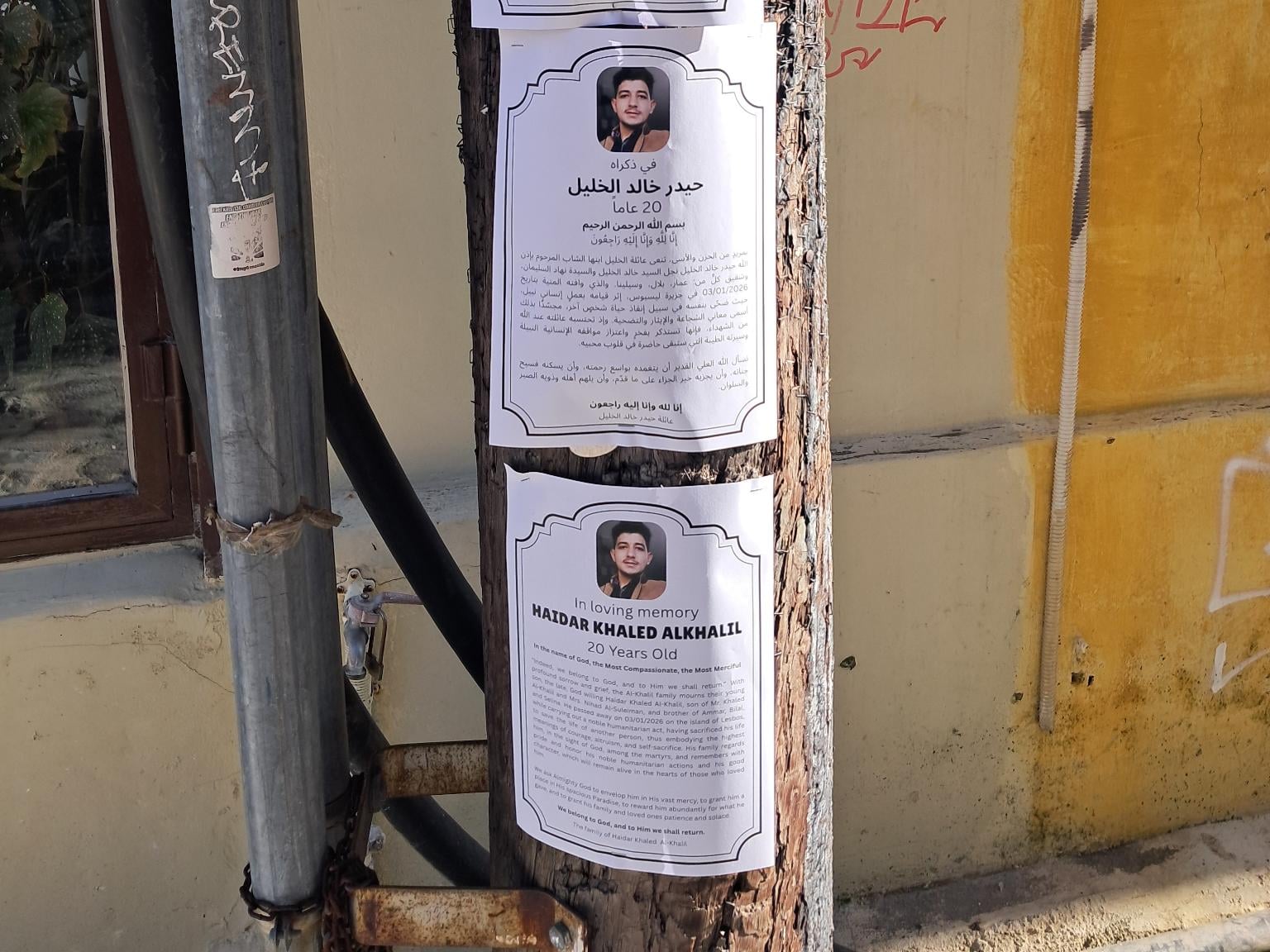
On New Year’s Eve, while many of us were wrapped in the warmth of our homes, surrounded by family and the quiet comfort of familiar voices, 20-year-old Haidar Khaled Alkhalil was spending the final hours of his life on the cold coastline of Lesvos. Far away from home, away from his family, perhaps the person that he loved, he walked barefoot over the jagged rocks and steep hills, soaked by the sea and frozen by the winter air.
Haidar had just arrived with ten other people seeking safety. According to those who survived, the driver of their boat forced them into the water before they reached the shore. They were among the “lucky” ones – they had life vests. Together, they struggled through the waves and reached land, holding onto one another, leaving behind everything they owned.
Once ashore, the group split into three, uncertain and guided by fear. They all knew they had to reach some safe area before policemen or Coast Guard officers could find them. They had heard several stories of people who, despite managing to reach some of the Greek islands, were abducted by the security forces and pushed back to Turkey. Nine of them reached a nearby village, where the presence of some locals offered a fragile sense of security. But Haidar and his close friend Houssein stayed behind, too afraid to be seen, too uncertain of what awaited them.
Alone, frightened, and disoriented, they continued into the mountains. Barefoot and half naked they walked on. With no food or water, they survived on rainwater and whatever fruit they could find along the way.
A small church, which they came across along the way, served as their refuge – and also as Haidar’s final resting place. Three days had passed already, and they were both exhausted. Haidar’s health had deteriorated badly. He couldn’t walk anymore and kept coughing. Inside this church, he fell asleep, never to wake up again. Maybe he was dreaming of his mother’s embrace, the touch of someone he loved, the scent of his favourite food, or a night out with all the friends he had to leave behind.
Houssein went in search of help. Although it was too late for Haidar, Houssein also had to be hospitalised for almost 20 days after a local man eventually found him. He managed to recover, but still has to carry the last images of his beloved friend.
Almost four months after his death, Haidar’s body remains in the morgue. Local human rights groups are trying to overcome all the bureaucracy, to secure for him what should never be denied: dignity in death. He will be buried in the “refugees’ cemetery,” among more than 200 others who lost their lives on the same journey toward what they hoped would be safety and freedom. Many of them lie beneath markers that read only one word: Unknown.
But Haidar, like everybody else buried in this cemetery, was also a son, a friend, perhaps a partner. He had a name, a story, a life interrupted.
And his story is not an isolated tragedy, nor a fleeting headline to fill empty space. It is the consequence of a violent border regime: a regime that forces people seeking safety through dangerous routes and networks, that embodies their fear, and that keeps them invisible.
No one should have to endure such a journey. No one should lose a loved one this way. And no one should be laid to rest so far from home, without the presence, the touch, or the farewell of those who loved them.