
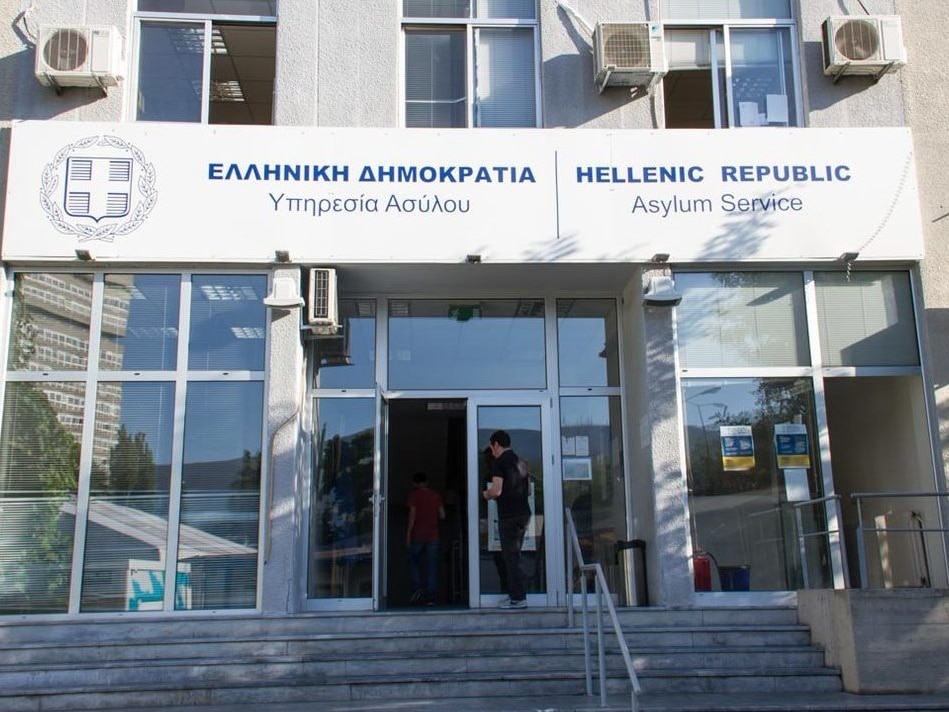
As active members of civil society we call for unhindered access to the asylum procedure for everyone, without any discrimination based on arbitrary legal grounds.
For several months, the Greek state has been systematically and unjustifiably denying access to international protection procedures, targeting those accused of driving boats carrying migrants towards Greece or facilitating migrants’ unauthorised entry to Greece.
For almost every boat that arrives, the authorities accuse someone of smuggling-related crimes – i.e. facilitation of unauthorised entry or unauthorised transport of people into Greece – arresting them upon arrival, often with limited or no evidence. In most cases, people are held in pre-trial detention for months, without having had the opportunity to register their asylum claims. While they retain the right to apply for asylum from prison, we have observed that these procedures are consistently – unjustifiably – suspended.
This is either because the clear and repeatedly communicated will to seek asylum is not registered by the police, judicial authorities or prison administration and the prisoner is not referred to the asylum procedure, or because – in cases where this will to seek asylum is referred – the asylum service is not assessing the case until after the court ruling on the criminal procedures. Sometimes, the asylum procedure of family members of the accused have also been unjustifiably suspended. The Ministry of Migration & Asylum, in an administrative circular, has given only a poor explanation for this practice.1
The discretionary practice of suspending asylum applications of criminal defendants violates not only the right to seek asylum2 but also the right to the presumption of innocence.3 By denying people accused of crimes access to asylum, defendants are seen as guilty from the first moment of their arrest, deprived of their fundamental rights and framing the narrative for their prosecution and eventual conviction.
Besides denial of access to asylum, various reports4 have highlighted the unlawful processes that people accused as smugglers face within the prison and court systems of Greece: from trials lasting only a few minutes; to improper interpretation; to the acceptance of written testimonies into evidence without the possibility of the defense conducting cross examination. In addition, the fundamental right to effective legal support during all the stages of the criminal procedure is hindered due to various systemic obstacles and omissions. Characteristically, in a considerable number of cases, defendants are appointed a state lawyer the same day of the trial.
Ensuring the right to access the asylum application procedure is of paramount importance, as it can play a significant role in criminal prosecution. According to Article 3(3)(e) of the Greek Migration and Social Integration Code (Law 5038/2023, as amended by Law 5275/2026), asylum seekers and recognised refugees are exempt from prosecution for migration related crimes, including facilitation of unauthorised entry and unauthorised transport of people into Greece.
The exemption clause provided for in Greek law is being applied inconsistently and arbitrarily, as detailed in a recent report by the Human Rights Legal Project and Legal Centre Lesvos.5 Aside from a few isolated cases, courts have repeatedly denied the application of the Article 3 Exemption Clause, even when raised by the defense.
While the exemption clause provided for in Greek law applies equally to both asylum seekers and recognised refugees, some courts have rejected application of this exemption on the grounds that the examination of the defendant’s asylum application has not been completed. Thus, the arbitrary freeze on the examination of asylum applications can have a real impact on the outcome of criminal cases. As such, it constitutes another violation of the defendants’ rights.
Under Greek and international law, people who have committed war crimes, crimes against humanity, and serious non-political crimes are excluded from receiving international protection.6 However, suspending the asylum procedure while waiting for a verdict in the criminal prosecution is a clear violation of the presumption of innocence. To protect the right to the presumption of innocence, the Ministry of Migration & Asylum should instead revoke asylum status only after someone is convicted of a serious crime – something that is regularly and systematically done.
Moreover, the exclusion of people convicted as ‘smugglers’ from receiving asylum is contrary to international law. The Ministry of Migration & Asylum, in its circular interpreting what constitutes a “serious crime”, takes the position that the smuggling of migrants constitutes a serious crime simply because the smuggling of migrants is considered a crime under international law – despite the fact that Greece’s definition of smuggling is much more vague and broad than the international definition from the UN’s Palermo Protocol, and by definition is a victimless crime. The UN Protocol Against the Smuggling of Migrants by Land, Sea and Air (Palermo Protocol) specifies that people must receive a material benefit in order to be considered smugglers7 and that migrants cannot be prosecuted if they themselves are smuggled across a border,8 making clear that individuals transporting themselves and others should not be considered smugglers, as they are under Greek law. Thus, the arbitrary obstruction of defendants from asylum leads to a situation where, as concluded by HRLP and LCL in their 2025 report, “Defendants are trapped between two systems: asylum services that refuse to assess their claims until criminal cases are resolved, and criminal courts that refuse to recognise defendants’ right to be exempt from prosecution until their asylum status is confirmed.”
As further highlighted by the BVMN-CPT AMS report (2026), “Even where charges are later dropped, or the individual is acquitted, the prolonged delay may already have deprived them of essential legal protections and opportunities for integration. The result is a state of legal limbo in which individuals are unable to pursue protection-related procedures because of the criminal accusations against them.”9
We stand against this unjust state practice of the denial of access to asylum that leads to discriminatory administration of justice.
We demand that the competent authorities take all necessary measures to ensure everyone who wishes to apply for asylum has access to services, regardless of any criminal charges.
We stand against the carceral system and for papers and freedom of movement for all.
Signed organisations:
- Aegean Migrant Solidarity – Community Peacemakers Teams
- Legal Centre Lesvos
- Border Violence Monitoring Network (BVMN)
- Equal Rights Beyond Borders
- De:criminalize
- Alarm Phone
- 50 out of many
- Greek Forum of Migrants
- EmpowerVan
- Avocats Sans Frontières France (ASFF)
- Samos Volunteers
- Human Rights Legal Project (HRLP)
- Fenix Humanitarian Legal Aid
- I Have Rights (IHR)
- Collective Aid
- Greek Council for Refugees (GCR)
- Europe Cares / Paréa Lesvos
- Thalassa of Solidarity
Footnotes:
1 Ministry of Migration & Asylum, Circular Protocol No. 87206/14 February 2022, page 11.
2 Article 14(1) of the Universal Declaration of Human Rights (UDHR).
3 UDHR, Article 11; International Covenant on Civil and Political Rights, Article 14(2); Charter of Fundamental Rights of the European Union, Article 48; European Convention on Human Rights, Article 6(2);Greek Code of Criminal Procedure, Article 71.
4 Border Violence Monitoring Network, & Community Peacemaker Teams. (2026, March 30). Trial monitoring annual report 2025.
5 Legal Centre Lesvos, & Human Rights Legal Project Samos. (2025, November 29). New report: The exemption from criminalisation: A real safeguard or an illusion?
6 Article 11(2)(b) of the Greek Asylum Law Code, which implements Article 12(2)(b) of Directive 2011/95/EU.
7 Palermo Protocol, Article 3(a).
8 Palermo Protocol, Article 5.
9 Legal Centre Lesvos & Human Rights Legal Project Samos, The Exemption from Criminalisation: A Real Safeguard or an Illusion?