
Here in Greece, the war on Gaza is written on Athenian streets. Murals of Palestinian martyrs spring in the wake of every demo. Stencils show that “the oranges of Palestine have become the stones of resistance”. Bars and cafés hang posters telling war criminals: “We don’t want you here”.
As the UN warns that 14,000 babies in Gaza are on the brink of death, Israel’s finance minister Smotrich speaks openly of its “conquering” and “cleansing”. He boasts that the “total destruction” of Gaza “has no precedent globally”. If it were up to him, he wouldn’t even let water in, though he warns his constituents “if we do that, the world will force us to halt the war”. Israel has therefore let in a paltry amount of aid, starting with five trucks, two of them loaded with burial shrouds. Meanwhile, vigilantes do what he can’t be seen to: block the trucks themselves.
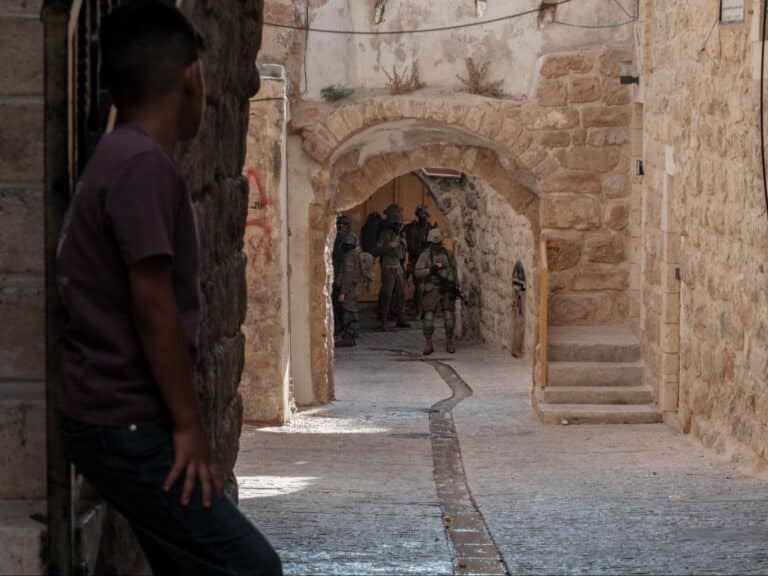
This week CPT Palestine releases Learning Under Threat, a report on children’s access to schools in Al Khalil/Hebron. “Since 7 October 2023”, they write, “the conditions for Palestinian children reaching their schools have worsened.” The kids speak for themselves. “Once, a soldier forced me against the wall, searched me, and ordered me to raise my hands”, writes a ninth grader. “He laughed and spat on me.” The team broadcasts these daily humiliations across the Occupation’s attempted information blackout. “When we see CPT nearby, we feel cared for”, writes a teacher. “It’s not just about protection – it’s about being seen, and knowing our struggle matters.”
Have we reached a turning point? The UK, France, Canada and the EU this week all said a line has now been crossed, threatening “concrete actions” against Israel. The British foreign secretary called the blockade “abominable” as he suspended trade talks with Israel. Despite his escalated rhetoric, his posturing rang hollow when a member of his own party – long sidelined for opposing the genocide – confronted him with his record of arms exports to Israel. She asked him how he could sleep at night. He denied it all. Now, his colleagues are being dragged before a committee to answer for £127.6 million in arms exports, laundered through loopholes.
We are seeing a “change of heart” from those who have fuelled this war and given it moral cover. Perhaps they’ve realized how history will judge them. How much of that shift is down to global solidarity with Palestine? Last weekend half a million marched in London. In the Netherlands 100,000 marched to the Hague. Students in the US continue to defy their universities’ attempts to silence them. At Yale they are on hunger strike. Columbia University’s acting president was shouted down during a graduation speech — her sardonic defence of the “strong tradition of free speech” countered by chants of “Free Mahmoud”.
“One day, when it’s safe, when there’s no personal downside to calling a thing what it is, when it’s too late to hold anyone accountable, everyone will have always been against this.” Has the day come?