Since at least October 2023, and especially throughout 2024–2025, Israeli authorities have installed hundreds of iron gates, concrete blocks, and military checkpoints across the West Bank. Reports document roughly 898 checkpoints and gates in the region.
In specific governorates, including Hebron, Ramallah, Nablus, and Jerusalem, the number of military checkpoints and gates is particularly high. There are over 200 checkpoints and gates in the Hebron governorate alone, with hundreds more elsewhere.
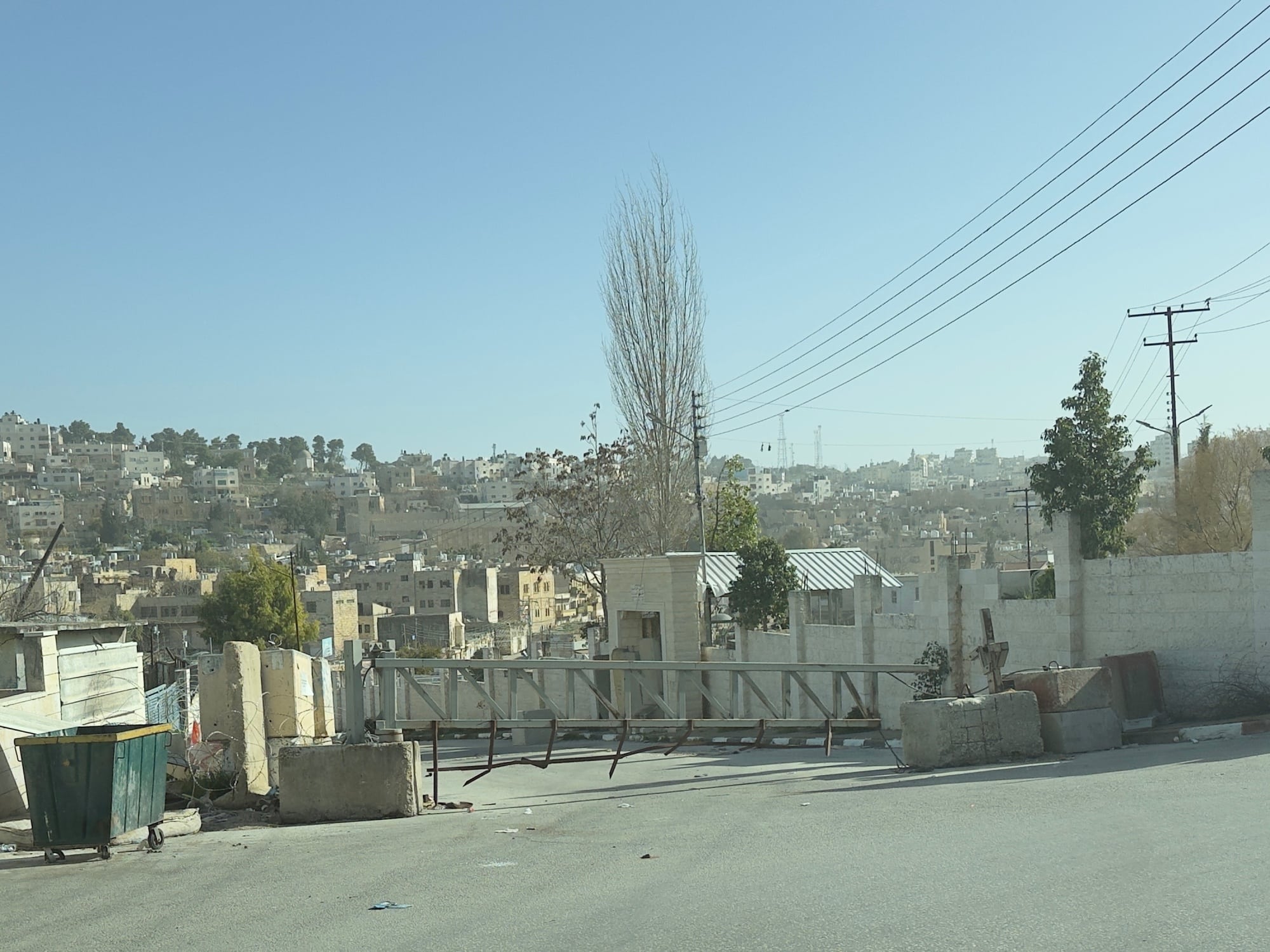
These gates are often heavy iron or steel barriers placed across roads leading into towns, villages, neighborhoods, and even refugee camps. In many cases, these gates are closed by soldiers, and they can be opened only at certain times or not at all.
Hebron (Al-Khalil): a city transformed into a large prison
Hebron is one of the largest and most populous cities in the West Bank. It is an economic hub with a long history of Palestinian urban life, markets, industries, and family communities. Its downtown area and surrounding towns form a dense network of daily activity, mobility, and social life.
In recent years, particularly since late 2023, all of Hebron’s major entrances and many internal roads have been blocked with iron gates and barriers. Most roads leading into and out of Hebron are blocked by gates that are either permanently closed or opened unpredictably. This has turned the city and its towns into something resembling a large prison.
Palestinians attempting to travel within the governorate must take long, difficult detours through areas where they face additional checkpoints, inspections, and delays. Public services like ambulances and emergency vehicles can be seriously delayed if a gate is closed or requires permission to pass, sometimes forcing patients to be transferred between vehicles at checkpoints.
Such closures are a form of collective punishment, affecting especially Palestinian workers, students, and families. One of the most profound effects of these gates is how they divide Palestinian communities into isolated pockets. Before this recent surge, many towns and villages were linked by continuous roads and public transportation routes. Today, gates and checkpoints segment the West Bank into isolated cantons. A village that once had several routes to a nearby city might now have only a single narrow road under surveillance or behind a gate.
Roads that were main arteries of life connecting farms to markets, children to schools, and families to their relatives are often blocked. This forces people onto smaller, rough, unpaved roads where travel is slow and sometimes unsafe. Many community entrances are closed for days or weeks without notice, meaning people can be trapped or forced to travel 20–50 kilometers more on detours just to reach basic services like hospitals or government offices.
The combined impact is that cities are no longer contiguous urban spaces but collections of fragmented areas with restricted access, forcing residents to plan each trip around the unpredictable opening and closing of gates and checkpoints. People are forced to follow the news and check apps in order to plan their routes around checkpoint closures.
Daily life at military checkpoints
At every major gate, there are Israeli soldiers or military personnel who control the movement of vehicles and pedestrians. The soldiers check IDs, inspect vehicles, check mobile phones, social media accounts before deciding whether to let people pass. These decisions can depend on the time of day, perceived security concerns, or arbitrary judgment.
The consequences of this are that people often spend hours waiting at gates and checkpoints. Workers risk losing time at jobs, students miss school hours, and many miss medical appointments due to long delays and unpredictable closures. There is economic strain: delays and movement restrictions make it harder for workers to reach jobs, for merchants to transport goods, and for farmers to access their lands. This contributes to economic hardship in many towns. There is psychological stress too. The uncertainty and lack of control over one’s own movement create anxiety, and a constant sense of being under surveillance. And there is the social isolation. Families are often separated by checkpoints that make social gatherings, weddings, funerals, and family events harder to attend.
Gate colors and their meanings
In many areas, particularly since the expanded installation of gates after 2023, a simple color system conveys different access conditions.
Yellow: These gates are commonly installed at many entrances. They may be opened or closed depending on military needs or security assessments on any given day. Sometimes they allow passage but only with frequent checks and delays.
Green: These are theoretically “open” but are often subject to intensive searches by soldiers. Passage is possible but slow and unpredictable.
Red or orange: These gates are usually completely closed to Palestinian civilians. They block access entirely and can remain locked for long periods.
Blue or Black: These are typically military gates, often permanently closed to civilians and used by the Israeli military for patrols, deployment, or security operations.
Local observers describe how these colors are widely circulated on social media and among residents, becoming a daily reminder of how movement is controlled and monitored.
Today, the West Bank’s iron gates and checkpoints are more than physical obstacles; they are markers of how control over movement affects society, economy, family life, and personal dignity. In cities like Hebron, where entrances and internal roads are blocked, daily life feels like navigating a maze of delays, restrictions, and uncertainties. Despite official Israeli statements about security, many Palestinians see these gates as tools of fragmentation and collective punishment that make life harder and opportunities scarcer.
Understanding the roles, colors, and consequences of these gates helps illuminate how pervasive these structures have become, not just in military or political terms but in the very rhythm of Palestinian life.