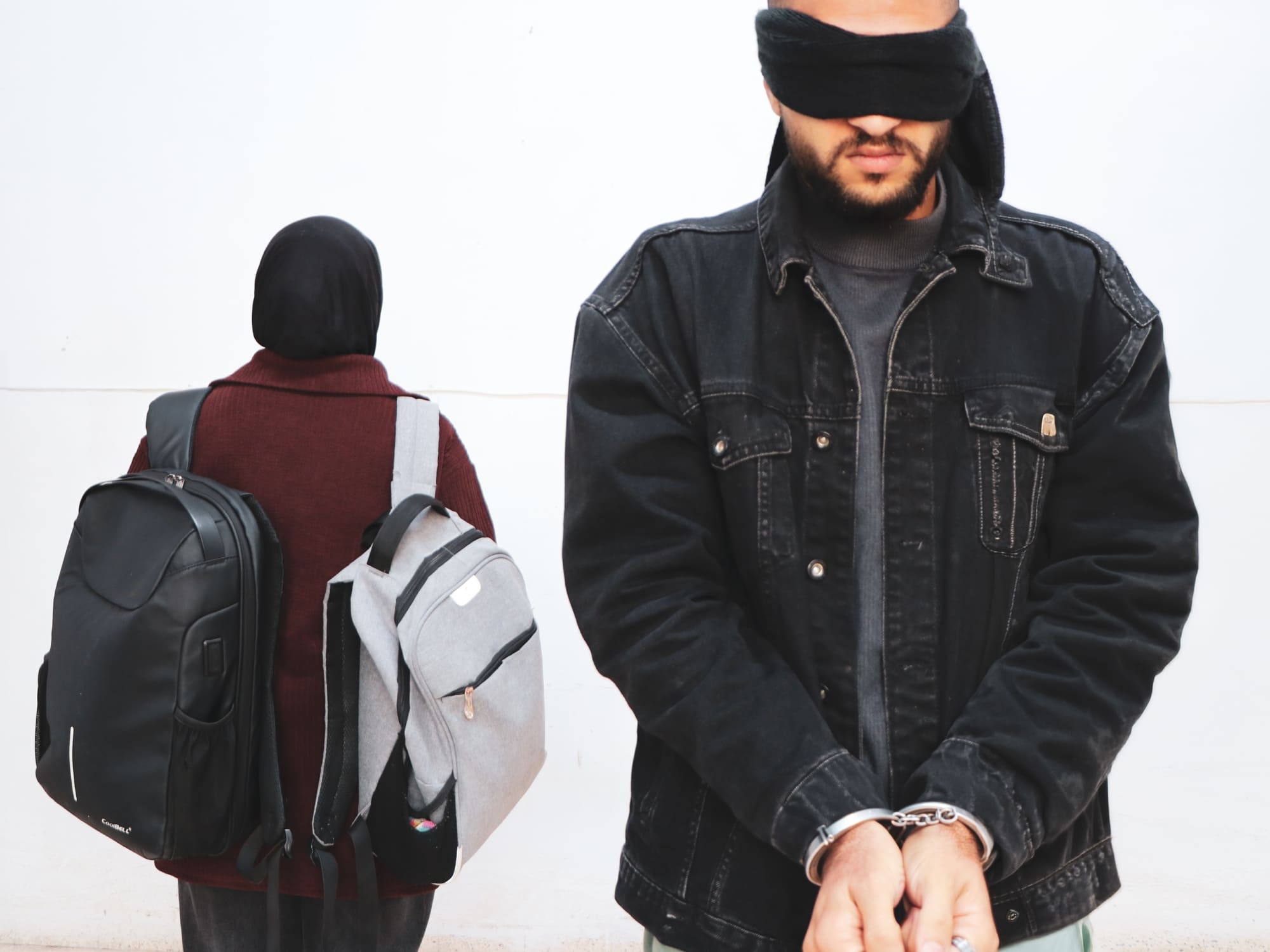
It was just after 7am on 28 December 2025. The sun had barely peaked over the gloomy mountains, with the cold morning settling in. It was cold in that quiet, bone-deep way, just before the city woke up. Rain fell steadily, not heavily enough to flood the roads, but persistent enough to keep your jaw shivering, causing everything to slow down. The sky hung low and grainy over the Salaymeh checkpoint, invading the already confined space. It was never easy, even on calm days.
We were there on our school accompaniment duty with CPT, standing with the children as they crossed the checkpoint on their way to school. One of us carried the camera, with a cold strap against the neck, while the other kept documentation of numbers and incidents, recording the morning for our upcoming school report.
The checkpoint felt especially uneasy that day. Schoolchildren moved through it in small clusters, their colorful backpacks hanging oversized on their small shoulders, shoes splashing in shallow puddles. Soldiers moved in and out of the checkpoint in unpredictable patterns, with their weapons holstered at their sides. The rain, the floodlights, and the tension in the cold air made the space feel unstable, unhinged even. As we continued observing, we exchanged brief looks of tension, sensing that troubled feeling in our guts. We acknowledged it was time to slip away, and we started moving from the checkpoint, onto the street.
We moved quickly, determined to get out of there as quickly as possible, scanning our surroundings in paranoia. We looked ahead for a taxi that could take us back to downtown Hebron.
“Hey I’m a bit scared, do you think they follow…”
Before we knew it, the brief sense of safety was shattered. The jeep pulled up right in front of us and swerved left, blocking the street and cutting off our path. It stopped with a precision that felt intentional, as though they were awaiting the exact moment we let our guards down, the moment we became vulnerable. Four soldiers quickly jumped out and surrounded us from all sides. They were young and reckless, yet they carried out their orders.
7:33am. Him:
“Give me the camera,” the captain shouted in Arabic. I reached under my coat and pulled it out. I handed it over calmly. My fingers were numb from the cold, but my hands didn’t shake, though my knees did. The younger, blue-eyed, European soldier flipped through the photos, scrolling fast, zooming in, analysing what I had been doing. I was accused of taking illegal photos of the Salaymeh military checkpoint and the IOF military jeep.
I was pushed to the wall, my chest pressed against the rocky cold stone. One soldier pinned me there with my hands behind my back, positioned in an angle that elbows aren’t supposed to reach, while the other searched me from head to toe. I was shivering from the cold, only hoping I’d get another chance to feel my mother’s warm hands hug mine. Still, I stayed calm, I only spoke in English, choosing my sentences carefully. I wanted to distort the reality that was unfolding, trying to convince myself that this was still manageable, that I could somehow get this under control.
They turned me back to face them, with one soldier gripping both my arms tightly from behind. The other soldier lifted his phone and began taking pictures of me, my ID, and of the camera screen. I didn’t resist, nor did I raise my voice, and that was the moment I realized I was being separated from her.
7:39 am. Her:
“The soldiers stopped us, are searching us, they have the camera, and I’m putting my phone away because they are next to me.”
Those were the first messages I texted to the team’s WhatsApp group. If we were arrested or detained, someone had to know. Someone had to witness what was happening. Out here, it was only me, him, and the soldiers. I didn’t even know how I had the courage to hold my phone and text while being pushed back by a short soldier with no badge on his arm.
The taller, older one was holding the tactical radio, blabbering something in Hebrew I couldn’t understand. Then I noticed the red badge on his arm, which meant he was the commander. This was the moment I felt that everything was real. You could almost hear my heart drop. My knees nearly gave in. Breathing, something so natural, turned into a deliberate task. I fought to stay quiet, trying to hold my anxiety in check while my thoughts raced through every possible scenario. As if pretending to be calm could somehow protect us. As if control was still mine to claim. My voice gave me away though, shaking despite my best efforts.
I was waiting for the inevitable: “Delete them and never again.” Every second felt like an eternity, as if we were waiting for a death sentence. How could it get worse? I was under the impression that they would let us go. I never thought this would happen.
7:42am. Him:
I knew this would happen. The moment they took photos of my face with my glasses removed, took photos of the camera, and kept the ID with them, I knew they were going to take me.
7:46am. Her:
“Where are you taking him?” I suddenly lost it. The act, the role, the pretending, the mask I was wearing, all dropped. What could I do to stop this, and with what power?
For a moment, I forgot everything I had trained for. For a moment, I did not act like a member of CPT. At that moment, I realized I was not protected after all. Whether I am a human rights activist or just a regular Palestinian, we are all targets at this point. I mean, I knew that. How silly of me to think otherwise, when I had heard millions of stories from journalists, human rights activists, children, and women. Why would our case be any different? Still, knowing something in theory and experiencing it, truly understanding it, are two very different things.
“Where are you taking him?” I kept shouting repeatedly until he disappeared into the military jeep.
Him:
I didn’t know where they were taking me. When they pushed me into the jeep, they drove me directly to the Salaymeh checkpoint. I remember every small detail, and could see without restriction. Two soldiers sat pressed against me in the back seat, their knees touching mine, while two others sat in the front. No one explained anything. When we arrived, they led me inside and to the far end of a room, positioning me with my face toward the wall. That was when they blindfolded me and cuffed my hands tightly behind my back. The plastic restraints bit into my wrists as they secured them. The cold from the stone floor and the winter air seeped through my clothes. Without sight, every sound felt amplified.
During the questioning, they repeatedly asked where I was from and why I was taking so-called “illegal photos of military borders”. As I stood there, blindfolded and restrained, one thought kept circling in my mind: “Hokum Idari”, administrative detention. Six months in prison without charge or trial. The possibility of being held indefinitely, without explanation, felt terrifyingly real.
Later, sitting at the edge of the room, still unable to see, I heard the sharp sound of a zipper being opened. I froze. My bag. The one that had been with her when they first stopped us. Did they find her? Did they detain her too? Were they going through my belongings, my phone, things that carried pieces of my life?
Her:
Luckily, I had his bag with his belongings and his phone. Yet I stood there alone, weighed down by a crushing sense of guilt, as if I had abandoned my colleague, even though I was powerless to help. I walked in a state of panic, desperately trying to think of something, anything, I could do. Before I knew it, a military jeep was approaching me. At that moment, I knew they had come back for me.
I ran, my eyes scanned everything around me, hunting for a garden, a doorway, any place to hide. I could not let them arrest me. Fear pushed me forward until I spotted a building with an open door.
I rushed inside, clutching my bags and his belongings, breaking down in tears. I stayed there, waiting until the jeep left the area so I could make my way back to the office.
Him:
The blindfold kept me in a constant state of fear. Being unable to see what was happening around me made every movement, every footstep, every shift in tone feel threatening. The plastic cuffs were painfully tight around my wrists, cutting into my skin as the hours passed. From approximately 7:30am until 4:30pm, I remained detained. Much of that time standing against the wall, blindfolded, allowed only brief moments to sit before being ordered back up. Eight hours felt endless. At one point, a soldier turned me around while I was still blindfolded. I felt fabric pressed against my chest. It was an Israeli flag, clipped onto me. I saw the brief flash of a camera through the thin fabric before it was removed again. The act felt like it was only staged to make me feel helpless. Like they somehow owned me. The interrogation itself was repetitive and hollow, the same questions asked again and again. But it was the waiting that was most unbearable. Time stretched unnaturally; every minute felt suspended, as if the day would never end.
4:33pm
“He’s with me, I just picked him up near the checkpoint. I got my boy back, and we’re going home.”
The question consuming our minds is this: will it happen again? And if it does, would it be any different? This incident remains deeply imprinted in our memories, and we’re unsure if it will ever fade. The fear is that this will one day seem small, erased by a more horrifying memory that will haunt us forever, until even this becomes normalized as part of our daily reality.
The suffering, fear, misery, and agony of our people are an open wound. The unknown terrifies us. You may appear prepared, ready to face another day, yet you never truly know whether you will have the strength to endure it again.
So will it happen again? Or perhaps we should ask: when will it happen again? The targeting of human rights observers continues, and it will only stop when the occupation itself comes to an end.