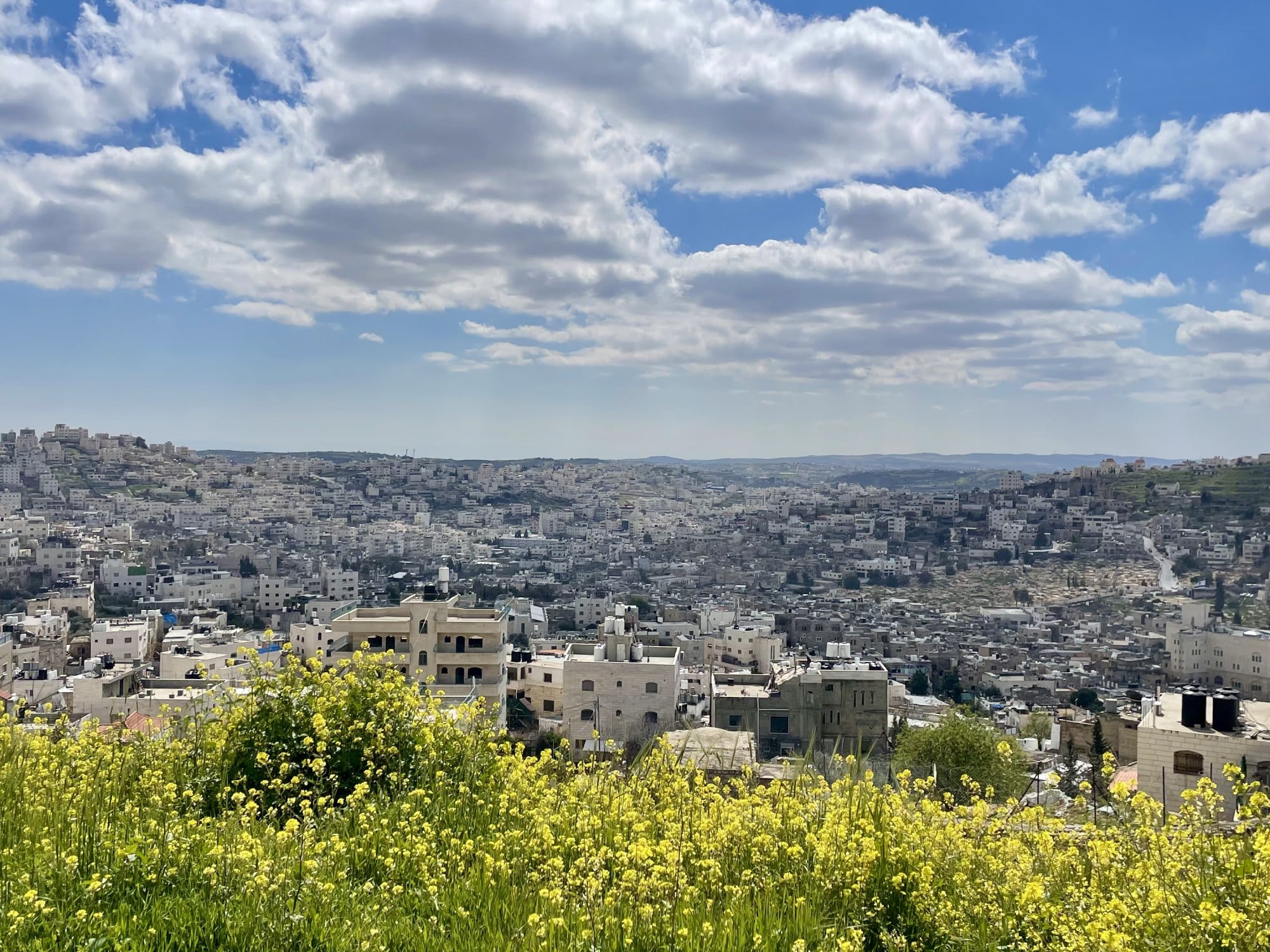
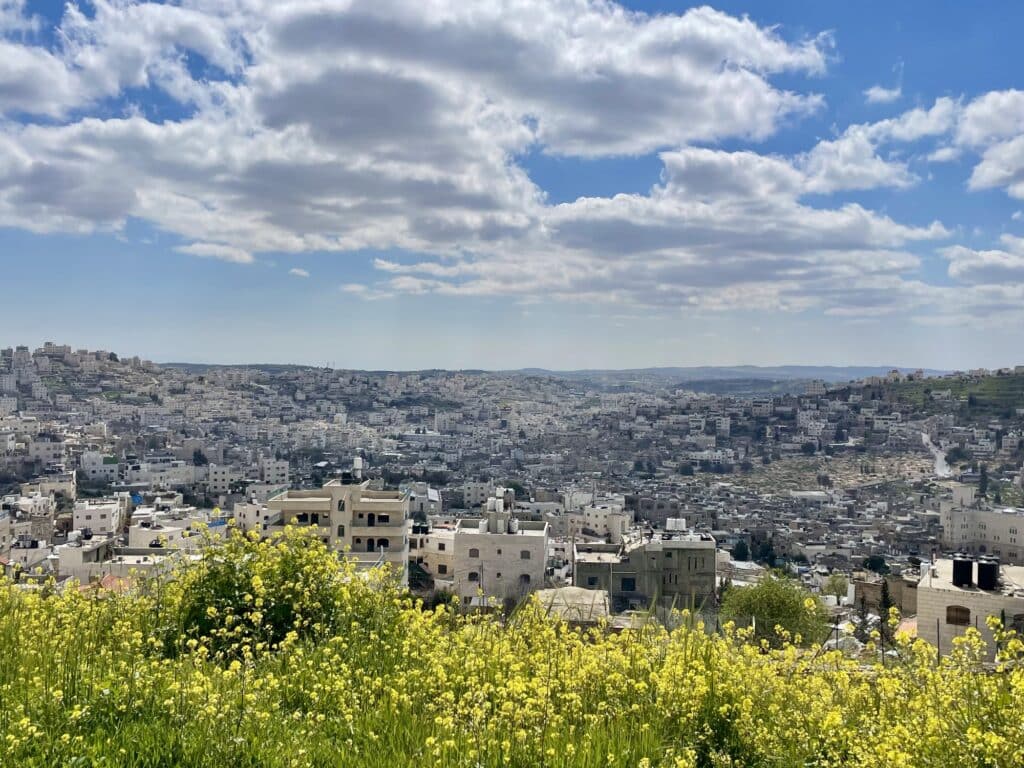
Hebron. The place where I was born and where I grew up. It’s a city filled with layers of history, shaped by the many people who have lived here over the generations. Hebron is known for its crafts and traditions: the glow of the glass factories, the art of pottery, the taste of the famous sweets, and a rich and diverse food culture that reflects the spirit of its people.
Before 1929, Hebron was a city shaped by religious diversity. Jewish people, Muslims, and a small Christian community lived side by side in the same neighborhood, walking the same streets, meeting in the same markets, sharing food, trade, and the rhythm of everyday life.
Hebron is widely known as “City of Ibrahim,” a name that reflects the deep spiritual history of the city. According to tradition, the Prophet Ibrahim came from the Arabian Peninsula and settled in this land. At the heart of Hebron stands the Ibrahimi Mosque, named after him, a place that has carried religious and historical significance for centuries.
As a Muslim, I grew up hearing the name of the Ibrahimi Mosque and learned about its importance for us. I also grew up knowing Hebron as a religious city that once reflected cultural diversity in its daily life.
Yet understanding the reality of the city was always complicated. Why is Hebron so different from the other cities? Why are there so many restrictions controlling daily life here?
When I started working with CPT, I began to see these complexities more clearly, through the work itself, and through the questions visitors often ask me. Why Hebron? Why is there such a strong focus on this city?
I found myself asking the same question, especially knowing that, historically, Jews and Muslims once lived together as part of Palestinian society, without divisions or religious discrimination.
One might ask if the root of the problem is really religious discrimination, or if that is what people have been led to believe over the course of the past century. As I mentioned earlier, historically Palestinians of many faiths in Hebron lived together peacefully before 1929. So what changed? What made this city so different?
I live in this city as a Palestinian Muslim. I have Christian friends from different Palestinian cities, and I know Jewish people from outside the country. We do not fight each other. We do not try to take each other’s homes or land. This was once simply normal life in Hebron.
But if we look more carefully at history, we begin to see when things started to shift. During theOttoman period, and later under British colonial rule, certain political decisions began to reshape the region. Privileges and policies increasingly favored Jewish immigration and settlement. After the Balfour Declaration in 1917, Jewish immigration to the area increased significantly, with new arrivals coming from different parts of the world. With the support or facilitation of the authorities at the time, land and homes began to change hands.
Tensions gradually grew across the region. Restrictions, unequal treatment, and political control created anger and frustration among local communities. Conflicts began to appear, especially in Jerusalem, and the tension eventually spread to Hebron as well.
These growing tensions eventually reached a tragic peak during the Al-Buraq Uprising in 1929, which spread across Palestine. In August of that year, anger erupted in Hebron, and several Jewish families were killed in what became known as the Hebron massacre. After these events, the Jewish presence in the city disappeared until 1967.
Now, the reality of Hebron is very different. The city is surrounded by settlements and by occupation. In almost every part of the Old City, it feels as if haunting eyes are always watching. The division of the city into areas such as H2, the Old City, and other restricted areas has reshaped Hebron’s geography and daily life. This division feels less like an administrative arrangement and more like a structure designed to increase Israeli control.
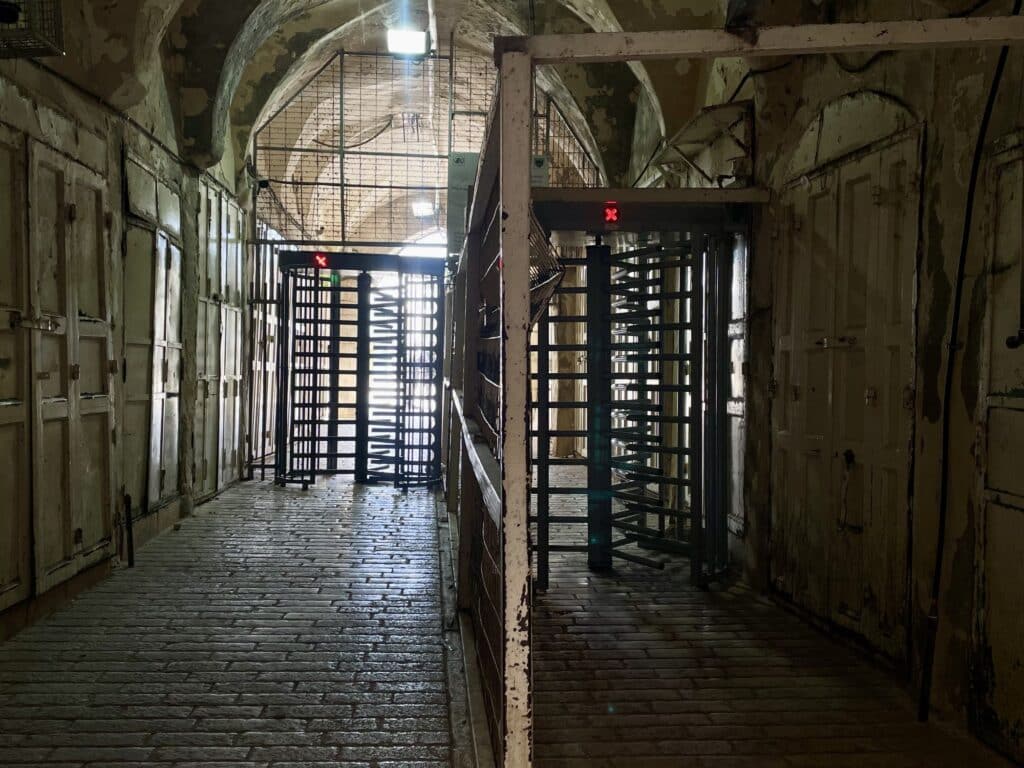
Attacks and tensions continue to increase. The number of checkpoints has also grown over time. Today, the H2 area alone is surrounded by nearlytwenty checkpoints. Settler violence is increasing, and so is the number of settlers’ homes inside the city. With these changes, violence, restrictions, and daily tensions caused by the Israeli occupation have become a constant part of life in Hebron.
These restrictions on Palestinians often become more visible during certain occasions, especially some Jewish holidays. During these times, curfews are sometimes imposed, and restrictions on movement become even tighter. Settler incursions into the Old City also take place regularly, often every Saturday. These visits are sometimes described as tours, but in reality, they often lead to increased restrictions on Palestinian movement and greater control over people’s daily lives.
Some events seem to happen only in Hebron. I often find myself wondering why. Why is the focus on Hebron so intense? Why do settler movements and violence increase during these holidays and events? What do these occasions mean religiously, and why do they have such a strong impact on life in this city?
My own knowledge about Jewish religious traditions is limited. I had the opportunity to conduct an interview with a Rosh Yeshiva, a head of a religious school, from the anti-Zionist Shel Ma’ala Yeshiva, to better understand these holidays and how they relate to Hebron and affect the lives of people living here.
“It all started with Zionism, and it is part of a colonial project,” she said. There is a huge difference between Judaism and Zionism.
This distinction is important. Judaism is a religion with spiritual traditions and holidays centered on reflection, rest, and community. Zionism, however, is a political ideology that developed in a specific historical and colonial context.
One of the most important Jewish holidays is Sukkot, the autumn harvest festival. Traditionally, it is a time when Jews dwell in small huts, remember their history, welcome strangers, and celebrate life peacefully. In its essence, the holiday carries values of hospitality, humility, and rest.
Yet in Hebron and across parts of the West Bank, the experience of these holidays looks very different. For many Palestinians, these moments have become periods of heightened tension, when settler presence increases, restrictions tighten, and violence sometimes escalates, caused by the Israeli occupation and Zionist settlers. Instead of a time of peace, the holidays can become moments when land is taken, movement is restricted, and daily life becomes even more difficult.
“You are Arab for them, not Palestinian,” she said. “And they always see themselves as living under threat.”
The ideology of Zionism, as some critics describe it, has often been built around the idea of constant insecurity, the belief that Jewish people are under threat everywhere and must defend themselves at all costs. Within this framework, the narrative of victimhood becomes central: a belief that survival depends on control, protection, and expansion.
For many Jews, however, Hebron (Al-Khalil) is a place of deep religious significance. In Jewish tradition, it is believed to be the burial place of the tzaddikim, the righteous ancestors, including the Prophet Ibrahim (Abraham). According to the religious story, Abraham purchased a small piece of land there as a burial place, from the people who were the original stewards of that land. Because of this, Hebron has long been a place of pilgrimage.
But the history of Jews in Palestine is also more complex than the political narratives often suggest. In the early twentieth century, particularly during the 1920s, some Palestinian Jews were part of local resistance against Zionist movements. Leaders organized and advocated alongside the broader Palestinian population, Jewish, Muslim, and Christian alike. Even the Chief Rabbi of the Ottoman Empire, Haim Nahum, firmly opposed Zionism during his tenure. Their identity was deeply tied to the land and to the communities around them. There are even stories in Hebron of families whose ancestors were originally Jewish but later changed their religion in order to remain part of the local society and continue living as Hebronites. Some people point to well-known families in the city, such as the Al-Muhtaseb and Al-Dweik families, when telling these stories.
Religious holidays in Judaism are traditionally meant to be moments of rest and reflection. The Sabbath, for example, is a holy day when people are not supposed to work, but instead stay home, rest, and reconnect with family and faith. But in Hebron, and often across the West Bank, these times are connected to settler activity. During some holidays, large groups of settlers enter Palestinian areas under military protection. For many Palestinians, these visits feel less like religious pilgrimages and more like demonstrations of power.
The violence that has taken place in Hebron during certain religious occasions has left deep scars in the memory of the city. One of the most devastating examples occurred on 25 February 1994. On that morning, during the Muslim holy month of Ramadan, an Israeli settler, Baruch Goldstein, entered the Ibrahimi Mosque and opened fire on Palestinians while they were performing the Fajr prayer. Twenty-nine worshippers were killed, and many others were injured. The attack took place during the Jewish holiday of Purim, a moment that, for many Palestinians, became forever associated not just with a Jewish holiday, but with loss and painful memories.
Events like this have shaped how people in Hebron experience Jewish holidays today.
Looking at the broader picture, what is happening in Hebron and across Palestine is part of a much larger colonial project tied to Zionist expansion in the region. The issue is not only about Hebron, or even Palestine. When we look at the current political discourse, including ideas such as a “new Middle East” and the expansionist visions sometimes reflected in new Israeli maps, it appears to be part of a much wider regional struggle over power, land, and control.
This raises difficult questions. How far can a Zionist project built on displacement and domination go? Who has the power to stop cycles of violence and oppression that are justified in the name of security or religion? And how long can the region continue to endure the bloodshed and suffering that these oppressors produce?
Hebron is often portrayed as a place of religious conflict, but the reality is far more complex. At its core, the struggle is not simply about religion, but about land, power, and displacement. When an ideology convinces people that domination over the land is justified, it becomes difficult to challenge those who believe in it. These questions, however, cannot be ignored. So I leave them with you. Each of us must decide whether to remain silent in the face of injustice, or to become part of breaking the cycle of oppression.