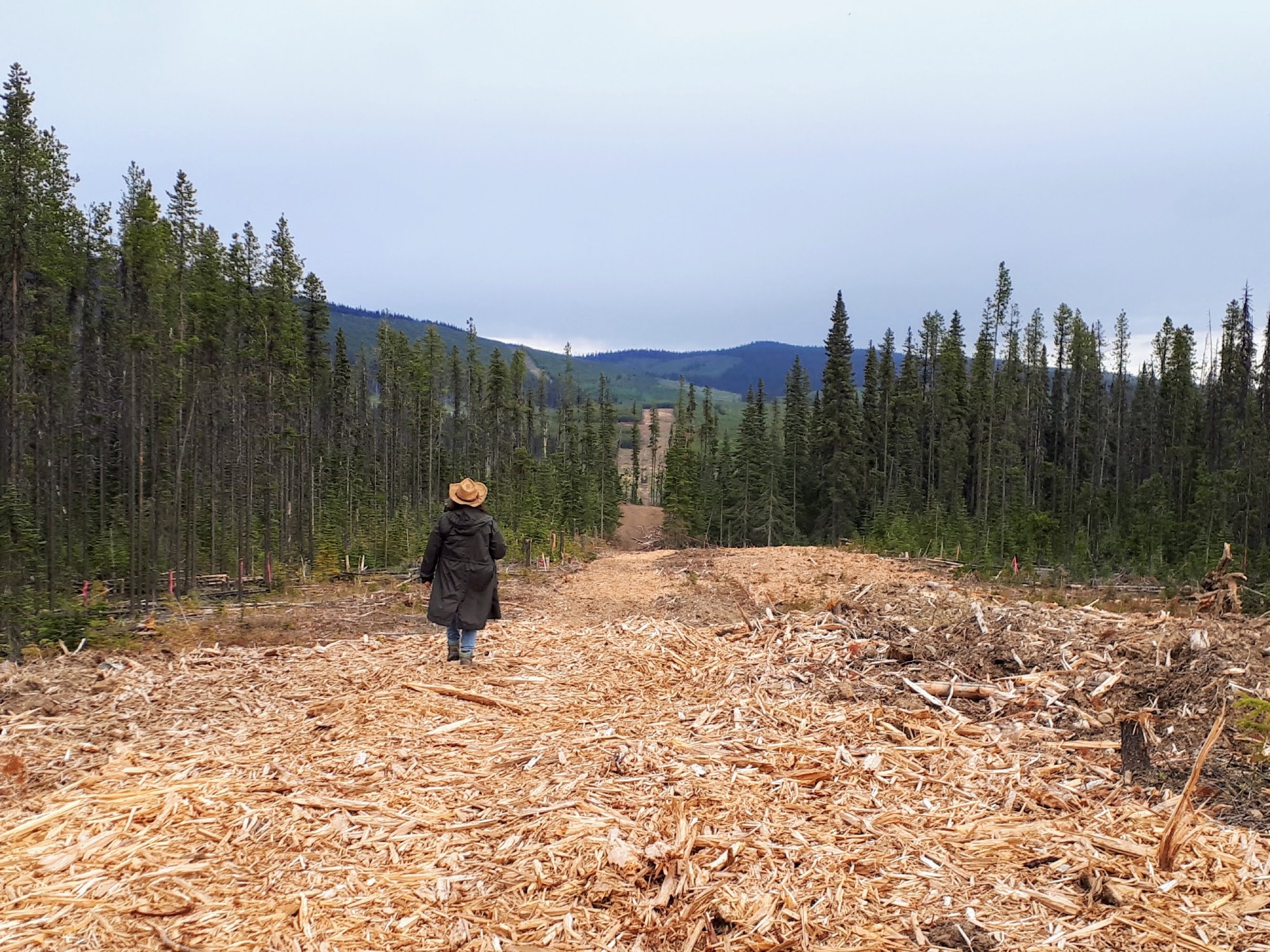
It has been a year since both the Canadian federal government and the province of Ontario pushed forward legislation – Bill C-5 and Bill 5 respectively – aimed at “protecting” Canada’s economy by expediting resource extraction projects. These laws allow the government to designate “special economic zones” in which the government can waive regulations such as labour standards, environmental assessments, and Indigenous consultation processes. This is a very serious threat to Indigenous sovereignty and treaty rights.
These bills exploit an economic crisis to erode hard-won environmental protections, Indigenous rights, and labour rights. They come at a time when people living in Canada are facing a rise in the cost of living. Disparity between rich and poor continues to grow and political polarization is fueling societal instability. Within this climate, various levels of government are spending public funds on propaganda ads that promise “protection”, “sustainability”, and “strength”. Political rhetoric of equality and progress has given way to messages about political dominance.
In this article I will analyze government advertisements: what they promise and what political agenda they serve. I will also look at the financial and social cost of these campaigns.
Strong. Sustainable. Saskatchewan.
Saskatchewan is beautiful. I grew up on the prairies. While there are plenty of jokes about Saskatchewan being flat and boring, I often question if the “comedians” have even been there. The homeland of the Blackfoot, Plains Cree, Assiniboine, Lakota, Cree, and Stoney Peoples is a place of rolling hills and a sky that comes alive with every sunset.
The government of Saskatchewan is running an ad campaign using the slogan, “Strong. Sustainable. Saskatchewan”. The slogan sounds idyllic while it plays over views of the rolling prairie hills. Yet this ad campaign isn’t about protecting the landscape. It doesn’t take long for the CEO of Foran Mining Corporation to make an appearance claiming that their projects are making Saskatchewan strong.
In 2023, 8 Indigenous grandmothers from Peter Ballantyne Cree Nation protested Foran Mining’s McIlvenna Bay Project, which aims to mine 1.5 million tons of ore annually. Elder Eileen Linklater, one of the grandmothers, told the CBC: “It concerns us. The water, the land, the medicine on it will be destroyed. The caribou that are roaming in that area and all the mushrooms and wild rice there. All of it would be contaminated.” She criticized Foran for failing to meet with members of the First Nation.
In the Saskatchewan government commercial, the CEO of Foran, Dan Myerson, claims that “mining is going to play a critical role in fighting climate change.” This is a frequent argument by mining companies advocating for the expansion of mining for “critical minerals” used in electric vehicles and other digital technologies. They rarely mention that these minerals are also in demand for military technologies, nor do they willingly discuss the fossil fuel emissions of mining projects. Resource extraction does not save us from climate change, it fuels it. In line with the federal priority of accelerating resource extraction, Prime Minister Mark Carney designated the McIlevenna mine as one of the first “nation building” projects to be fast-tracked for approval.
The government of Saskatchewan has come under fire for the cost of this advertising campaign. In 2023, when Saskatchewan rolled out the nationwide campaign, it was said to have cost over a million dollars. In speaking to the CBC, Scott Moe, the premier of Saskatchewan, defended it as an outreach initiative to other Canadians: “I would say this is more of an investment in awareness to our fellow Canadians of what we’re doing here and how we’re doing it.” Meanwhile, Saskatchewan’s tired and rundown healthcare system struggles to care for the population. Nothing about these priorities is sustainable.
Protect Ontario
In the last year, the Ontario Government has rolled out two publicly funded ads using the slogan “Protect Ontario.” The government spent over $7.5 million to promote the first ad, aired during the Major League Baseball playoffs. The ad promotes mining in the “Ring of Fire” region as the means to create economic stability for Ontario during challenging times. In line with the usual industry rhetoric, it boasts that Ontario is “unlocking critical minerals the world needs.”
The Ring of Fire is a region of northern Ontario that is home to several underserved Indigenous communities. Chronic underfunding of social infrastructure and services – a result of colonial policies – has produced decades of by-design repeated crises for these communities. Yet the Ring of Fire is also an area rich in minerals which the Ontario government has been interested in exploiting for years. According to treaties and the UN Declaration on the Rights of Indigenous Peoples, development on Indigenous lands requires the free, prior, and informed consent of Indigenous peoples. While two First Nations have agreed to industry accessing the Ring of Fire, Neskantanga First Nation has said “NO”. In fact, thirteen First Nations have raised concerns over mining in the Ring Fire.
Despite their concerns, Doug Ford’s Conservative government has ploughed forward. When Ontario passed Bill 5, the Ring of Fire was the first example Ford named as a potential “special economic zone” for fast-tracked development. Indigenous communities and their supporters have vowed resistance if the Ford government goes forward with this plan, suggesting disruption on par with the 2020 “Shut Down Canada” protests in support of Wet’suwe’ten pipeline blockades.
I initially thought the second “Protect Ontario” ad was a spoof of conservative politics. It begins with a view of kids playing on a playground and a voiceover saying,
“A safer Ontario means playgrounds with no drug injection sites close by. It means fewer cars being stolen thanks to more police officers and prosecutors. New jails so criminals stay behind bars. Public spaces without encampments. And bail reform that protects our neighbourhoods…”
Given this ad’s prominence during the FIFA World Cup broadcasts, I have watched it countless times. Upon every view, I have an urge to scream into the abyss. Analyzing each of its statements could be an article unto itself. But the reality is, these “public safety” policies are already making Ontarians less safe.
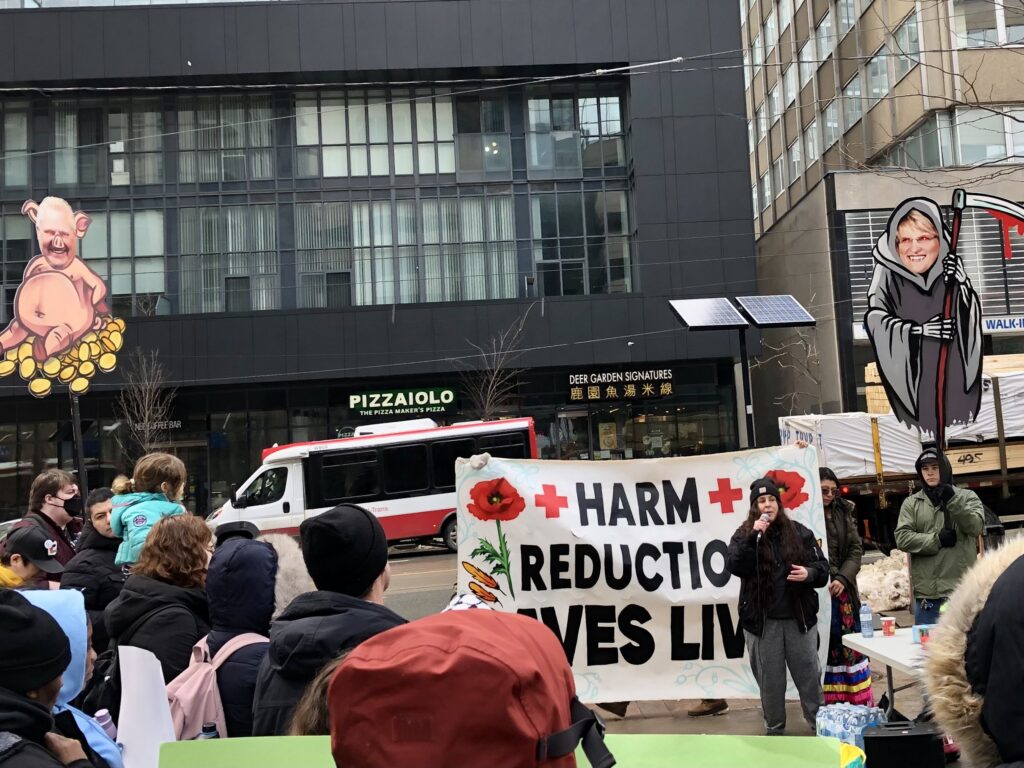
In March 2025, the province closed nine safe consumption sites; it closed the remaining eight in June of this year. Safe consumption sites were proven to save lives, yet now residents of Ontario who use drugs (excluding those that use alcohol) will be forced to use them in more isolated and unsafe places, leading to an increase in overdoses and death. This approach does not protect the people living in Ontario. It does the opposite – it will kill residents of Ontario.
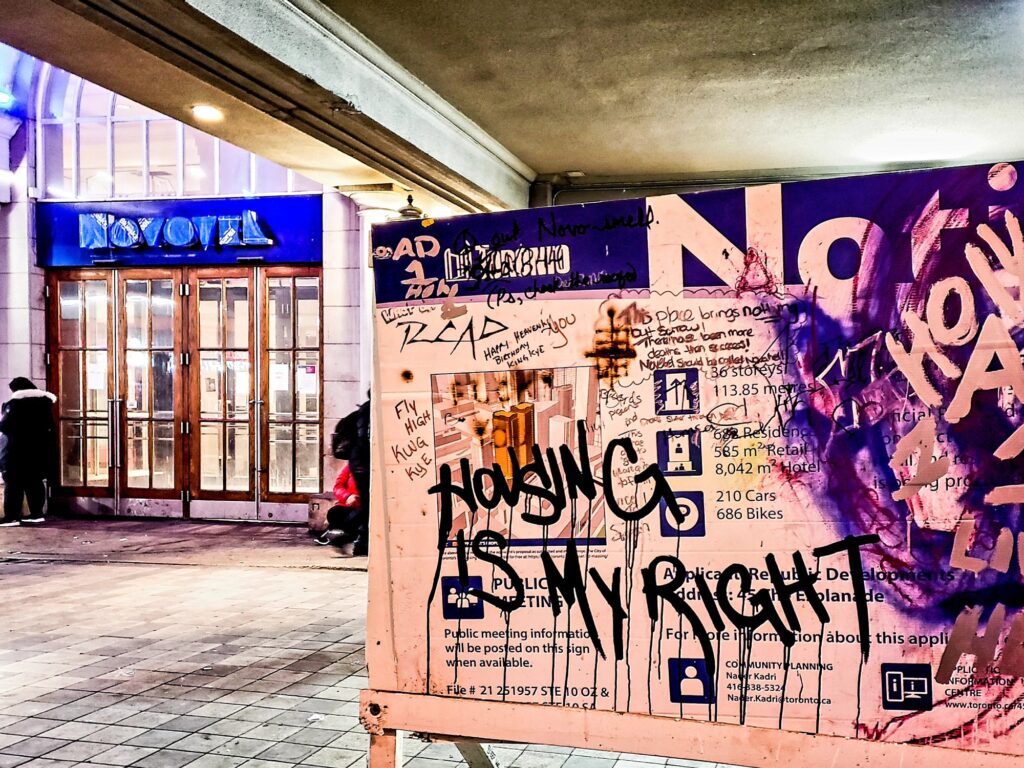
Ontario’s Ford government is pursuing the goal of “public spaces without encampments,” not by funding social housing for unhoused people, but through policing. Close to 200,000 individuals and families in Ontario are on waiting lists for social housing, and unhoused people are routinely turned away from shelters that are full. Those who are able to access shelters often find them oppressive and unsafe; CPT has documented rights violations. Yet Ford does not identify the housing crisis as the problem; rather he identifies encampments as the problem. In recent years, several Ontario cities have used police to remove encampments in public parks. These removals have not only displaced communities, they have at times been incredibly violent, including in 2021 when the Toronto Police cleared the encampment at Lamport Stadium. Toronto Police attacked the encampment and their supporters, breaking bones and doling out concussions. The encampments have returned because the people living there have nowhere safer to go. His call for “public spaces without encampments” will result in more state violence against people in Ontario who are unhoused.
The Ford government’s promises of more police, more jails, and more prosecutions follow the same pattern: public order through punishment rather than social care. Decades of policy research have shown that the most effective solution to homelessness is affordable housing with support services; that the most effective responses to addiction are harm reduction and consent-driven treatment programs. Housing, health and social programs are also more economical than emergency services, policing, and incarceration. The Ontario Conservatives have still chosen to campaign on policies that violently remove people in distress from public view instead of providing for their needs.
By March 2026, the provincial government had spent over $12 million dollars on this campaign. Ontario’s health care and education systems continue to crumble due to funding cuts, including dramatic cuts to university and college tuition grants. Since 2018, the Ford government has spent $452 million on publicly funded ads, including a record $112 million in 2024-2025. Under the slogan “Protect Ontario,” they are promoting policies that actually make life more violent, precarious, and uncertain.
Canada Strong
The federal ad campaign “Canada Strong” also promotes a positive view of resource extraction. Its messaging is less direct than Saskatchewan’s and Ontario’s blatant promotion of the mining industry. Instead, the ad begins by celebrating workers who “built” Canada. It then talks about the need to “build again” using lumber, steel, and technology. While more subtle, it instills a sense of national identity based on industrial development and resource extraction, glossing over the impacts of this kind of development on the environment and Indigenous peoples. This is precisely the narrative of “progress” that has driven centuries of colonization and environmental destruction, and that threatens to drive the world into climate chaos.
The Carney government’s Bill C-5 – the so-called One Canadian Economy Act – is very similar to Ontario’s Bill 5. This legislation allows the federal government to create economic priority zones in which it can waive environmental restrictions and curtail Indigenous rights. Prime Minister Carney has begun designating various energy and mining projects as “nation-building projects” for expedited approval. Among the first five are the Foran Copper mine mentioned earlier in this article and LNG Canada Phase 2 – the expansion of Canada’s first liquefied natural gas (LNG) export terminal.
Carney has endorsed LNG Canada Phase 2 even as the existing LNG facility continues to face scrutiny over a toxic smoke stack. The smoke stack in Kitimat frequently releases toxic black smoke, in violation of their rules of operation. Tracey Saxby, executive director of the environmental organization “My Sea To Sky,” believes that the LNG facility is operating unsafely. In an interview with energeticcity.ca she said, “[The federal government] needs to step in and issue a stop‑work order to LNG Canada, which has been spewing unregulated toxic chemicals into residential areas and exceeding its flaring permits by up to 40 times.” Instead, Carney’s government is fast-tracking Phase 2, which includes a new pipeline that will go through Gitxsan territory. Gitxsan Hereditary Chief Charlie Wright has already taken the British Columbia provincial government to court over the planned pipeline route. Not only does the LNG Canada expansion threaten Indigenous rights and the health of local residents; it makes no economic or environmental sense at a time when demand for LNG is falling as many countries are transitioning toward cleaner energy sources. Carney’s plan to build “Canada Strong” by fast-tracking fossil fuel projects only sabotages our future.
Conclusion
“Strong. Sustainable Saskatchewan.” “Project Ontario”. “Canada Strong.” These slogans and ads have been paid for by the public. While our healthcare tumbles, roadways crumble, and education backslides, our governments are using our taxes to fund projects that will lead to environmental destruction and instability. To make it worse, they are also using our money to try to sell this destruction to us.
These ad campaigns tell one truth: the projects will create jobs. Mining and fossil fuel companies will employ workers until their bodies break from the strain of long hours operating machinery. Doctors and nurses will be in high demand to treat illnesses caused by pollution. Environmental remediation is a growth industry. Financial stress, climate anxiety, and social conflict will benefit the wellness industry and divorce lawyers. Police recruitment will expand as the state cracks down on Indigenous Land Defenders. Militaries will scale up as climate change creates resource shortages and political instability; and military expansion will drive more climate change. As environmental destruction decimates life on earth, there will be jobs created through the decimation.
But there are alternatives to the propaganda these governments are selling that actually breathe life into our world. Dismantling the war machine is a life saving measure not just for victims of modern warfare, it is a life saving measure for our planet. An anti-war strategy is also an anti-mining strategy. Eliminating the massive environmental footprint of global militaries would be a major step toward climate goals.
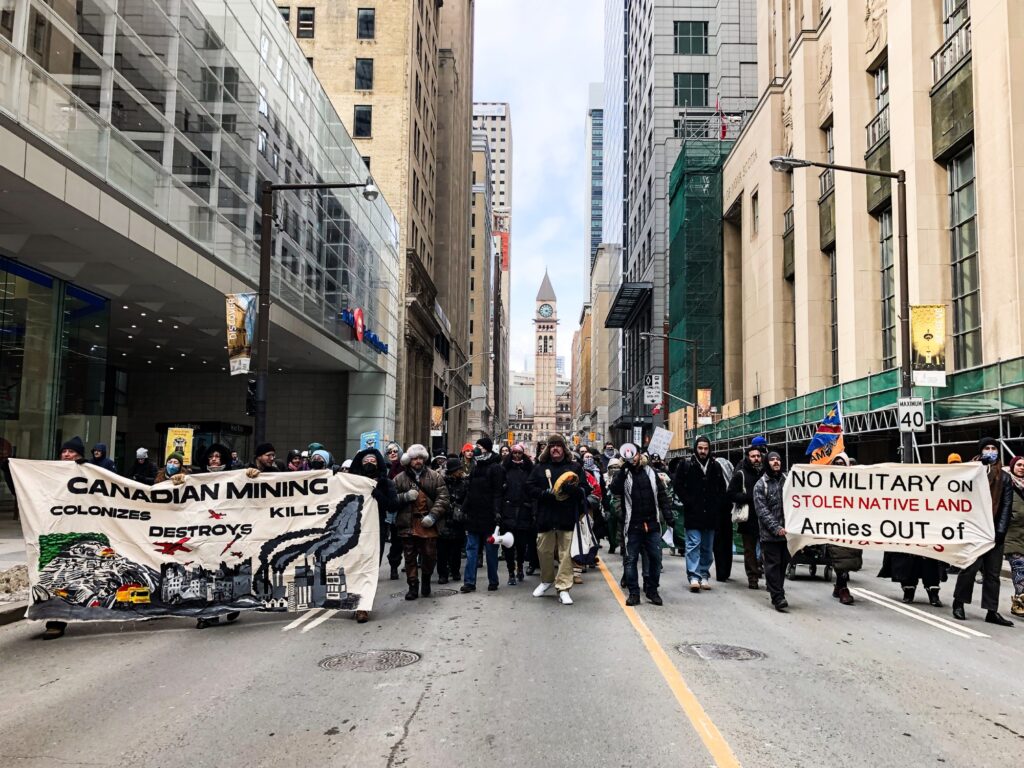
A critical alternative is supporting Indigenous Land Defenders – such as Gitxsan people resisting Canada LNG Phase 2 and the people of Neskantaga resisting exploitation of the “Ring of Fire”. We need to pour our resources into Land Defenders to protect the ecosystems that sustain us and demand us to take care of each other and our communities. By building up our communities and networks of resistance we can set an agenda that does not lead to scarcity, death, and destruction but to a life of abundance, sharing, and security.