During the spring season, shepherds traditionally release their sheep into the green mountains. This is when Palestinians start producing local Palestinian foods like zibdeh (butter) and labn (yogurt). For the villagers of Masafer Yatta, this period is essential. This production is their main source of income and deeply connected to their way of life.
These days, however, many villagers are unable to send their sheep to graze due to ongoing attacks. Without access to the land, they’re also struggling to afford feed for their animals. This situation is putting increasing pressure on the community, threatening both their livelihoods and their ability to remain in the South Hebron Hills. This is another violation and deprivation of rights – another aspect of the systematic displacement of Palestinians by Zionist settlers in Masafer Yatta.
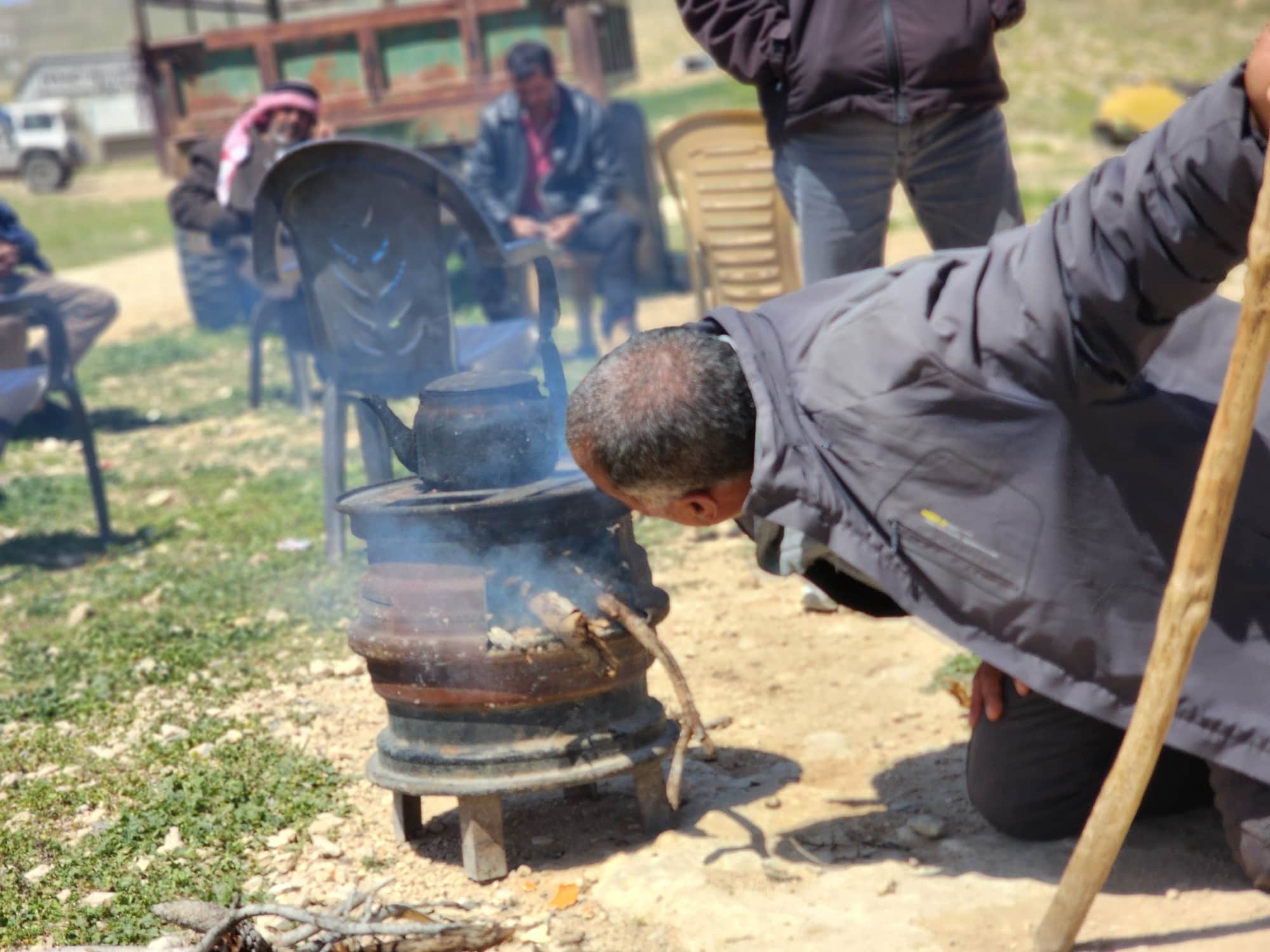
I’m from an urban area. When we visited Masafer Yatta (the South Hebron Hills) as a team for the first time, I saw a group of men sitting at the side of a bumpy road, overlooking another hill. We stopped and how they were doing.
“They took the rest of my land,” Mr R.A. told us. “Look, there they have demolished the main house, and they took the place I used to live. Look how they have brought their sheep and their camel.” I was shocked.
At that moment I became depressed. His house had been forcibly taken from him. He said he tried to call the Israeli police, but the station told him that they can’t do anything since these settlers were underage. “I was afraid for my daughters,” said Mr. R.A., “so I moved to a tent next to the Bedouin community.” While he was not at home, the settlers took his house.
We continued on the bumpy road between the mountains. This is the daily struggle faced by Palestinians: no asphalt, just a rocky road that they must traverse for hours and hours. We visited Al-Fakheet school. The principal told us of their daily preparations, coordinating cars to bring Palestinian students to and from school, under settler threat.
“We don’t have enough cars to carry them”, the principal told us. “We collect 90 students from more than ten tribal Bedouin communities. We need more funding to refurbish the school. We need more people to be with us to support and protect the students. We witness settlers with their sheep around the school, and they interrupt the lessons, making a lot of noise which negatively affects students’ ability to study.” The principal said that, many times, students cannot attend, and they don’t have tablets or mobile phones to continue studying remotely. During the US-Israel war on Iran, Palestinian students have shifted to online study sessions, but 70% of students had no tablets with which to attend.
We continued to Tuba, another Palestinian Bedouin community. They were under attack last week, and had been living in a cave. “The settlers started attacking from the top of the mountain”, Omar Jundiah told us. “They covered their faces and began hitting and destroying everything in their way. We put our sheep away and covered them, because we knew they would try to steal them. But we forgot one pen – we didn’t close it properly – and they stole five sheep from us. Then they left. We called the Israeli police, but they came after the settlers had left. They didn’t help us.”
“As you know,” he continued, “we Bedouin live our lives from the products we make from our sheep. The settlers are attacking the source of our livelihood.”
I met an international volunteer who was here for his sixth round providing a protective presence in Masafer Yatta. I asked him why he would leave everything behind to be here. “I believe in justice,” he replied, “and the Palestinians must be supported. I call for international activists to be here, in Masafer Yatta, to bring a protective presence and to help Palestinians to stand with justice.”
Finally, we visited Um al-Khair. A day earlier, Israel had fenced off the mountain path which students took to reach their schools. Mr Khalil told us that they had stormed the students with smoke grenades without warning. “They are children going to schools… They did nothing”, he said. “With no humanity, with no dignity, they are attacking our children.”
Working side by side, we call all those fighting for freedom and justice to stand with Masafer Yatta. Provide a protective presence. Stand with the Palestinians, live with them, and make a change for global justice. Be with us, and be with the right side.